The use of German and Austrian instruments from around 1900 is meant to bring us closer to the orchestral sound Mahler knew. The instruments produce a more heterogenous color palette in which the strings, lacking the tonal weight of their modern counterparts, allow more pungent winds and percussion to cut through orchestral texture.
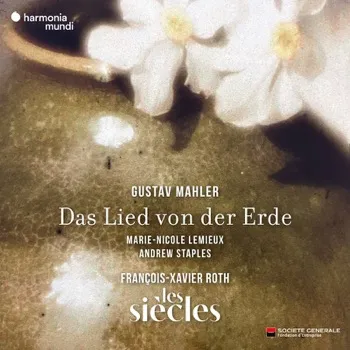
This is the third album of Mahler by Les Siècles and Roth. While their 2019 recording of Hamburg/Weimar 1894-94 version of the first symphony is excellent, I found their 2022 performance of Symphony No.4 lightweight and emotionally reticent.
Occasionally, one hears surprising new colors and balances, though this may have just as much to do with Harmonia Mundi’s engineering, which places the listener on the conductor’s podium instead of in the hall. It is as if we are standing right in front of Georges Seurat’s “A Sunday on La Grande Jatte—1884,” close enough to see every point of color. It certainly provides us with a clinical view into the originality of Mahler’s orchestration. But looking at the painting so closely robs the viewer of the ‘impression’ Seurat intends, just as the closeness of the engineering suggests an objective approach to the music making.
This is, of course, a subjective reaction, and others may revel in the opportunity to hear the orchestral accompaniment with such clarity. Yet I would argue that Boulez’s Vienna recording (DG), as well as Jurowski’s more recent album with the Berlin RSO (Pentatone, reviewed here) offer a similar clarity without sacrificing a touching emotional connection. Still, the playing of Les Siècles is beautiful and refined, with far more character than is heard on another recent “period” album by the Mahler Academy Orchestra under Philipp von Steinaecker, performing Symphony No. 9 (Alpha, reviewed here).
Roth’s recordings of Romantic music reveal consistent interpretive priorities: technical precision, transparent orchestral textures, and a less overtly emotional approach. Tempos tend to be quick: this “Das Lied” takes 57 minutes, substantially faster than classic recordings by Albrecht (Pentatone/62 minutes), Klemperer (Warner Classics/64 minutes), and Haitink (Philips-Universal/65 minutes).
I suspect the speedier tempo for “Das Trinklied” makes singing it slightly easier for Andrew Staples, whose performance is consistently fine. While he does allow strain and effort to occasionally show (the part has a notoriously high tessitura), it is surely intended to capture the meaning and mood of the text. And he finds a special color and quality to catch the dreamy haze of “Der Trunkene im Frühling,” though Roth’s tempo never finds the buoyancy it needs.
The final movement, “Der Abschied” is also rather quick (26’27” versus Klemperer/Warner Classics 29’32” or Giulini/DG 30’23”) but it never feels rushed, nor does the energy sag as it does in Rattle’s Bavarian RSO recording (31’28”).
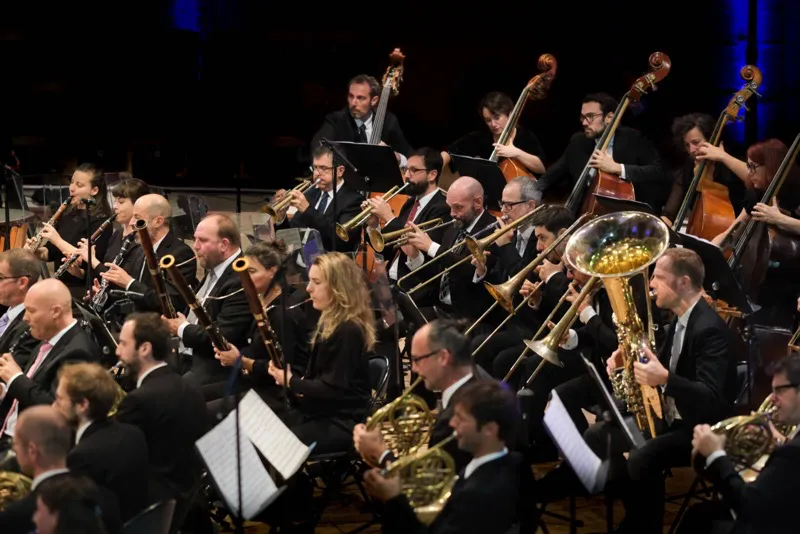
Les Siècles (image: ©️ Pauline Cluzeau)
Of course, the final movement draws attention to the contralto, sung here by Marie-Nicole Lemieux. Harmonia Mundi uses ‘contralto’ instead of ‘mezzo-soprano,’ and that suggests we will hear an exceptionally rich and darker vocal color. While this may be true of Lemieux’s lower range, her higher register brings a noticeable change in color, as well as a at times distracting tremolo.
While Sarah Connolly has similar issues in her recording with Jurowski (Pentatone – she is in fresher voice with Nézet-Séguin/LPO), her complete identification with text and mood makes one forget any vocal imperfections. Lemieux’s expression feels generalized in comparison to that performance, or indeed the wonderful readings by Christa Ludwig, Alice Coote and Janet Baker. Those performances leave me emotionally spent – this new reading does not.
Harmonia Mundi’s booklet is typically first-rate, including a full orchestral roster and detailed information about the instruments, as well as full texts and translations. I like many things about this recording, and am sure those studying orchestration and historically informed performance practice will find much to admire. But the other performances listed above are more successful in communicating the feelings and ideas that make Das Lied such a profoundly moving listening experience.
Recommended Comparisons
Klemperer | Karajan | Bernstein | Walter | Jurowski | Haitink

The Classic Review Newsletter
Get weekly updates about new classical music content.
By signing up, you acknowledge and agree to our Privacy Policy & Terms of Service .
Album Details |
|
|---|---|
| Album name | Das Lied von der Erde |
| Label | Harmonia Mundi |
| Catalogue No. | HMM902740 |
| Artists | Marie-Nicole Lemieux, contralto Andrew Staples, tenor Les Siècles François-Xavier Roth, conductor |