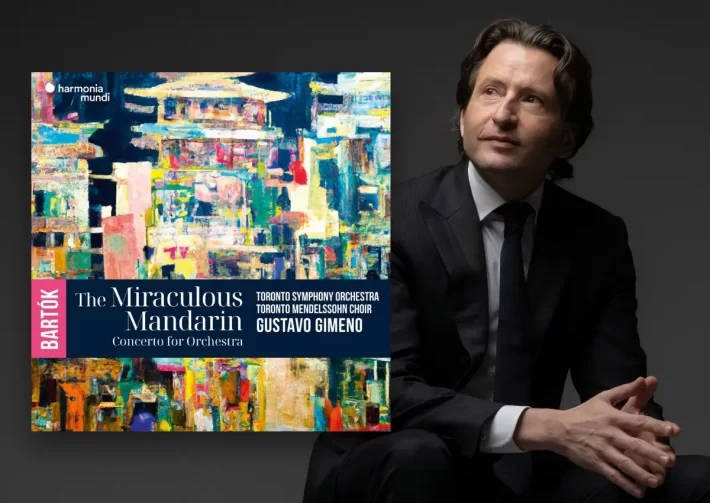
Harmonia Mundi’s first album with these artists was an exhilarating account of Messiaen’s Turangalîla-Symphonie (review). This was followed a year later by a recording of Stravinsky’s Pulcinella and The Fairy’s Kiss. This latest release pairs two Bartók masterpieces with a new work (2022) by Canadian composer Emilie Cecilia LeBel.
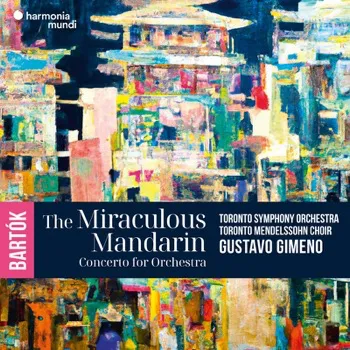
The opening of The Miraculous Mandarin is fabulous, the rushing strings and layered wind ostinatos, driven by maniacal percussion, painting a hectic, ominous cityscape. I wanted more snarl from the trombones, and the organ’s entrance at 0’52” is underwhelming (I suspect the part is played on a manual rather than the pedal, where 32-foot stops would provide the tummy-rumbling bass heard on the Rattle (CBSO/Warner Classics) and Neeme Järvi (Philharmonia/Chandos) recordings). Nevertheless, the orchestra’s energy and precision are gripping.
The young girl, forced by thugs to lure men off the street into a room to be robbed, is represented by the clarinet, and principal Eric Abramovitz makes each entrapment more sensual and lurid than the last. The Mandarin’s music is carefully shaped, building to a climax that captures his strange, otherworldly nature (track 4, from 1’40”). At the end of this passage (and throughout the album), note how every subtle change of color, articulation, and rhythm in the percussion is captured with astonishing clarity by Harmonia Mundi’s engineers. The bass drum is both heard and felt, like Telarc’s “extended bass” recordings from the 1980s–90s.
Bartók balances the girl’s three seduction games with the thugs’ three attempts to murder the Mandarin. Much of this music was cut from the suite prepared by the composer (the full ballet was banned several times), which is unfortunate because this section of the work features some of the most original and unsettling writing (such as the use of a wordless chorus as the strung-up Mandarin’s stab wounds begin to glow with a greenish-blue light). The ending is appropriately ambiguous (does the girl finally hold the Mandarin out of pity or love? Was the Mandarin pursuing her out of lust, love, or both?). If this reading lacks the last ounce of authentic Hungarian flavor found in Solti’s recording of the suite (Chicago SO/Decca) or Iván Fischer’s performance of the full ballet (Budapest FO/Philips), it is certainly in the same league, and its engineering is more impressive.
Emilie Cecilia Lebel describes the sediments (track 9) as an exploration of “…the interconnectedness of natural elements and their lasting presence throughout history.” The work is masterfully orchestrated, operating mostly within a soft dynamic range. Its exploration of color is reminiscent of Grażyna Bacewicz’s sonorist writing—atmospheric, though rather static. Here it seems to serve as a palate cleanser between the two Bartók works (one doubts that was the reason for its composition).
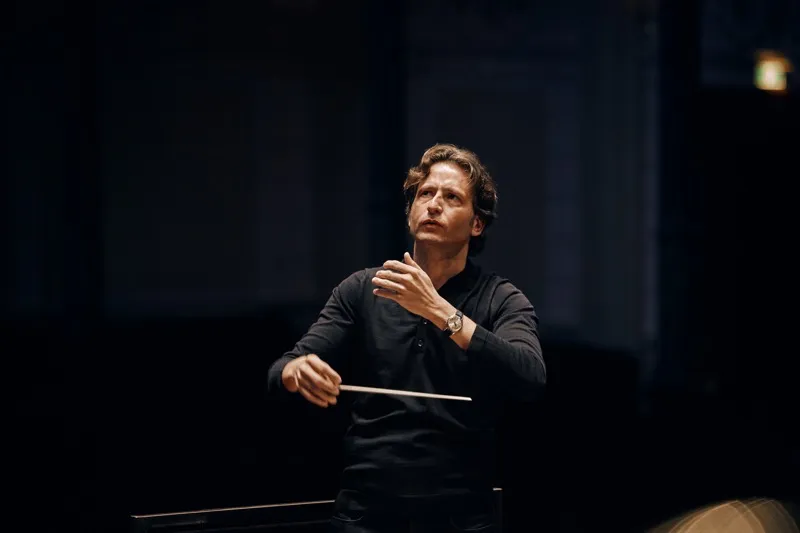
Gustavo Gimeno (image: © Anne Dokter)
Presto Music lists 170 available recordings of the Concerto for Orchestra, and performances by Hungarian conductors (Doráti, Fischer, Fricsay, Reiner, Solti) tend to dominate recommendation lists. This new reading is altogether more impressive than two recent performances I have reviewed (Mälkki/Helsinki SO/BIS and Canellakis/NRSO/Pentatone), without ever matching the brilliance of those five recommendations.
Gimeno’s first movement, Introduzione, begins promisingly, but the Allegro vivace feels a bit slow (10’18” versus Fischer’s 9’44” and Solti’s 9’06”), lacking forward momentum. Moreover, the razor-sharp articulation of Fischer and Solti is replaced by a more rounded attack, softening the music’s more angular contours. Thanks to characterful orchestral playing (those fabulous chortling bassoons in Giuoco delle coppie) and Gimeno’s attention to detail, the inner movements are more successful. But the urgent string utterances during Elegia, or those that open Intermezzo interrotto, do not lacerate as they do under Reiner, Solti, and Canellakis. Yet the “interrotto” section is certainly caustic, and the chamber music-like flexibility of the final minute is beguiling. The Finale is again a tad cautious, never matching the riotous joie de vivre that makes Reiner, Fischer, and Solti so thrilling.
The liner notes are interesting, and the booklet includes a full roster of the musicians involved in this live recording. While not as wholly successful as that first Messiaen release from a few years ago, this is still powerful and exciting music-making from an artistic partnership worthy of attention.
Top image: ©️ Marco Borggreve
Recommended Comparisons
Rattle | Järvi | Solti | Fischer | Reiner | Doráti | Fricsay
Album Details |
|
|---|---|
| Album name | Bartók – The Miraculous Mandarin, Concerto for Orchestra |
| Label | Harmonia Mundi |
| Catalogue No. | HMM905365 |
| Artists | Toronto Symphony Orchestra & Choir Gustavo Gimeno, conductor |