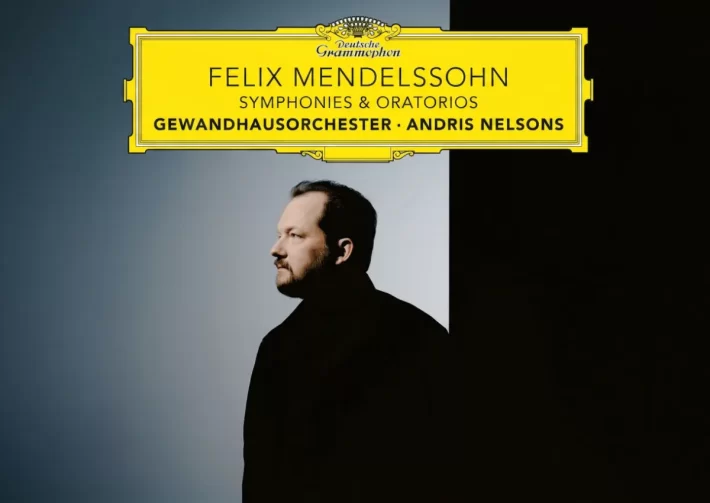
The last Gewandhausorchester/Mendelssohn symphony cycle was recorded by Teldec (now Warner Classics) in the 1990s, so it is good to have a new cycle featuring Mendelssohn’s ‘home’ orchestra, especially when it also includes two major choral works.
Indeed, this new Paulus jumps to the head of the pack. The MDR Radio Choir, soprano Julia Kleiter, and tenor Werner Güra offer singing that matches and often exceed the level heard on Herreweghe’s album (Harmonia Mundi), and Georg Zeppenfeld’s somewhat world-weary portrayal of Paul is a compelling portrayal. DG’s engineering is clear and transparent, the choir balanced well forward to ensure its integral part in the story telling. An impressively dramatic performance (and the first Paulus in DG’s catalogue) that warrants its own separate release.
Nelsons’s Elias is similarly impressive, even if it occasionally lacks the drive of more urgent readings by Pappano (LSO Live, sung in English – review) and Hengelbrock (Deutsche Harmonia Mundi, sung in German). The choral work (which includes several short solos and chamber groupings drawn from the larger choir) is a constant delight, as is the energetic and nuanced playing of the orchestra. The organ, beautifully integrated into the overall orchestral sound, delivers several moments of tummy-rumbling bass.
Andrè Schuen’s Elias is a fully fleshed out characterization, and Wiebke Lehmkuhl’s rendition of the beloved “Sei stille dem Herrn” (O rest in the Lord, Pt. 2, No. 31) is a gorgeous highlight. While the CD booklet does not include a choir roster, the rich weightiness of sound is comparable to Paul McCreesh’s 2012 album with the Gabrieli Consort and Players (Signum), a performance notable for involving over four hundred musicians, roughly the same number Mendelssohn used for the work’s 1846 premiere.
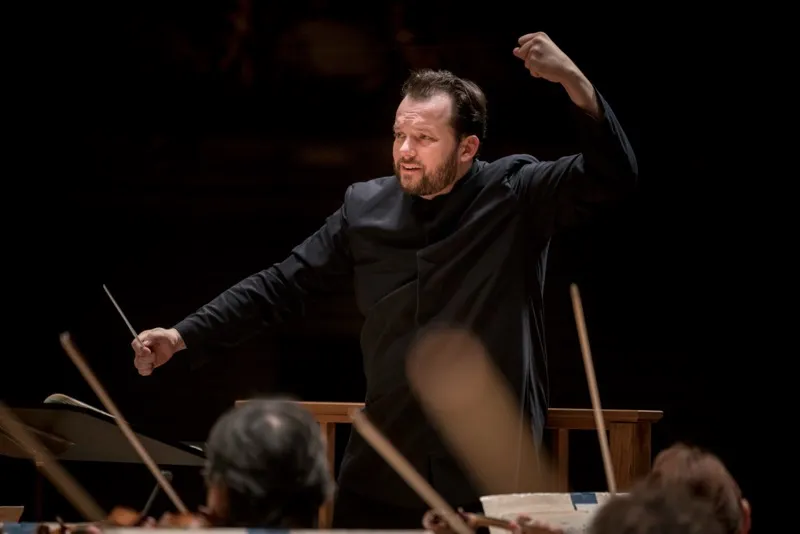
Andris Nelsons (image: Marco Borggreve)
Complete Symphonies
The symphony performances are not as successful. There is a nod to historically informed performance practice: timpani played with hard sticks, a more judicious use of vibrato, woodwinds balanced with greater prominence in the orchestral balance when compared to DG’s earlier Abbado and Karajan sets. But this is still ‘big-band’ Mendelssohn, with a weight and depth of sound eschewed by Paavo Järvi in his recent Zurich Tonhalle set (Alpha, reviewed here).
Symphony No. 1 has plenty of energy, but a seriousness of intent suggesting Nelsons wants us to see it as Mendelssohn’s first true symphonic statement (set apart from the thirteen string symphonies already composed). The slow movement is beautifully wrought, with gorgeous solos from first chair winds, but both Gardner (CBSO/Chandos) and Litton (Bergen PO/BIS) find more joie de vivre in the outer movements.
The Lobgesang Symphony No. 2 is a tougher nut to crack. Labeled Symphony-Cantata by the composer, some conductors lean towards cantata, others towards symphony. Nelsons seems to fall into the latter camp, taking his time in the first three purely orchestral sections, summoning an intensity and beauty of playing that held my attention.
That does not hold for the choral movements: the initial “Alles, was Odem hat” (Mvt. 2a) is thrillingly resplendent, but as the movements progress Nelsons’s tempos (seeking a certain nobility or solemnity?) work against the text’s sense of joy and praise. “Die Nacht ist vergangen” (Mvt. 7) is roughly a minute longer than Järvi, Litton, and Manze (NDR Radiophilharmonie/Pentatone) readings, and the beginning of “Nun danket alle Gott” is simply too slow, overly reverential, and sentimental.
The soloists are excellent and I appreciated tenor Werner Güra’s textual expression, a quality readily apparent in his Evangelist in Bach’s Johannes Passion (René Jacobs/Harmonia Mundi). But the excellence of the performers cannot make up for Nelsons’ lack of dramatic flow.
Nelsons’s Scottish and Italian symphonies enter a far more crowded and competitive field. The Scottish‘s opening Andante con moto is beautifully voiced, but the following Allegro un poco agitato never finds the right buoyancy, in part because phrasing feels four-square compared to Gardner, Järvi, and the classic Maag/LSO/Decca album. After a playfully sprung second movement, the Adagio feels overly slow, Nelsons reveling in beauty of playing at the expense of forward momentum. The final movement is quite good, with thrilling playing from the orchestra, though the Coda does not bring the rush of excitement found in the performances by Maag or Munch (Boston SO/RCA).
The Italian strikes me as under characterized, as if Nelsons is stressing its symphonic nature by downplaying programmatic elements. The first movement is taken at quite a lick, but phrasing is sturdy rather than elegant – just compare Nelsons to the more historically informed interpretations of Manacorda and Gardner, or Blomstedt’s more genial San Francisco reading (Decca). Nelsons steady tempo for the Andante conjures the image of Christian pilgrims in procession, and the third movement has welcome elegance. The final movement is quick but needs more bite from the strings.
The fifth symphony is more successful. Nelsons’s tempos are convincing. The opening Andante has potent atmosphere, answered by an energetic, strongly articulated Allegro con fuoco. The inner movements are beautifully done – I like the extra time he takes with the brief Andante, bringing out particularly cantabile playing from the Gewandhaus players. The final movement, faster than readings by Gardiner (Vienna PO/DG) and Litton, builds to a splendid final statement of Luther’s Ein feste Burg.
Overall, this is an auspicious release. The middle symphonies may be less successful than the other recordings used for comparison, but I certainly find Nelsons’s readings more consistently persuasive than Masur’s earlier Teldec set, and there is a clear rapport between the Gewandhaus players and their conductor that adds to one’s listening enjoyment. I wish the overtures were included, but an excellent new Paulus is certainly an added incentive, as is the cost: seven CDs for the cost of three. This is a set lovers of Mendelssohn music will certainly want to hear.
Album Details |
|
|---|---|
| Album name | Mendelssohn: Symphonies & Oratorios |
| Label | Deutsche Grammophon |
| Catalogue No. | 4868178 |
| Artists | Gewandhausorchester Leipzig; MDR-Rundfunkchor; Andris Nelsons, conductor; Julia Kleiter, Golda Schultz, Christiane Karg, Elsa Benoit, sopranos; Wiebke Lehmkuhl, alto; Werner Güra, tenor; Andrè Schuen, baritone; Georg Zeppenfeld, bass |