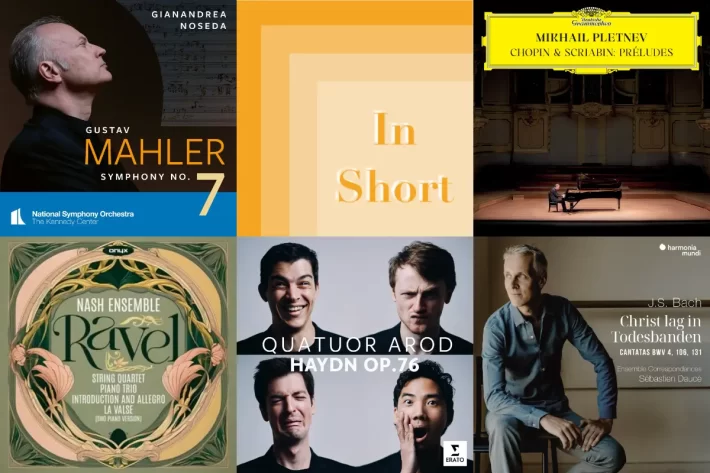
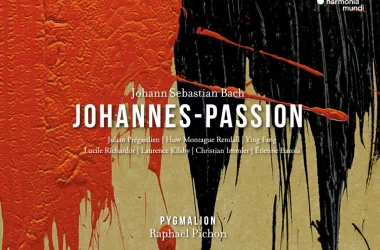
Bach: Cantatas BWV 4, 106, 131 – Ensemble Correspondances, Sébastien Daucé
Bach’s early cantatas, here BWV 4, 106, and 131, written well before Leipzig, often feel at their best with modest forces. The textures stay clear, the counterpoint speaks naturally, and the devotional tone doesn’t need added weight. You also hear just how fully formed Bach already is at this stage—still a little less expansive than the later Leipzig works, but hardly underdeveloped.
Sébastien Daucé leads Ensemble Correspondances with 14 singers, and the vocal sound is deliberately less blended than in ensembles such as Suzuki’s or Herreweghe’s, closer to a team of soloists singing as a group (an observation rather than a critique). The instrumental band, on the other hand, is where the intimacy really settles in, giving the music a chamber-like immediacy. Soloists drawn from the choir deliver their lines with poise, and the recording meets Harmonia Mundi’s usual high standard.
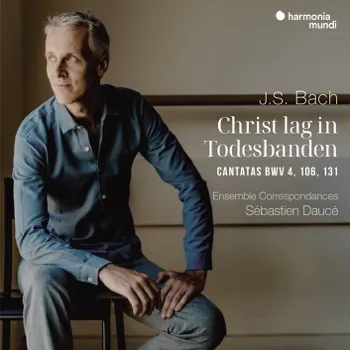
Ravel – Nash Ensemble
This Nash Ensemble Ravel disc finds a persuasive middle ground: the players sound fully committed, even passionate, yet the playing still preserves that hard-to-pin-down Ravel blend and precision. The introduction and Allegro comes off particularly well, helped along by a notably fine harp contribution from Lucy Wakeford; it’s the kind of performance where color and line feel carefully balanced rather than showy.
The Piano Trio goes in a more dramatic direction, with the players’ energy easy to register (the ensemble has recorded the work before, though with different personnel). By contrast, the String Quartet feels airier than some—less treated as post-Romantic lushness, more as four distinct voices, with the inner writing and counterpoint kept in clear view. The transparent, highly detailed recording reinforces that sense of separation and texture. Taken as a whole (including La Valse in the two-piano version), it’s a well-shaped 75-minute program that holds attention throughout.
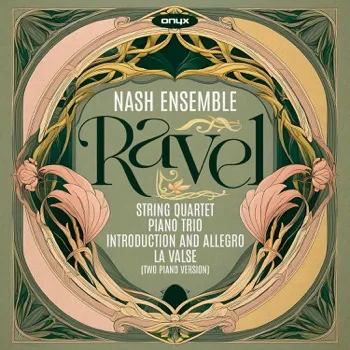
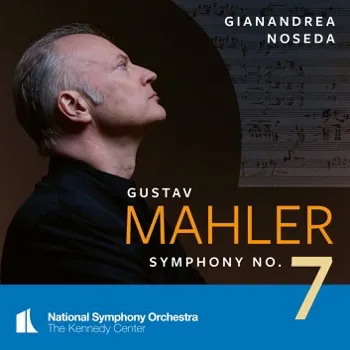
Mahler – Symphony No. 7 – National Symphony Orchestra – Gianandrea Noseda
Gianandrea Noseda’s Mahler Seventh with the National Symphony Orchestra has a particular orchestral character: the sound isn’t the polished, almost clinical finish you hear from some European orchestras, but it also avoids the New York Philharmonic’s sharper edge, or that high-wire volatility Bernstein can bring, where the music feels close to breaking point. The strings play with a beautifully tone, arguably a little too emphatic for a symphony that thrives on shadow and ambiguity. The brass and woodwinds deliver their lines solidly.
Sonically, there’s a slightly Hollywood sheen at moments (the first movement around 12’00” is a good example). The performance places Mahler, interpretively, closer to the 19th century than to the more unsettling, forward-looking side of the score. Some will appreciate this perspective; others may miss a deeper sense of strain (especially in the finale, where tension doesn’t fully accumulate) and may prefer more disquieting accounts from Bernstein, Gielen, or Rattle.
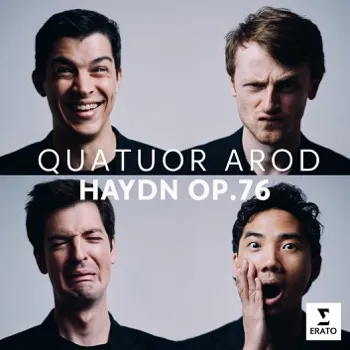
Haydn – String Quartets Op. 76 – Quatuor Arod
Quatuor Arod’s Haydn Op. 76 is played on modern instruments but with a firmly classical mindset: lighter bow work, judicious vibrato, and a generally rounded tone—less pronounced than the Doric Quartet’s more taut, high-contrast approach. Part of that profile comes from a technical choice noted in the booklet: the players use modern instruments, but they’ve adopted late-18th-century-style bows, modelled on a Tourte design from around the 1770s, aiming for greater flexibility, lightness, and clarity of attack.
The opening G-major quartet comes across as simply lovely, with a natural flow and a sense of ease that suits Haydn’s wit. Even within this relatively traditional frame, the group still makes room for playfulness; listen, for instance, to how first violinist Jordan Victoria decorates the line in the first movement of No. 1 (track 1, around 2′;’00”).
Not everything here is equally vivid: the “Fifths” Quartet feels more intimate than dramatic, and the dynamic contrasts could be pushed further. Still, the “Emperor” and the “Sunrise” quartets are handled with real care and stylistic understanding. Overall, it’s a very enjoyable traversal of works that rarely run out of fresh angles.
Chopin & Scriabin – Préludes – Mikhail Pletnev, Piano
According to Deutsche Grammophon, this is Pletnev’s first recording for the label in almost two decades, and it appears in two parallel editions: a standard digital release (CD/streaming) and a vinyl version described as a separately made, fully analog (AAA) recording—something DG hasn’t done in this form since the 1980s. Pletnev plays his trusted Shigeru Kawai grand.
As for the performances, this is Pletnev’s second time recording Scriabin’s 24 Préludes, while Chopin’s Op. 28 is new to his discography. Yet this also sounds like a later-period Pletnev. The playing is generally more mellow; when the music calls for force, the fortes can feel held back, and the articulation and finger clarity aren’t always as sharply defined (notably in Chopin Nos. 12 and 16). Still, there’s a natural ease and a slightly old-world spirit to his phrasing, something that can recall pianists from an earlier era. Even when he frustrates, Pletnev’s playing remains a fascinating listen.


The Classic Review Newsletter
Get weekly updates about new classical music content.
By signing up, you acknowledge and agree to our Privacy Policy & Terms of Service .
Albums Included with an Apple Music subscription:
Albums Available on Presto Music

Latest Classical Music Posts

Review: Bach: Cantatas BWV 4, 106, 131 – Ensemble Correspondances, Sébastien Daucé
Review: Mahler – Symphony No. 7 – National Symphony Orchestra – Gianandrea Noseda
Review: Haydn – String Quartets Op. 76 – Quatuor Arod
Review: Chopin & Scriabin – Préludes – Mikhail Pletnev, Piano