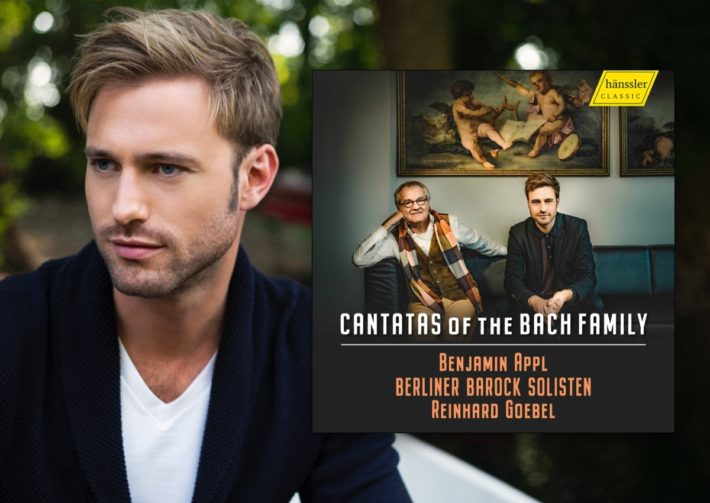
Benjamin Appl is without doubt one of today’s foremost baritones, with a diverse discography stretching from Bach and Telemann to Berio and beyond. This latest release from Hänssler, entitled “Cantatas of the Bach family”, builds on his previously acclaimed album, “Bach” (Sony). Working with Concerto Köln, the previous album successfully curated a diverse musical tour from a selection of Johann Sebastian’s cantatas and passions. In this new release, Appl is joined by the Berliner Barock Solisten and Reinhard Goebel, who’s orchestral sound is more vividly colored than Concerto Köln, though not as varied in their approach.
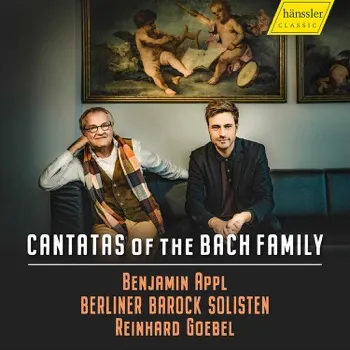
The album boasts three world premiere recordings. The first, “Ich bin vergnügt mit meinem Stande” by C.P.E Bach, is a short cantata cast in three movements, two arias bookend a central recitative. It could easily be mistaken to have come from his father’s pen. Appl is commanding, communicative and convincing, bringing an appropriate level of restrained drama throughout. The recitative’s accompaniment is brimming with flourishes from the harpsichord, which intensifies the mood, whilst the final aria has an added urgency.
The first of two ‘sinfonie’ follows. Both of these are three movement pieces following the Italian concerto model of quick-slow-quick, and provide pleasing listening. The first of these is credited to ‘Mons. Bach de Berlin’, assumed to be C.P.E Bach. Akin to early Mozart, this short piece is gently articulated, with a prevailing early classical style, incorporating gently contrasting details in the musical repeats; the final movement is especially spirited. Wilhelm Friedemann Bach’s “sinfonie in B-flat” is the second of these premieres. The continuo playing is less intrusive here than in the vocal pieces, allowing the music to flow more naturally, making the most of the conversation-like phrases between the violins and lower strings.
The central work, “Pygmalion” by Johann Christoph Friedrich Bach, is a hybrid between Handelian and Mozartian musical theatrics, and it is fully realized by Appl and Goebel. The arias brim with characterization from Appl, while the recitatives display appropriate continuo flourishes. Appl’s precision, however, is sadly uneven in this otherwise lively recording.
Closing the album is one of the most recorded of all Bach cantatas, “Ich habe genug” BWV 82, which originally exists for Bass or soprano (marked as BWV 82a), but performed by singers on all registers. Appl’s interpretation stands apart from the likes of Ian Bostridge, Andreas Scholl, or the less period approach of Dietrich Fischer-Dieskau. The quicker tempos of the arias lessen the emotional intensity, detracting from the sentiment of the text. In the opening movement, the tempo choice favors Appl’s vocal line, but makes the solo oboe seem rushed. Throughout, there are expressive changes of tempo, similar to how Masaaki Suzuki shapes his Bach Collegium Japan performances with Peter Kooij, but without the same degree of thoughtfulness or conviction. Whilst the ensemble is highly sensitive to the music, stepping back for Appl’s vocal line, he occasionally becomes disappointingly lost in the textures.
Overall, Appl’s tone is typically warm with a carefully measured and gentle vibrato. But his overall projection is inconsistent; low notes are lacking support on occasions, while notes in the tenor range sometimes sound slightly strained. His syllabic singing has a security, aided by his natural diction, but his melismatic phrases lack the same security of intonation and rhythmic clarity.
The recording has been made at a sufficient distance from the musicians, but the mixing brings the harpsichord and bass rather too close, which occasionally overpower the string timbres. What is disappointing is the lack of English translations to the Cantatas. Whilst for the well-recorded material this is easily sourced, for the works receiving their premiere, a translation would have enhanced this otherwise highly mixed release.
Image: ©️ Lars Borges / Sony Classical

The Classic Review Newsletter
Get weekly updates about new classical music content.
By signing up, you acknowledge and agree to our Privacy Policy & Terms of Service .
“Cantatas of the Bach Family“
Carl Philipp Emanuel Bach – “Ich bin vergnügt mit meinem Stande”.
(CPhE ?) Bach – Sinfonie in F-Dur für Streicher & Basso continuo Wq/HWV deest
Johann Christoph Friedrich Bach – “Pygmalion”
Wilhelm Friedemann Bach – Sinfonie B-Dur
Johann Sebastian Bach – “Ich habe genug”, BWV 82
Benjamin Appl – Baritone
Berliner Barock Solisten
Reinhard Goebel – Conductor
Hänsslerm, CD HC19081