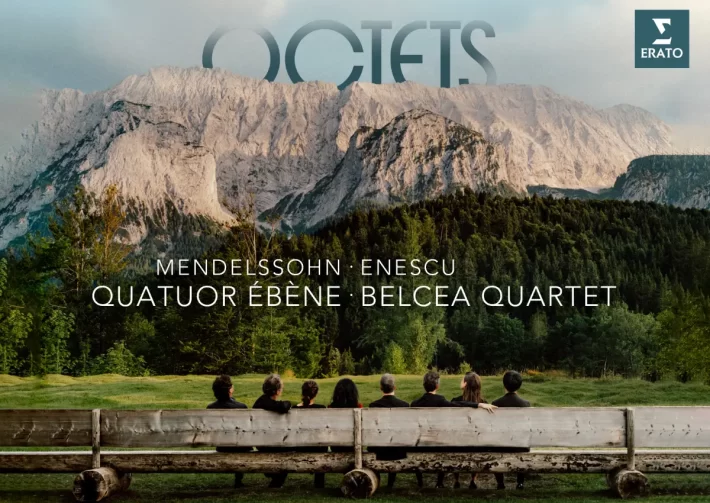
This coupling of two celebrated Octets by Mendelssohn and Enescu has appeared before, but the interest here lies in the collaboration between two established ensembles: the Belcea Quartet and the Quatuor Ébène. The division of roles is neatly conceived: the Belcea players take the role of “Quartet 1” in Mendelssohn’s Octet, while Quatuor Ébène lead in Enescu’s. The result is not a blending of identities but a dialogue between two clearly defined quartet personalities.
From the opening bars of Mendelssohn’s Octet in E-flat major, it is evident that this is a performance built on energy and forward momentum, with a strong sense of Romantic sweep. It is hard not to be reminded of the composer’s precocity—this is, after all, a work written at the age of sixteen.
Corina Belcea’s leadership gives the music a concerto-like brilliance, yet the supporting voices are never reduced to mere accompaniment. The lower strings frequently shape and pass on musical ideas with real intent. Notice, for example, the handover of material around 3’52” in the first movement, or the tightly coordinated exchanges in the Scherzo (track 3).
The performers place particular emphasis on the outer movements, which helps unify the work on a large scale. The finale, taken at a daringly fast tempo, highlights the virtuosity of all eight players. Other well-regarded recordings—by the Academy of St Martin in the Fields, the Boston Chamber Music Society, or James Ehnes and colleagues—offer strong competition, but few generate the same sense of urgency and collective drive heard here.
Enescu’s Octet in C, Op. 7 presents very different challenges. The composer himself noted that the work could be performed by a string orchestra, and this reading often seems to take that idea seriously, projecting a sound far larger than the forces involved. Although the piece is cast in somewhat traditional cyclic form, its density of material and constant transformation of themes demand exceptional structural awareness. Making sense of its many transitions requires not only long rehearsal time but a deep internalization of the score.
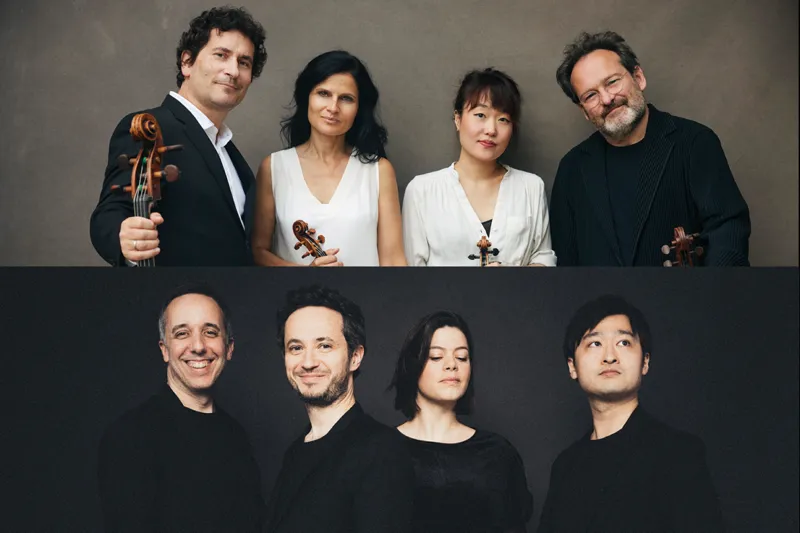
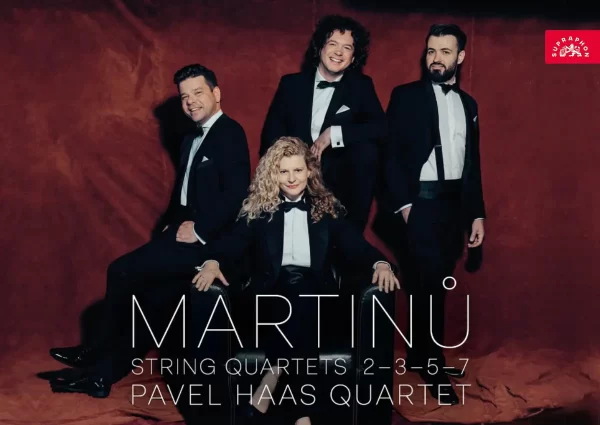
Belcea Quartet (top), Quatuor Ébène
The two quartets meet these demands through an almost instinctive familiarity with Enescu’s motives, allowing recurring ideas to emerge naturally, like internal quotations. As in the Mendelssohn, there is a finely judged balance between soloistic projection and ensemble cohesion. One striking moment occurs in the first movement (track 6, from 5’00”), where the lower strings shift seamlessly from bowed lines to pizzicato accompaniment, subtly changing the music’s character.
The second movement is dark and unsettling, at times anticipating the expressive world of later 20th-century string writing, while the slow third movement feels suspended and remote, as if drawn from a different sound world altogether. The closing pages are handled with particular assurance, underlining the stature of a work that still does not receive the attention it deserves.
Captured in spacious, well-balanced sound, this release makes a strong case for both Octets. Without overstating the point, these performances are persuasive enough to be considered among the most compelling modern accounts of these two works.
Recommended Comparisons
Mendelssohn: ASMF Chamber Ensemble | Ehnes | Lincoln Center
Enescu: Boston Chamber Music Society | Tetzlaff-Faust

The Classic Review Newsletter
Get weekly updates about new classical music content.
By signing up, you acknowledge and agree to our Privacy Policy & Terms of Service .
Album Details |
|
|---|---|
| Album name | Octets |
| Label | Warner Classics |
| Catalogue No. | 2173299729 |
| Artists | Quatuor Ébène, Belcea Quartet |