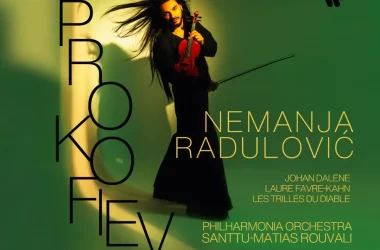
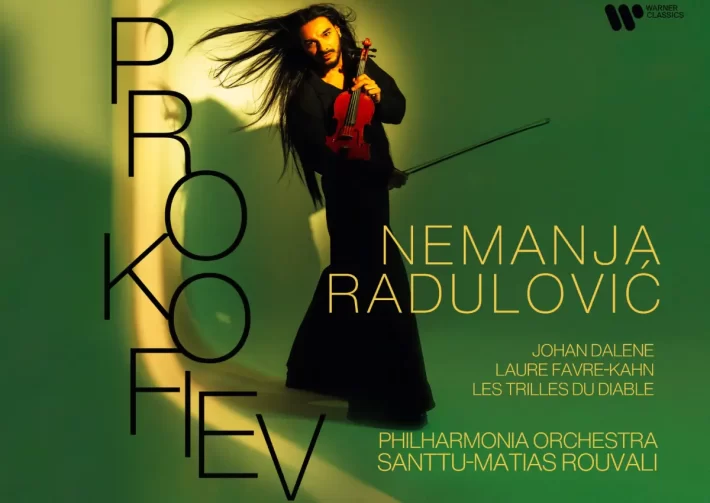
Nemanja Radulović presents a generous and eclectic Prokofiev program. At its centre is the Second Violin Concerto, alongside the Sonata for Two Violins, the Five Mélodies, and a selection of transcriptions from the operas, ballets, and symphonies.
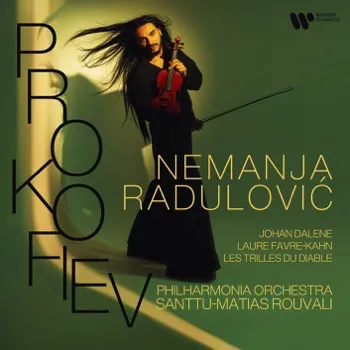
In his booklet foreword, Radulović remarks that playing Prokofiev involves moving between light and darkness, wit and vulnerability. Few works capture these contrasts more clearly than the Violin Concerto No. 2, Op. 63, a score that unfolds in episodes of lyricism, tension, and unease. As on his previous albums, Radulović combines technical ease with unforced expressivity and, above all, a clear sense of sincerity. In the opening Allegro moderato (track 1), the initial solo entry is shaped persuasively, the violin’s soft growl sounding at once sinister and alluring. Intricate passagework in the more suspenseful stretches remains light and clean, while the broader lyrical spans flow naturally without losing their underlying tension.
The central movement (track 2) brings out a melodic tenderness not always associated with Prokofiev, and both soloist and orchestra make the most of it. Radulović’s sound ranges from delicate whispers to more impassioned declamation, while the orchestral writing emerges with notable detail, especially in the woodwinds, brass, and lower strings. In the finale (track 3), Prokofiev’s sardonic humour comes more sharply into focus, and Radulović meets the double stops and leaps with bite and confidence.
One of the strengths of this release is the chance to hear Radulović in a variety of collaborative settings, including alongside other violinists. He joins Johan Dalene, whom we have also reviewed on these pages, in the Sonata for Two Violins, Op. 56, and the result is compelling. This is one of the album’s more emotionally unsettled works, and the players capture its shifts between unease, strain, and volatility. In the opening Andante cantabile (track 5), they lean into the dissonances created by the intertwining lines, allowing them to linger with quiet intensity. Their expressive commitment is equally well matched in the fiery Allegro (track 6), while the following slow movement shows careful attention to balance and phrasing: a study in restraint, where subtle emphasis on certain harmonies creates a soundscape of considerable colour despite the music’s relative stillness.
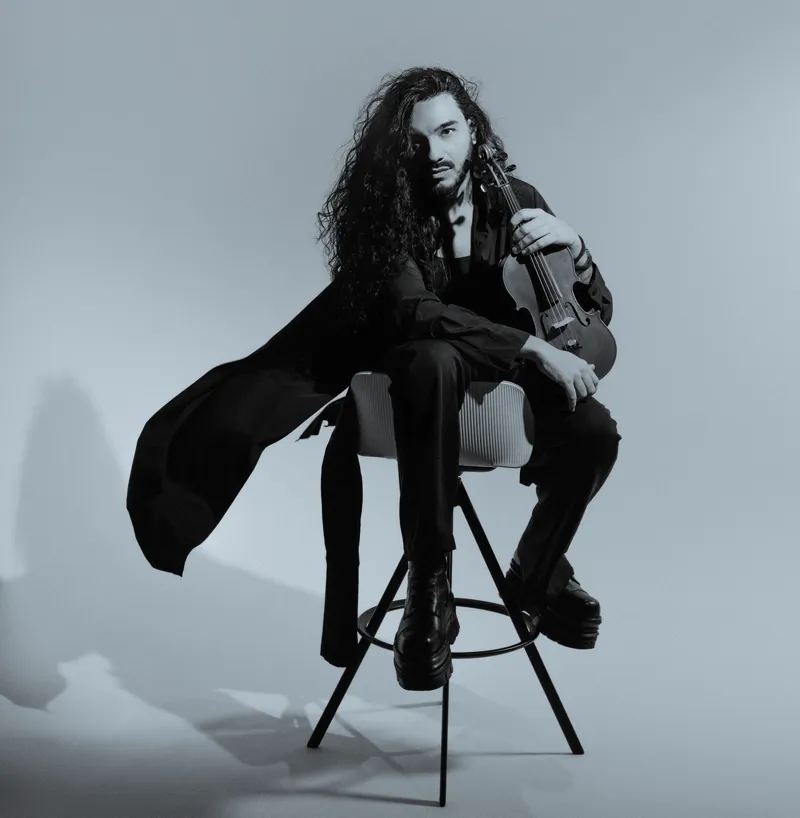
Nemanja Radulovic (© Parlophone Records, Jean-Marie Fox)
Among the shorter transcriptions, the selections from Romeo and Juliet are especially successful. In Montagues and Capulets (track 19), Radulović is joined by pianist Laure Favre-Kahn. It is no easy task to suggest the heavy tread of Prokofiev’s low brass at the keyboard, yet Favre-Kahn conveys something of their weight and menace. Radulović, for his part, plays with real force, even allowing the rougher edge of the bow stroke to register to telling effect. Heifetz’s arrangement of Masks (track 20) is another highlight, full of wit and rhythmic point. Favre-Kahn’s crisp staccatos and Radulović’s sharply articulated yet resonant pizzicatos give the piece its necessary lift. Duel and Death of Tybalt (track 22) makes for a strong conclusion. Where the concerto placed virtuosity in the service of line and proportion, here Radulović allows more overt brilliance to the fore. The playing is electric and aggressive, at times almost wild, while Favre-Kahn adds flair without ever upsetting the balance.
The famous March from The Love for Three Oranges (track 13) is also a welcome inclusion. The duo relishes its grotesque character, projecting the music’s abruptness and harmonic acidity without softening its edges.
The Five Mélodies, Op. 35bis, provide a needed change of atmosphere, offering repose after some of the more extrovert items. They also allow Radulović and Favre-Kahn to show another side of their musicianship. In the Andante (track 14), the violin takes on a supple, glossy tone, and the melodic lines are shaped with quiet eloquence. Favre-Kahn’s light, finely spun sound helps sustain the music’s elusive atmosphere. The Andante non troppo (track 18) is especially well judged in its architecture: it begins gently, with the pianist lending a faintly Debussian colour to the accompaniment, before the duo gradually transforms the tension from something inward and nagging into something more ominous. Radulović’s harmonics at the close leave a lingering sense of unease.
In violin concertos especially, achieving the right balance between soloist and orchestra is never straightforward, but the engineering here is consistently impressive. The violin retains its richness and sensitivity without being spotlit, and the orchestra has presence and space of its own. There are moments when one might wish for the piano to be set slightly closer, but this does little to diminish the overall quality of the performances.
Radulović has built a strong discography, and this release maintains that standard. It is a rewarding and thoughtfully assembled Prokofiev album, one that should appeal to admirers of the composer as well as to listeners drawn to violin repertoire more broadly.
Album Details | |
|---|---|
| Album name | Prokofiev |
| Label | Warner Classics |
| Catalogue No. | 2685435544 |
| Artists | Nemanja Radulović, violin; Philharmonia Orchestra; Santtu-Matias Rouvali, conductor; Laure Favre-Kahn, piano; Johan Dalene, violin |