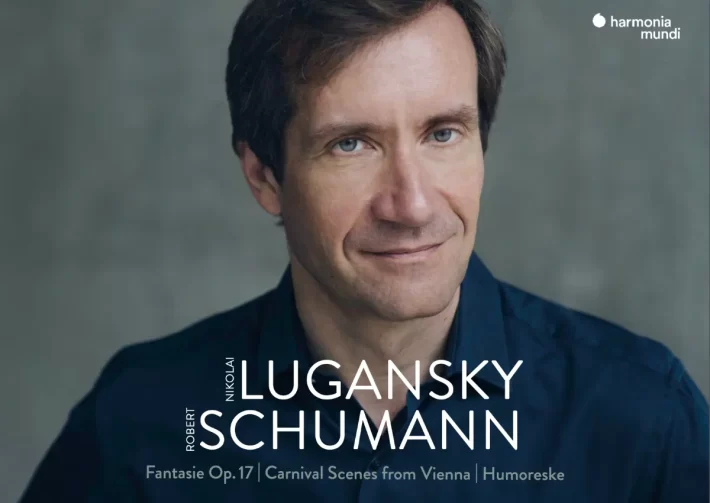
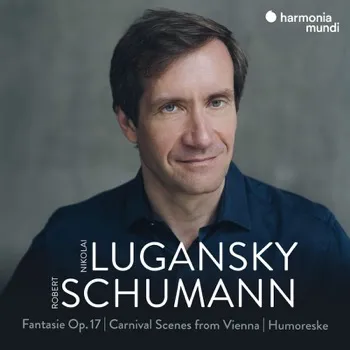
Nikolai Lugansky’s latest album features three of Robert Schumann’s major piano works. The program, comprising the introspective Fantasie, Op. 17, the witty Humoreske, Op. 20, and the lighthearted Faschingsschwank aus Wien, Op. 26 (Carnival Scenes from Vienna), exemplifies the vivid imagination at the heart of the composer’s style.
Although a large-scale work, I find that the Fantasie still reflects the spirit of cycles such as Davidsbündlertänze, Op. 6 and Carnaval, Op. 9, in how each movement encapsulates a distinct persona. The detail and care in Lugansky’s approach are evident in the opening movement. While some of the louder sections come across as overly percussive, he is in his element in passages requiring tenderness. The color changes within the piano dynamics are lovely, as is his attention to the inner voices that occasionally engage the melody in dialogue. Listeners may find that Lugansky’s spontaneity is not as immediately apparent as Martha Argerich’s volatile readings for Sony—but then again, who is?
The pomp and circumstance of the middle movement (track 2) come through as the pianist maximizes the resonance of the instrument’s bass. Yet I missed a certain playfulness, and the small dotted rhythms could benefit from more crispness. The ending, a notorious technical challenge, sounds overly cautious where a more “reckless” approach—akin to Maurizio Pollini’s DG recording—would better capture the feeling of sheer jubilation.
The final movement is perhaps the most musically challenging of the three, demanding that the performer convey profundity through understatement. Lugansky evokes comfort through the arpeggiated figures, and while the melodies may not be as poignant as in Vladimir Horowitz’s 1965 live performance at Carnegie Hall, they are infused with a palpable thoughtfulness.
The Faschingsschwank aus Wien begins with a brisk and rousing Allegro (track 4). Lugansky’s handling of each episode within the recurrent rondo creates a series of eclectic vignettes. In the doleful Romanze (track 5), he highlights the harmonies created through suspensions and chromaticism; in the sparser lines, this adds body and sets up an effective contrast with the warmth of the more consonant sections.
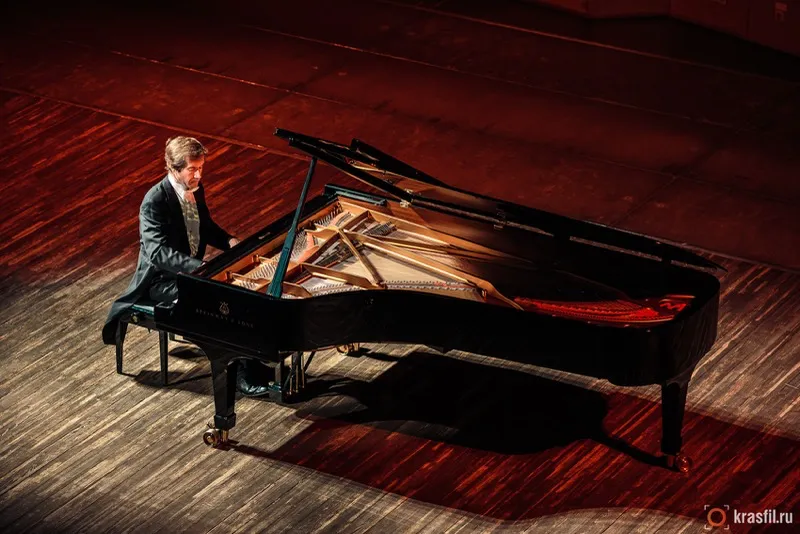
Nikolai Lugansky (image: ©️ Nikita Larionov)
The Scherzino (track 6) lightens the mood with a playful pep, the pianist leaving enough space between the notes to ensure clarity. The passionate, swirling Intermezzo (track 7) provides a perfect buildup to the Finale, which is the highlight of the set. Lugansky shows effortless command of the virtuosic passages, providing plenty of electricity amidst the helter-skelter.
Humoreske, Op. 20 opens with a beautiful, song-like section (track 9). Its lyricism is a fitting complement to the Sehr rasch (track 10), whose levity is punctuated by assertive chords and galloping passages with a hint of stubbornness. Among the remaining movements, Innig (track 13) is particularly multidimensional. Nestled between buoyant sections is a sensitive middle part where Lugansky’s enviable tone quality shines through. The finale, Zum Beschluss, is an enigmatic conclusion; he adds a sense of persistence and even a touch of darkness to its chromaticism. The humor in this set arises from unpredictability and contrast, both of which are maintained faithfully, providing the cycle with a strong sense of unity.
One significant distraction is the sound engineering rather than the performance itself. Particularly in the Fantasie, the microphone placement makes the instrument sound boomy and the registers unbalanced. Despite this, the album represents a solid effort from Lugansky. Even if it does not quite displace existing reference recordings, It remains a most enjoyable listen.
Album Details |
|
|---|---|
| Album name | Schumann – Fantasie, Humoreske, Faschingsschwank aus Wien |
| Label | Harmonia Mundi |
| Catalogue No. | HMM902753 |
| Artists | Nikolai Lugansky |