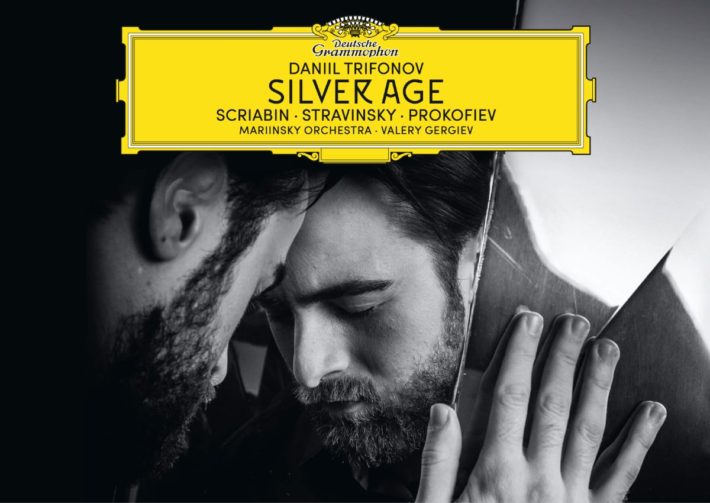
This packed 2-CD release finds Daniil Trifonov performs works by Russian composers from the “Silver Age,” a short-lived but vibrant era. This album features some of the most cherished (and performed) works in the piano repertoire – Stravinsky’s “Petrushka”, “Firebird” and Serenade are presented with Prokofiev’s 8th Piano Sonata and “Sarcasms”, and on the second CD we have two Piano Concertos – Scriabin’s Op. 20, his sole effort in the genre, and Prokofiev’s No. 2 in G Minor.
The pianist’s Petrushka pulls focus away from its overt virtuosity and places it instead on its eclectic compositional style. An elegant Russian Dance (CD 2, track 5) shows a frugality of pedal use but greater reliance on his strong fingerwork. What results is a wonderful clarity – every note has its place in the work’s complex texture. When compared to an equally enjoyable recording by Beatrice Rana, which this writer reviewed on these pages last year, we hear two sides to the same piece: Trifonov plays to Petrushka’s roots as a ballet, while Rana emphasizes its qualities as an orchestral transcription.
Petrushka’s Room (CD 2, track 6) embodies the pianist’s own description in the booklet of Stravinsky as a stylistic “chameleon” – there are snippets of atonality, Impressionism, and folk dance. There is also a quick, often unpredictable change of moods, a caprice that the pianist embraces in his dynamic interpretation. A nice example is in the middle of the movement: a sharp and foreboding moment (0:46-1:26) seems to evaporate into a dreamy, lullaby-like section.
Prokofiev’s Second Piano Concerto in G minor is one of two concerti on this album. Trifonov approaches this challenging work with a balance of finesse and raw energy. It is this relationship that underlies much of the first movement: he has a fierce and biting sarcasm in the middle section which contrasts with the brooding, expansive opening.
A mention of the infamous cadenza, of course, cannot be skipped: to describe its as ‘formidable’ is an understatement, but Trifonov delivers with aplomb. He manages to create well-defined phrases amidst a barrage of technical challenges, which is an important factor in developing the cadenza’s momentum. I found some of his rhythmic pushes and pulls unexpected but interesting – when handled less skillfully, they can disrupt the pacing, but his sensible approach augments a growing tempestuousness into a full-blown cataclysm. The Intermezzo is a solid collaborative effort where soloist and orchestra show the emergence of the movement’s two different personalities.
The relentless and march-like ostinato in the brass and low string possesses an impersonal, almost cold austerity. On the other hand, the piano evokes an undulating mysteriousness in its legato sections: Trifonov shows the subtleties of the contrapuntal writing here so that we can appreciate a kaleidoscope of harmonic colors. A scintillating (and impressively briskly paced) finale concludes the work in electrifying style.
Scriabin’s F-sharp minor concerto, one of his early-period works, shows a well-versed musician, clearly at home in a more Romantic idiom as much as he is in Prokofiev’s. His playing adds richness to the composer’s complex chromaticism and luxurious harmonies. The Mariinsky Orchestra, too, has a strong showing under Valery Gergiev. The second movement (a short theme and variations), is an absolute delight. Its breathtaking opening shows that the ensemble can be as delicate as it was powerful in the previous movement. Trifonov brings out the glassy timbre of the instrument, adding a lovely translucence to the first variation.
The third, a declamatory conversion between piano and orchestra, is well-done. With most of the playing in the lower register, he let the notes steep in profundity but never to the point of overpowering the listener. The final variation returns to the movement’s gentle nature, with the piano evoking an airy birdsong that lasts until the movement’s close.
One review can’t cover everything on this packed program, including a wonderfully dark performance of Prokofiev’s 8th Sonata (the third of his three “War Sonatas”), just to mention that there are several sets of shorter-form pieces offered which are just as enjoyable as the bigger ones. Prokofiev’s Op. 17 Sarcasms are of note: No. 3 (track 7), shows Trifonov’s meticulous control of harmonic balance in its fast-moving intervals.
His rendition of No. 4 is the best of all. It is a chilling and effective representation of an irony the composer identifies as an underlying concept of the work: “a man may laugh senselessly at others,” he writes “only to realize their pity and unhappiness is what causes him misery.” Illuminating liner notes give us an in-depth background into the Silver Age as an artistic and historical movement – a fitting companion to a well-conceived and excellently presented album.
Recommended Comparisons
Bavouzet | Ugorski | Rana | Bronfman

The Classic Review Newsletter
Get weekly updates about new classical music content.
By signing up, you acknowledge and agree to our Privacy Policy & Terms of Service .
“Silver Age”
Stravinsky – Serenade in A, The Firebird, 3 Movements from Petrushka
Prokofiev – Piano Concerto No. 2, Piano Sonata No. 8, Sarcasms,
Scriabin – Piano Concerto in F Sharp Minor, Op. 20
Daniil Trifonov – Piano
Mariinsky Orchestra
Valery Gergiev – Conductor