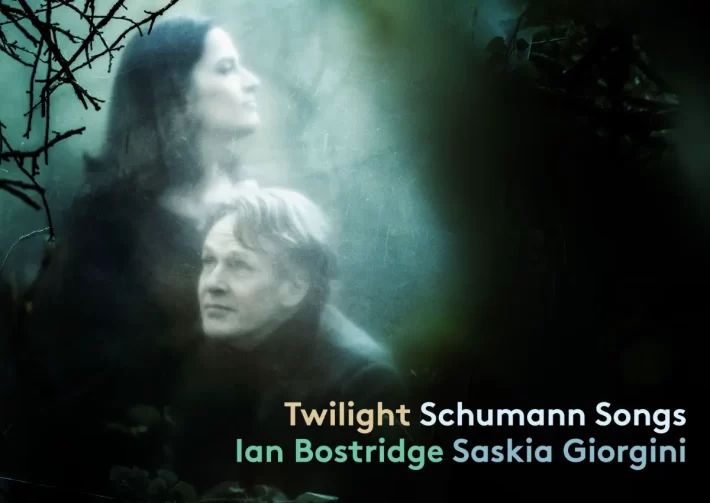
This is the third collaboration between Ian Bostridge and his accompanist for the Pentatone label, with the two having recorded Schubert’s Die schöne Müllerin (reviewed here) and an album of Respighi Songs. This new project is dedicated to songs by Robert Schumann, including the Op. 35 Kerner cycle and the Op. 39 Liederkreis.
12 Gedichte von Justinus Kerner, Op. 35, was composed in Schumann’s celebrated “year of song” (1840), alongside Dichterliebe and Liederkreis. The cycle explores a spectrum of emotions ranging from passion (No. 1) and hope (No. 3) to longing (No. 5). Bostridge convincingly meets this expressive range throughout. The pianist allows Bostridge ample space to shine, though at times her playing feels somewhat subdued, struggling to match her collaborator’s intensity.
Liederkreis (Op. 39) may arguably show the composer’s vocal work at its best; based on the poems of Joseph von Eichendorff, the cycle encompasses themes of landscape and love. As he exemplified in his breakthrough album of Schumann’s Dichteliebe (1998), Bostridge shows that his strongest suit is an ability to convey the earnestness he has for the music. He uses beautiful phrase contouring to bring to life the narrative quality of the poem in Der Fremde (track 6).
Mondnacht (track 10), one of the most famous songs of the set, showcases beautifully crafted long lines from Bostridge, although his tone might feel overly bright considering the delicate, almost fragile nature of von Eichendorff’s text. A more dreamy approach could have suited this song better, yet the subtle character and color shift at 1’53” is especially lovely. The accompanist, however, feels slightly measured here, missing some of the fluidity demonstrated, for instance, by Gerald Moore accompanying Dietrich Fischer-Dieskau.
Listen to the lovely character and color shift in Mondnacht (track 10, 1’53”), one of the most famous songs of the set. The pianist feels a bit too measured here, in one place where a pianist can move more fluidly (Gerald Moore’s reading with Dietrich Fischer-Dieskau proves more satisfying in this regard).
Both performers’ enthusiasm is particularly evident in Frühlingsnacht (track 17), providing a strong conclusion to the set. Bostridge’s voice radiates optimism, and the cumulative buildup across the three stanzas—each stanza becoming more energetic and buoyant—makes for an especially convincing performance.
As for the other sets, “Des Sennen Abschied” from Op. 79 (track 31) is beautifully done, offering listeners a farewell whose warmth resonates with the sincerity evident throughout the album.
The liner notes include helpful song texts and translations, as well as forewords from both Bostridge and his accompanist. Each eloquently expresses admiration and respect for Schumann’s music. Although some performances resonate more successfully than others, the sincerity of both artists ultimately shines through, resulting in a laudable effort.
Recommended Comparisons
Gerhaher | Goerne | Fischer-Dieskau | Padmore | Quasthoff
Album Details |
|
|---|---|
| Album name | Twilight – Schumann Songs |
| Label | Pentatone |
| Catalogue No. | PTC 5187162 |
| Artist | Ian Bostridge |