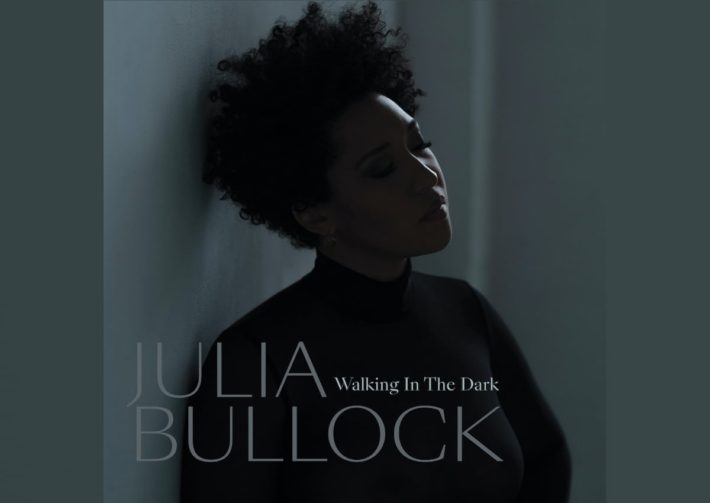
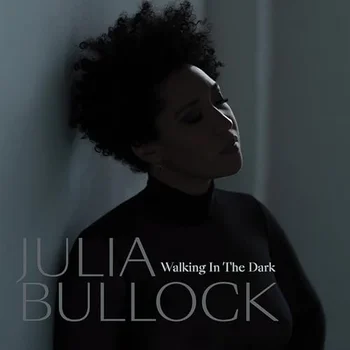
The track listing of soprano Julia Bullock’s solo debut, Walking in the Dark, has a bold eclecticism. She explores several different genres over the course of her performances: there’s Barber‘s ‘Knoxville: Summer of 1915’, a traditional spiritual, ‘City Called Heaven’, as well as a contemporary selection from a 2000 John Adams opera. And doesn’t stop there: Bullock also crosses into the realm of 1950s popular song via Connie Converse’s ‘One by One’ and folk-rock with Sandy Denny’s ‘Who Knows Where the Time Goes?’. With this intriguing set, I wondered how all these selections fit together. The theme, it turns out, is a personal one: Bullock mentions how these are works that she’s revisited time and time again—they are an integral part of her growth and development as a singer.
Another part of the album’s variety comes from Bullock’s collaborations in both a large and small-scale context. An example of the former is the Barber (track 6), which she performs with Christian Rief and the Philharmonia Orchestra. The instrumental introduction strikes a rhythmic yet ambling, vibrant yet introspective chord with the listener: I liked how I could hear the individual textures of the winds, especially the bassoon in the opening and the smooth interchange of the ostinato between flute and clarinet. Bullock has a tangible richness to her voice that holds up to the ensemble well; when coupled with her expressive, earnest singing, we experience the full effects of the narrative, suspenseful, and musing characters that appear in the different sections.
John Adams’ Memorial de Tlatelolco from his opera, El Niño, could not be more diametrically opposed to the Barber. In place of smooth, expansive narration is an aggressive and blistering presence which both singer and ensemble do an excellent job evoking. The strings are front and center in the work’s drive: listen for the vicious scrapes starting at 0’42”. Bullock, too, really goes for it where the angularity of the phrases are concerned: there is a palpable ferocity that borders (most effectively) on terrifying, yet her musicality and technical precision are not sacrificed. Pitches are clear as a bell and she finds a way to use her thicker timbre to temper the otherwise strident texture of the vocal lines.
In the works for voice and piano, One by One (track 2) has a meditative and hymnal quality. The lines touch upon a wide range of registers, and Bullock exhibits no difficulties in bringing out the best qualities of each. The low notes are pleasing in their fullness and resonance while the higher ones are silvery and carry well over Rief’s thoughtful accompaniment.
Versatility is also evident in the Sandy Denny selection (track 7), which she arranged with Reif (again at the piano here) and Jeremy Siskind. This is by far the strongest performance of the album: Bullock’s voice, husky and inviting in its warmth, is complemented by the clear diction that brings the poetic words to light and in a captivating fashion. Meanwhile, Rief’s velvety tone quality adds a lovely glow that has its moments of almost crystalline sparkle in the tasteful accents of dissonance (0’54”-1’02”).
For such wonderful performances from Bullock and her collaborators, I was crestfallen that the entire album is under an hour. I’d hoped to be treated to even a couple more selections. It’s also a shame that the recording engineers at Nonesuch could not keep up with the stellar level of the artists. There’s a perceptible difference in quality of sound and balance between the orchestral and piano-accompaniment works: in the Barber, for instance, Bullock’s voice sounds oddly boomy and sequestered at times (and the orchestra, through no fault of theirs, can and does overpower). The Conny Converse song, however, is quite nicely engineered for a very personal listening experience.
The album as a whole is a memorable debut for Bullock, who also makes it clear that she’s unafraid to carve out her distinct persona when it comes to choice of works. While all the selections are effective, she shines brightest just alone with the piano. It is in these songs we can hear her unparalleled nuance and sensitivity: these are what make the quietest moments the most powerful. Enthusiastically recommended.
Recommended Comparisons
Walking in the Dark
Julia Bullock – Soprano
Philharmonia Orchestra
Christian Rief – Conductor, Piano
Nonesuch, 7559790817