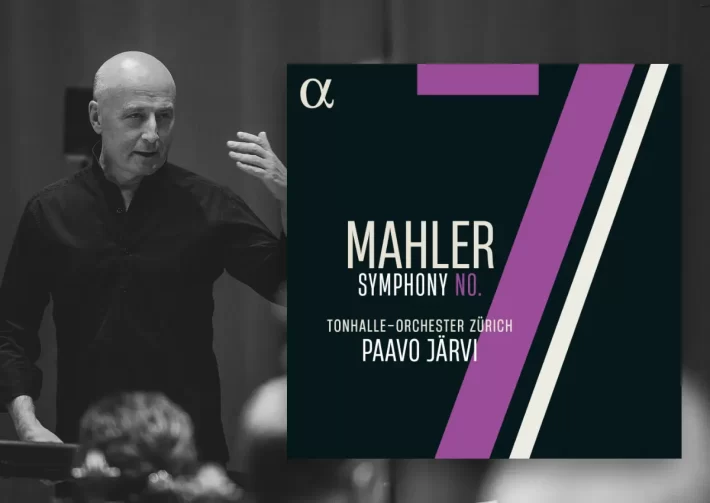
Could Mahler‘s Symphony No. 7, long treated as something of the ugly duckling among his symphonies, be moving into fashion? I recently reviewed Noseda’s recording of the work (review), and now this new release arrives as the third installment in Paavo Järvi’s ongoing Mahler cycle with the Tonhalle-Orchester Zürich. The booklet itself notes how often the symphony has been regarded as difficult and misunderstood, and Järvi’s decision to place it so early in the cycle can indeed be read as a sign of commitment to the piece.
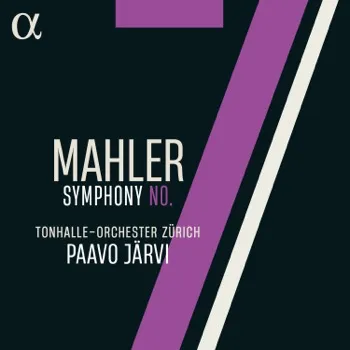
Anyone who heard the earlier recordings of Symphonies Nos. 1 and 5 will know more or less what to expect. Järvi is not a conductor of abandon in Mahler. His approach is transparent, calculated, and precise, with a strong sense of what he wants to reveal in the score. That is apparent from the opening movement, where even the dotted rhythm of the introduction is given a slightly held-back profile, as if carefully placed under a microscope. The playing is exceptionally clear, and the forward momentum is more pronounced than the sense of dread one hears in more overtly nightmarish performances.
That clarity pays off in many places. At track 4, around 1’50”, the trills and later processional material come through with unusual audibility, which is genuinely illuminating. The brass and woodwind are sharper in attack than on many rival versions, sometimes making the orchestral sound almost classical in outline. That is not necessarily a negative; Mahler, after all, was a great opera conductor with a firm grounding in the classical Austro-German tradition. Järvi’s emphasis on articulation, structure, and balance can make the work sound less like an expressionist hallucination and more like a tightly argued symphonic design.
The Tonhalle players respond magnificently. Solo strings, woodwind, and brass all make strong contributions, and the engineering is better balanced than in the previous volume of the cycle, where the microphones occasionally felt too close to the woodwind. Here, the sound still offers detail, but with less distraction. In the first Nachtmusik, for instance (track 8 at 3’00”), Järvi nicely clarifies how this nocturnal dance can remind us of the first movement of Mahler’s First Symphony. Such moments of thematic or atmospheric kinship are not always so easy to register in denser, more saturated performances.

Paavo Järvi ©️ Alberto Venzago
The inner movements suit Järvi especially well, with a good sense of humor. The serenade unfolds with charm and poise, lightly worn and attractively pointed. The Scherzo is less frightening than in some recordings, but it is finely controlled and rhythmically alert.
Where the transparency becomes more problematic is in the finale. Here, Järvi’s insistence on making every layer audible, especially the percussion, comes at a cost. The tension leaks away just where Mahler most needs cumulative impact. The big climactic moments never quite deliver the overwhelming release one hears in Bernstein’s New York recordings or Abbado in Berlin. In that respect this performance also recalls Rattle’s otherwise superb BR account (review), whose finale likewise feels a touch underpowered when the stakes should be at their highest.
Still, one cannot accuse Järvi of inconsistency. This is very much of a piece with his previous Mahler recordings: excellently played, lucid, and often revealing, with a lighter and sometimes more objective side of Mahler brought to the fore. It stands alongside accounts by conductors like Osmo Vänskä (review) or Adam Fischer as a compelling alternative to the more heavily romanticized tradition.
Recommended Comparisons
Bernstein | Abbado | Rattle | Vänskä | Fischer

The Classic Review Newsletter
Get weekly updates about new classical music content.
By signing up, you acknowledge and agree to our Privacy Policy & Terms of Service .
Album Details |
|
|---|---|
| Album name | Mahler – Symphony No. 7 |
| Label | Alpha |
| Catalogue No. | ALPHA1206 |
| Artists | Tonhalle-Orchester Zürich, Paavo Järvi |