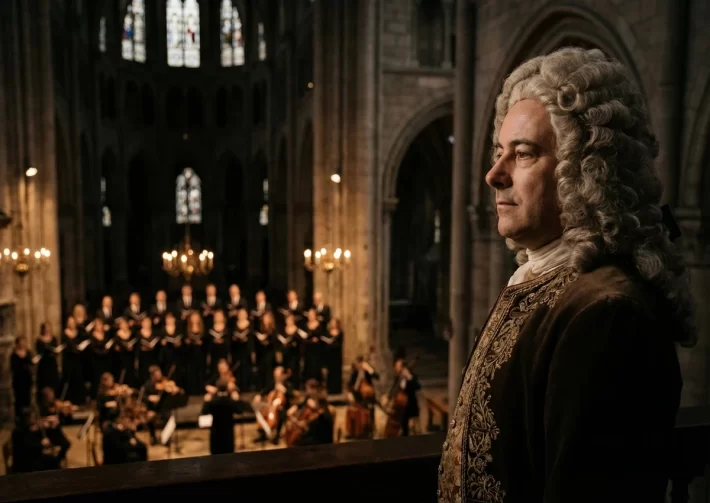
Handel composed Messiah in just 24 days during the summer of 1741, setting a libretto by Charles Jennens drawn entirely from the King James Bible and the Book of Common Prayer. Premiered in Dublin the following April, the oratorio quickly established itself as one of the supreme achievements of Baroque choral music, and it has remained a cornerstone of the concert repertoire ever since. Structured in three parts tracing the prophecy, birth, passion, and resurrection of Christ, Messiah stands apart from Handel’s dramatic operas and other oratorios in having no named characters or narrative action; instead, its power lies in the cumulative effect of arias, recitatives, and choruses — culminating in the iconic “Hallelujah” — that move between contemplation and exultation with extraordinary rhetorical force.
Here are The Classic Review editorial team’s recommendations for the best recordings of Handel’s Messiah.
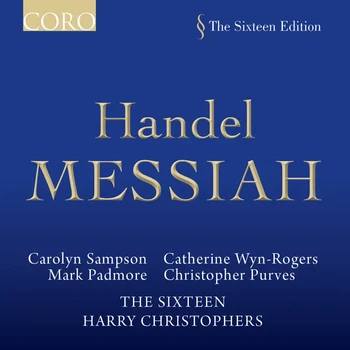
The Sixteen, Harry Christophers
Recorded in 2007 at St Paul’s Church, Deptford, this performance draws on the intimate choral tradition Harry Christophers has refined with The Sixteen over decades. All four soloists — Carolyn Sampson, Catherine Wyn-Rogers, Mark Padmore, and Christopher Purves — have long associations with the ensemble, lending the performance a rare sense of artistic unity. The period-instrument orchestra is warmly expanded for a fuller theatrical sound, while the choir delivers each chorus with luminous precision. Winner of the MIDEM Classical Award for choral works in 2009, this is a deeply considered yet spontaneous-sounding account of Handel’s masterpiece.
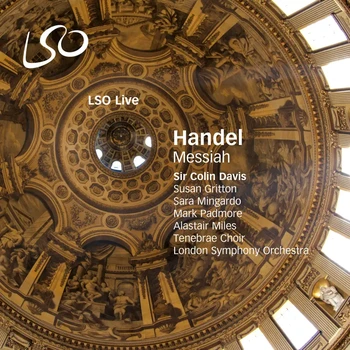
London Symphony Orchestra, Sir Colin Davis
Recorded live at the Barbican in December 2006, this was Sir Colin Davis’s third and final recording of Messiah, following his acclaimed 1966 Philips version and a 1984 set with the Bavarian Radio Symphony Orchestra. The London Symphony Orchestra plays with modern instruments but in pared-down forces, achieving a chamber-like transparency. Davis prepared his own edition of the score, carefully annotating ornaments and restoring the 1741 aria assignments. With the superb Tenebrae choir and soloists including Mark Padmore and Sara Mingardo, this is a towering achievement among modern-instrument accounts of Messiah.
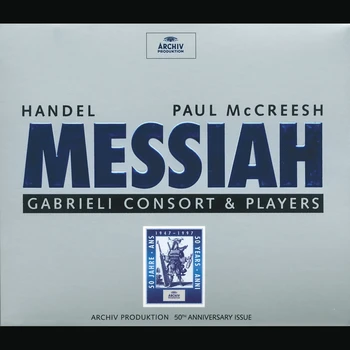
Gabrieli Consort & Players, Paul McCreesh
Recorded in December 1996, Paul McCreesh’s boldly theatrical account reconstructs the 1754 Foundling Hospital performance, using period-appropriate forces and a large chamber organ that evokes the scale of Handel’s own concerts. The pacing is urgent and declamatory, with crisp articulation driving the drama forward. Soloists Dorothea Röschmann, Bernarda Fink, and Charles Daniels are outstanding — Daniels’s “Comfort ye” is particularly affecting. McCreesh treats Messiah not as a devotional exercise but as vivid musical storytelling, and the Gabrieli Players respond with focused, colourful playing. A revelatory interpretation that has lost none of its impact.
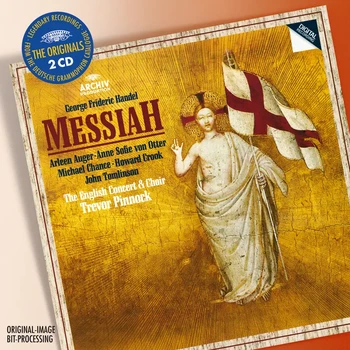
The English Concert & Choir, Trevor Pinnock
Recorded at Abbey Road Studios in January 1988, Trevor Pinnock’s account balances period-instrument detail with an expansive sense of occasion. The cast of soloists is exceptional: Arleen Augér brings radiant purity to the soprano arias, Anne Sofie von Otter is profoundly moving in the alto numbers, and Michael Chance delivers a commanding “But who may abide the day of His coming.” Howard Crook and John Tomlinson complete a lineup of remarkable consistency. The English Concert plays with crisp ensemble and warm tone, and the choir sings with confident precision. A benchmark recording that remains thoroughly persuasive.
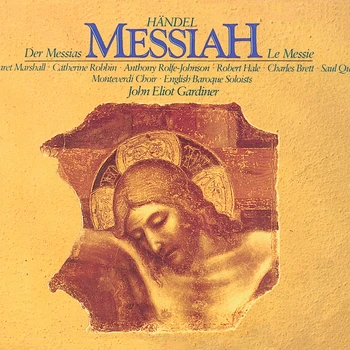
English Baroque Soloists & Monteverdi Choir, John Eliot Gardiner
Recorded in November 1982, this was one of the earliest major period-instrument recordings of Messiah — arriving just two years after Christopher Hogwood’s pioneering version — and it set a new standard for historically informed performance of the work. John Eliot Gardiner’s Monteverdi Choir sings with disciplined clarity and infectious energy, while the English Baroque Soloists provide crisp, dancing accompaniment, with Crispian Steele-Perkins’s natural trumpet ringing out brilliantly in “The trumpet shall sound.” Anthony Rolfe Johnson is the standout among the soloists. A landmark recording whose vitality and conviction have kept it at the centre of the catalogue for over four decades.
Top image ©️ The Classic Review, AI generated