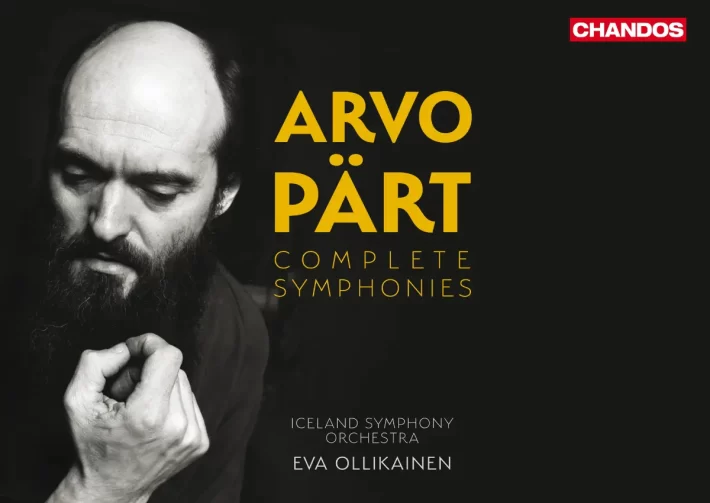
Arvo Pärt‘s symphonies have been recorded only a few times compared to the plethora of albums dedicated to his choral music. Interestingly, most of the symphony recordings are conducted by the Järvi family — Neeme, Paavo and Kristjan. This is the second album to gather all of Pärt’s symphonies on a single disc; the first, released in 2018, features the NFM Wrocław Philharmonic led by Tõnu Kaljuste (ECM New Series).
Written in 1963, Pärt’s first symphony was composed at the end of his studies with Heino Eller at the Tallinn State Conservatory. Its subtitle, ‘Polyphonic’, is reflected in the structure of its two movements: I. Canon and II. Prelude and Fugue. Anyone expecting Pärt’s tintinnabuli style will be shocked by the dissonant dodecaphonic writing, laid out by Ollikainen and her Icelandic orchestra in bold colours and transparent textures. Ollikainen’s reading is fast (16’28”), objective and clinical. The slower readings by Kaljuste and Paavo Järvi (Estonian National Symphony Orchestra/Warner Classics) use the additional time for greater expressivity. Neeme Järvi’s Bamberg SO reading (BIS) is only ten seconds faster than Ollikainen’s but has greater drive and cogency; the Icelandic performance feels like a careful run-through that never finds its emotional footing.
The performance of Symphony No. 2 is more successful. Written in 1966, the work is divided into three unnamed movements (Chandos provides the composer’s metronome marks for each) that add up to less than fifteen minutes in total. The music is again serialist and sonorist, a technique that features in the Chandos Bacewicz series I have reviewed on this site. I found this work easier to appreciate, and in this instance Kaljuste’s reading (lasting a little over ten and a half minutes) feels brusque, whereas Ollikainen’s pacing (12’29”) feels ideal: dissonant passages have tremendous impact, and she creates a more compelling atmosphere in slower sections. Neeme Järvi’s first reading (Bamberg SO) is similar, though over a minute longer, while his second recording, with the Philharmonia Orchestra (Chandos), is slower still and lacks energy and focus. Paavo Järvi’s performance lasts over fifteen minutes as he works to smooth out the symphony’s rough, abrasive edges.
The Järvi family (the symphony is dedicated to Neeme) have helped make Symphony No. 3 the most recorded of the four: Neeme has recorded it in Bamberg and with the Gothenburg Symphony Orchestra (DG); Paavo with the Estonian SO (Warner Classics); and Kristjan with the Rundfunk-Sinfonieorchester Berlin (Sony).
This symphony, written in 1971, was the only concert work Pärt produced during his ‘period of silence’ (approximately 1968–1976). During this time he studied Gregorian chant, Medieval and Renaissance polyphony, and those styles became the compositional fodder for the symphony. It marked a clear rejection of his serialist style and pointed the way towards the tintinnabuli compositional method that was first heard in Für Alina (1976). Pärt described this symphony as a “joyous work”, though it was not “the end of my despair and search”.
The symphony’s structure wanders a bit, but the tonal language is now far more consonant. The decreased rhythmic business and use of silence will feel familiar to listeners who know the music written over the last two decades. Ollikainen’s interpretation is notably quicker than the Järvi performances (20’06” versus Kristjan 24’01”, Paavo 24’31” and Neeme’s second reading, 25’17”). While the music is beautiful, its compositional materials benefit from faster tempos, and the Icelanders offer tighter execution than their Polish counterparts, though Kaljuste elicits more rarefied beauty from his orchestra.
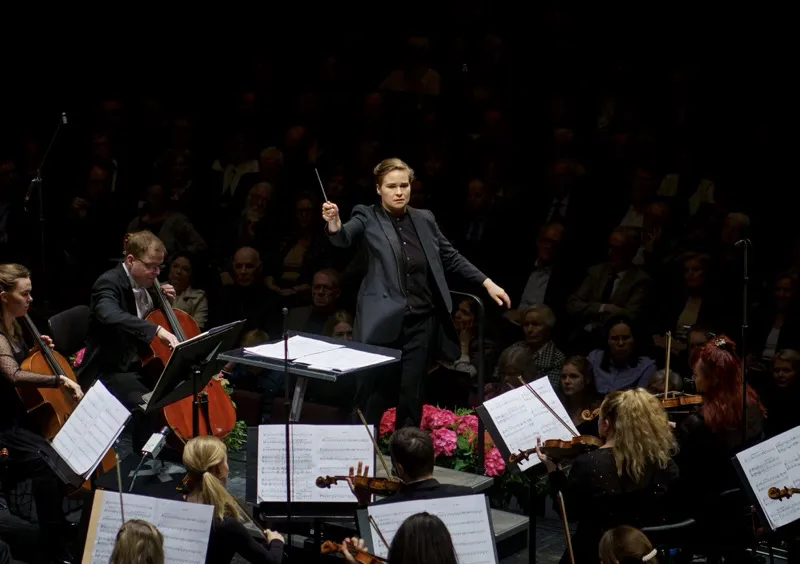
Eva Ollikainen, the Iceland Symphony Orchestra. image © Haraldur Jónasson (Hari).
Symphony No. 4, composed 37 years after the third, is the only one to use the tintinnabuli style. Ollikainen has a firm grasp of the structure, and the Icelanders offer beautifully refined playing; much the same can be said of Kaljuste’s reading. For me, neither interpretation matches the premiere recording (released first as a DG download from the live Walt Disney Hall performance, and later on ECM CD) by Esa-Pekka Salonen and the Los Angeles Philharmonic. I believe Salonen was a late convert to Pärt’s music, and his performance, slower than any other recorded reading, has a unique passion and intensity. As good as the Polish and Icelandic orchestras are, they do not match the sophisticated splendour heard in Los Angeles.
If collectors are in the market for a single CD of these symphonies, the choice comes down to this new Chandos release versus the earlier ECM recording. Both have excellent programme notes and exceptionally engineered sound, though the earlier album has more room ambience than the new Chandos, and that better serves the music. If forced to choose, I recommend the ECM release as the better option.
Recommended Comparisons
Complete Symphonies
Kaljuste / NFM Wrocław Philharmonic (ECM)
Symphonies Nos. 1–3
N. Järvi / Bamberger Symphoniker (BIS)
Symphony No. 4
Salonen / Los Angeles Philharmonic (ECM)
Album Details |
|
|---|---|
| Album name | Arvo Pärt: Complete Symphonies |
| Label | Chandos |
| Catalogue No. | CHSA 5372 |
| Artists | Iceland Symphony Orchestra; Eva Ollikainen, conductor |