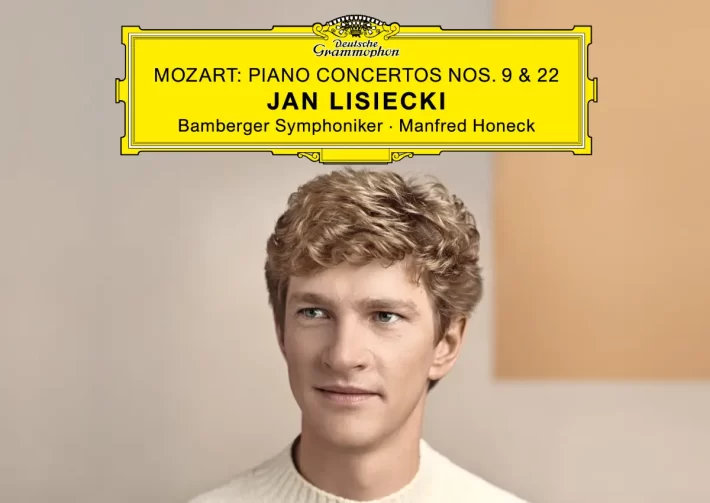
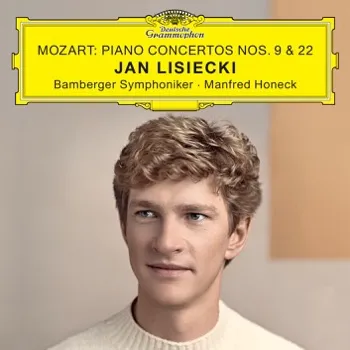
Jan Lisiecki’s newest album marks both an homage to Mozart in his 270th-anniversary year and the pianist’s return to the composer’s concertos since his 2012 DG recording of Nos. 20 and 21. The two works on the program — No. 9 Jeunehomme (K. 271) and No. 22 (K. 482) — share a key but otherwise trace the development of Mozart’s concerto style.
Lisiecki and Honeck have worked together for several years now, and the performances here reflect the comfort of an established partnership. They are stylistically aligned in a delightful, breezy Jeunehomme, capturing the essence of a more intimate, chamber-scale performance.
The Bamberger Symphoniker sound is impeccably balanced and exquisitely blended across the sections. Lisiecki’s piano playing is equally pristine, and the passages, in the composer’s own words, “flow like oil.” Beyond the effortlessness, he captures the concerto’s youthful charm in a way many recordings miss. In the Allegro (track 1), the second theme’s carefree buoyancy comes to life, and there is a nod to playfulness in Mozart’s own cadenza, where Lisiecki handles the switches from minor to major with refreshing humor.
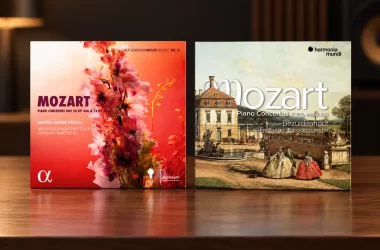
The middle movement (track 2) brings out the gravitas of the partnership. The Bamberger players lean into chromatic slides and dissonances, drawing out their poignant sighs; Lisiecki, in turn, weights his trills similarly. While true melancholy can be challenging to evoke in such a restrained idiom, the performers capture the sentiment authentically: they do not hold back in the more expansive moments, letting the drama reach an appropriate intensity. Although this is not a period performance, the fragility and transparency of the strings can suggest one. (Listeners after a true period reading will want to hear Kristian Bezuidenhout with the Freiburg Baroque Orchestra or Ronald Brautigam with Die Kölner Akademie.)
The finale (track 3) is the epitome of a successful musical partnership. The pianist’s joy in the music is matched by the ensemble’s enthusiasm, and from the lighthearted appoggiatura quips to the sparkling runs, it provides a convincing close to a performance that holds its own alongside reference accounts from Alfred Brendel and Charles Mackerras or Mitsuko Uchida and Jeffrey Tate.
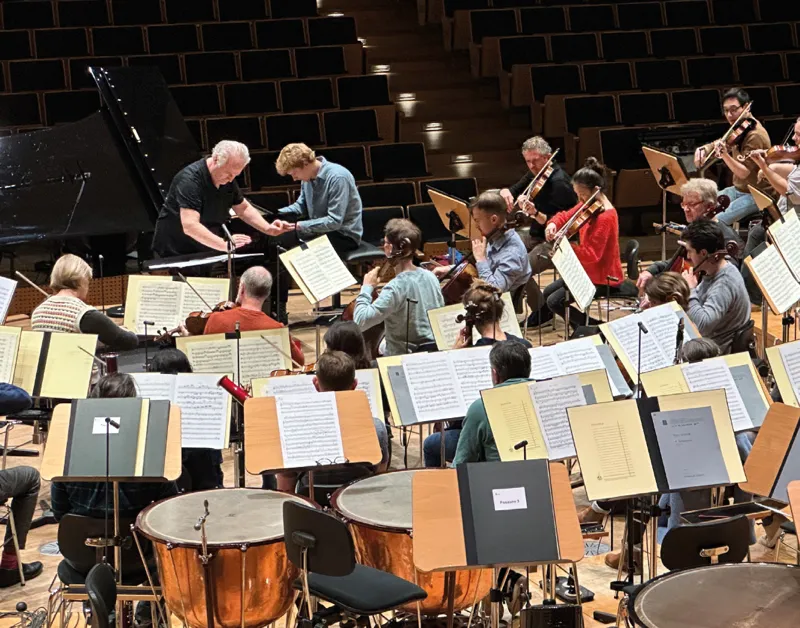
Jan Lisiecki and Manfred Honeck.
K. 482, written eight years after K. 271, exhibits more contrapuntal complexity and a bolder character, something the orchestra makes salient. A range of personalities emerges in the opening orchestral segment (track 4), from the jaunty bassoon solo to the smooth clarinet duo. The pomp and circumstance come from a more distinct presence of the low strings, a satisfying addition that gives the ensemble more dimensionality. Lisiecki brings out the delicate side with crystalline articulation reminiscent of birdcalls. When the two forces work together, there are surprising outbursts of Sturm und Drang (e.g. 3’45” onwards). The cadenza by Paul Badura-Skoda is a strong choice, well executed, and highlights some of the movement’s features in microcosm.
As in the Jeunehomme, the middle movement of K. 482 speaks to darkness, here with more complexity. Much of it is subtle, but the contemplation runs deep. Some of the most profound moments are also the simplest, as in Lisiecki’s tenderly rendered single-line passages or the ensemble’s slower-moving lines, which are deep, rich, and resonant. Brightness returns in the finale (track 6): less virtuosic than its counterpart in K. 271, it is played with elegance and nobility.
Lisiecki contributes his own foreword and commentary, written with the eloquence and sincerity that mark his playing. The sound engineering is excellent throughout, and the result is a release that earns its place in a crowded catalog.
Recommended Comparisons
Concerto No. 9 (Modern)
Brendel / Mackerras | Uchida / Tate
Concerto No. 9 (Period)
Album Details |
|
|---|---|
| Album name | Mozart: Piano Concertos Nos. 9 & 22 |
| Label | Deutsche Grammophon |
| Catalogue No. | 4868410 |
| Artists | Jan Lisiecki, piano; Bamberger Symphoniker; Manfred Honeck, conductor |