
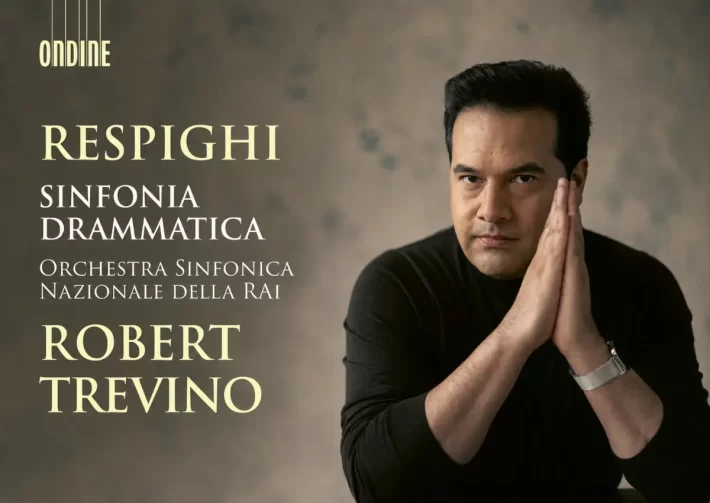
Respighi completed his Sinfonia drammatica in Rome in 1914, months before Italy entered the First World War. His first large-scale orchestral work, it runs to three sprawling movements and roughly an hour of music, and it has never matched the popularity of his later, overtly programmatic scores. The composer’s wife, Elsa, wrote in her biography that The Fountains of Rome (1916) was “the first entirely characteristic orchestral work by Respighi.” In an introductory note, conductor Robert Trevino observes that no one in the orchestra had played the piece before the recording sessions.
The discography is small: this release is only the work’s fifth recording. The first, from 1986, came from the Slovak Philharmonic Orchestra under Daniel Nazareth (Marco Polo, reissued on Naxos in 1999), an energetic account with solid orchestral playing that was later overshadowed by Edward Downes and the BBC Philharmonic in 1993, whose greater sophistication came captured in vivid Chandos sound. A 2015 performance by the Orchestra Sinfonica di Roma under Francesco la Vecchia (Brilliant Classics) takes slower tempos than its predecessors, but la Vecchia lacks a convincing sense of structure, leaving each movement episodic; the playing is ragged and the engineering disappoints.
In 2016, BIS released a thrilling performance by the Orchestre Philharmonique Royal de Liège and John Neschling, in excellent Super-Audio sound. Neschling commands both the music’s structure and its pessimistic trajectory, and that underlying bleakness may be one more reason for the work’s neglect.
The music makes more sense once you know Respighi’s state of mind as he wrote it. He had recently broken off an engagement and moved from Bologna to Rome, and in a letter of May 1914 he told a friend he was “going through a difficult time, a time of melancholy, of sadness and of loneliness … Oh! How I detest this city!” With the war closing in over Europe, the resulting music is deeply tragic, and Neschling’s reading conveys that sorrow most fully.
That brings us to the new recording. Trevino takes 24’38” over the first movement, against Neschling’s 22’49” and Downes’s 25’04”. The margins look small, but the broader tempo shows a willingness to savour the orchestral sound at the expense of momentum, and the softer middle section can feel a little listless.
The Chandos performance carries a weightiness that leans toward Strauss (especially in the opening minutes) and even Mahler, underlining those affinities in Respighi’s writing, though it also sits a touch heavy, without the buoyancy Trevino and Neschling find. Trevino clarifies textures well, yet Neschling’s reading is more transparent still; Trevino charts the emotional journey convincingly, but Neschling’s forward drive stays more consistently engaging.
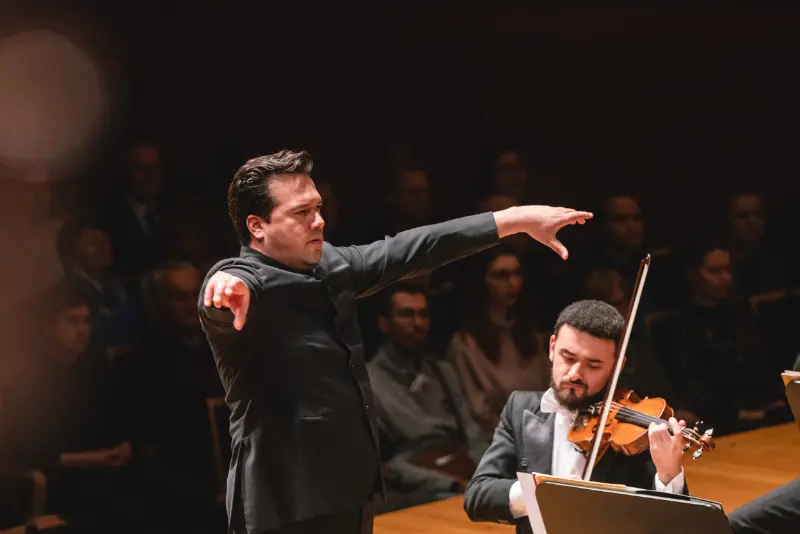
Conductor Robert Trevino.
Taking the middle movement more slowly than his colleagues, Trevino faces what is arguably the most pessimistic music in the work. Passages of quiet lyricism are broken off by the brass, the trombones especially, which seem to rage against any thought of acceptance or healing. By giving the music time, Trevino uncovers a lush lyricism that still feels more objective than the readings of Downes or Neschling.
Neschling conveys an ardour that suggests the pain is being felt in the present; Trevino places that anguish further in the past. I respond to this music most as a deeply personal expression of its composer’s suffering, though other listeners may find that Trevino’s cooler stance makes the expression feel more universal.
In the finale, Neschling and Trevino are evenly matched, though Neschling’s Coda is more brutally destructive, a horrifying premonition of the war to come. Trevino is no less affecting, and the intensity and power he draws from his Italian players makes one keen to hear their earlier album of Respighi’s Roman trilogy, released by Ondine in 2023.
In a recent review of Ondine’s new Sibelius cycle, I found their standard stereo engineering almost a match for the Super-Audio BIS sound of Osmo Vänskä’s Minnesota cycle. I can’t quite make that case here: Ondine’s engineering is very fine, but it doesn’t reach the sonic depth BIS gives Neschling. The BIS release also remains the only dedicated recording to pair the Sinfonia with another work, Respighi’s Belfagor overture. So, for all the excellent work of Trevino and the RAI orchestra, Neschling’s recording stays my first choice.
Album Details |
|
|---|---|
| Album name | Respighi: Sinfonia drammatica |
| Label | Ondine |
| Catalogue No. | ODE 1477-2 |
| Artists | Orchestra Sinfonica Nazionale della RAI; Robert Trevino, conductor |
