
This release marks the latest Sibelius symphony cycle led by Jukka-Pekka Saraste. His first, from the late 1980s and early 1990s on RCA and Sony Classical, features the Finnish Radio Symphony Orchestra and gathers several other orchestral works in a generously filled eight-CD boxed set. The second, released on Finlandia, captures the same orchestra’s 1993 live performances in St. Petersburg. The Helsinki Philharmonic Orchestra has itself recorded the cycle several times, most recently in 2006 under Leif Segerstam for Ondine. For comparison I limited myself to Saraste’s first cycle, Segerstam with Helsinki, Herbert Blomstedt with the San Francisco Symphony on Decca, Osmo Vänskä with the Minnesota Orchestra on BIS, and Santtu-Matias Rouvali’s Gothenburg Symphony Orchestra cycle on Alpha.

The opening of the Symphony No. 1 signals great things, the clarinet conjuring a forlorn, elegiac atmosphere. The remainder of the movement, and the entire symphony, shows considerable care for the score’s markings and dynamics. Here and throughout the cycle, Saraste shapes the music with convincing naturalness, letting it flow with organic inevitability. The playing is consistently beautiful, with transparent, balanced orchestral textures. This contrasts with his earlier recording, where the brass tends toward a steely brightness. Saraste also rarely resorts to the kinds of interpretative mannerisms often heard in Segerstam’s readings. Yet this new account of the first symphony never quite catches fire.
Many commentators argue the work shows Sibelius’s admiration for Tchaikovsky, a connection apparent in the luscious final tune of the last movement. Here, around the 8’55” mark, the music lacks the weight and intensity of the Blomstedt and Segerstam readings. Segerstam’s performance finds that Tchaikovsky-like passion. Saraste’s first recording may be more exciting, but its sound is murky, and the playing does not match the level heard in Helsinki.
The Symphony No. 2 brings the same virtues, now wedded to greater intensity and engagement. The first symphony is the only studio recording in the set; the others were captured live in concert, which may explain the change in atmosphere. Sampling the opening minutes of the finale reveals a main theme of sweeping ardor that felt missing from the first symphony.
This performance is over two minutes faster than Saraste’s first and almost four minutes faster than Segerstam, and the added momentum makes the reading more compelling. The coda sounds suitably grand without an interminable slowing in the final bars. Applause is retained, the first real indication of an audience.
The Symphony No. 3 is just as impressive. Saraste’s first recording was speedy at 27’30”, against Segerstam’s 29’14”, Vänskä’s 30’08”, and Rouvali’s 31’26”. Here he is a notch faster still, the lifted rhythms and buoyancy conveying a joie de vivre not normally associated with this composer. The sweetly sung Andante, graced with gorgeous woodwind playing, evokes the warm glow of midsummer rather than a wintery Nordic landscape. The clarity of inner detail, with woodwinds well forward, left me wondering whether Saraste admires Berglund’s final cycle with the Chamber Orchestra of Europe on Finlandia, where a smaller string section produces similar balances.
Karajan reportedly said that the pathos of the Symphony No. 4 left him exhausted for days. I sense similar angst in the Segerstam and Vänskä readings, while Blomstedt faces the tragedy with implacable stoicism. Neither of Saraste’s accounts finds the same desperate emotion, framing the struggle as personal rather than universal. It is a fascinating interpretation, though I think it slightly misses the composer’s intent.
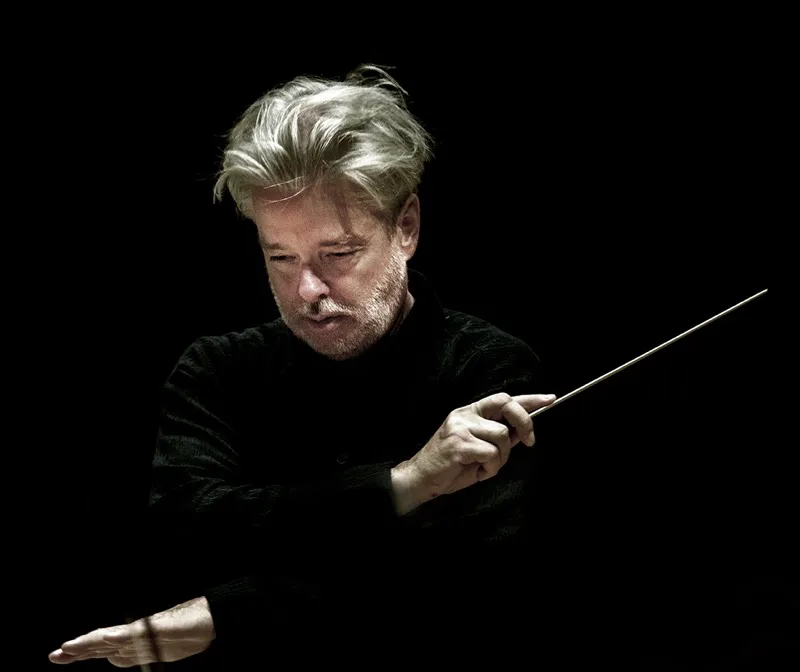
Jukka-Pekka Saraste. Photo © Felix Broede.
In the Symphony No. 5, the opening movement brings a wealth of detail, each tempo acceleration finely managed. In the coda, however, the brass and timpani feel too reined in; Blomstedt’s handling is just as detailed, and his coda carries overwhelming force. Saraste’s second movement improves on his earlier account, faster and lighter on its feet. But the emotional trajectory of the finale feels too middle of the road. Segerstam, Vänskä, and Rouvali all chart a deeper emotional journey, leaving Saraste’s coda underwhelming by comparison.
Saraste’s Symphony No. 6 is faster than any of the comparison recordings, yet it never feels rushed, nor does it skirt the music’s emotional weight. He charts the shifting moods and atmospheres with assurance, and the orchestra’s playing, telling in the soft passages, held my attention from first to last.
The Symphony No. 7 stays emotionally neutral. An optimism and lightness run through the reading, at odds with Simon Rattle’s description of the final measure as the most depressed C major in all of musical literature. Vänskä, like Saraste, finds more optimism here, but his reading is more poetic and convinces more fully.
Collectors may regret that Ondine has not recorded the series in Super Audio CD sound. Even so, Ondine’s engineering comes close to the high-resolution quality of BIS in Minnesota. The liner notes describe how Saraste has developed his interpretations over the years, including a striking reference to the experience and tacit knowledge passed down by Jussi Jalas, one of the first conductors of the Finnish Radio Symphony Orchestra and Sibelius’s son-in-law. This enjoyable set offers another fine prism on this music, and I will find a spot for it on my shelf.
Recommended Comparisons
Sibelius: The Symphonies
Saraste / Finnish Radio Symphony Orchestra | Segerstam / Helsinki Philharmonic Orchestra | Blomstedt / San Francisco Symphony | Vänskä / Minnesota Orchestra