Elgar composed his Variations on an Original Theme, Op. 36, between October 1898 and February 1899, building a set of fourteen orchestral portraits around a melody that came to him one evening at the piano. Each variation sketches a friend or family member — from his wife Caroline Alice to his publisher August Jaeger, whose portrait in the ninth variation, “Nimrod,” has become one of the most performed pieces in the orchestral repertoire. The work’s premiere under Hans Richter in June 1899 marked the moment Elgar entered the front rank of European composers.
Here are The Classic Review editorial team’s recommendations for the best recordings of Elgar’s Enigma Variations.
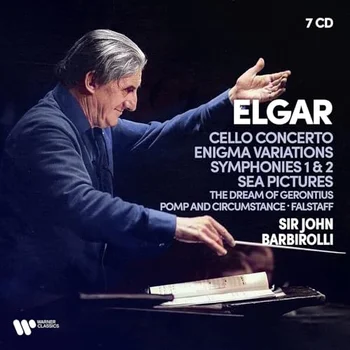
Philharmonia Orchestra, John Barbirolli
Recorded at Kingsway Hall in 1962 with the Philharmonia Orchestra at peak form, Barbirolli’s Enigma is at once deeply felt and structurally lucid. A former orchestral cellist who played under the composer’s baton, Barbirolli brings an intuitive feel for the warmth and contrapuntal richness of Elgar’s scoring. His emphasis on the interplay between instrumental voices gives each variation a vivid interior life, while the careful attention to lower strings lends the performance a characteristic depth and nobility.
London Philharmonic Orchestra, Adrian Boult
Having known Elgar personally and championed his music for decades, Boult brings an unmatched sense of authority to this 1970 recording with the London Philharmonic. His tempos are more spacious than those of some rivals, allowing room for the lyricism in each portrait to breathe. The characterisations are sharply drawn yet never overstated, with a particularly eloquent ‘Nimrod’ and a wistful, beautifully shaped ‘Romanza.’ Boult’s unpretentious manner lets the music speak with a directness that reflects a lifetime of familiarity with this score.
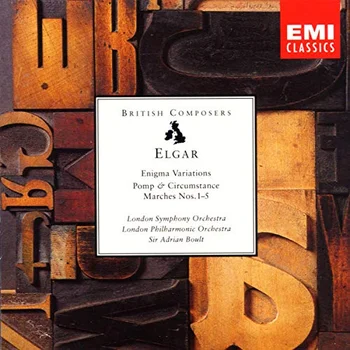
London Symphony Orchestra, Pierre Monteux
What distinguishes Monteux’s 1958 account with the London Symphony Orchestra is the naturalness of its phrasing and the personality he brings to every bar. His tempos feel ideally chosen, and there is an appealing atmospheric halo to the sound — captured by Kenneth Wilkinson at Kingsway Hall — that suits the music’s nostalgic character. ‘Nimrod’ opens at a true pianissimo before building to a passage of genuine radiance. Throughout, Monteux balances energy and charm with an unhurried directness, producing a reading that feels less like a formal interpretation and more like storytelling among friends.
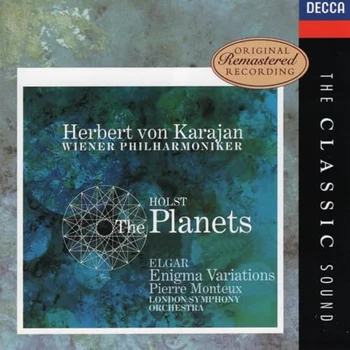
Chicago Symphony Orchestra, Georg Solti
Solti’s 1974 recording unleashes the full power of the Chicago Symphony Orchestra in a reading that emphasises brilliance and dramatic sweep. The brass playing is particularly striking, with a burnished weight that gives the climactic variations — ‘E.D.U.’ above all — an almost overwhelming impact. Solti keeps the rhythmic pulse taut and the textures lean, driving the music forward with an intensity that sets this account apart from more reflective readings. The Decca engineering captures the orchestra’s formidable dynamic range in vivid detail.
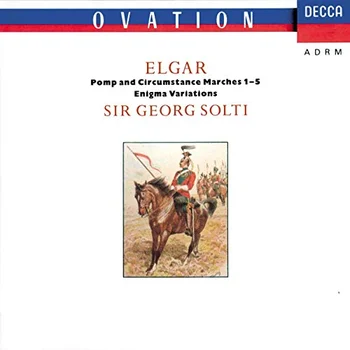
BBC Symphony Orchestra, Andrew Davis
Davis’s account with the BBC Symphony Orchestra crackles with energy from the outset, lending the opening theme a veiled, quietly searching atmosphere before launching into sharply characterised portraits. The forward momentum is maintained throughout without sacrificing the individuality of each variation, and the orchestral playing is both committed and idiomatic. Davis finds interpretive details that others overlook — the result of genuine engagement rather than routine. Recorded in 1991 for Teldec’s ‘British Line’ series, the sound is full-bodied and assertive.
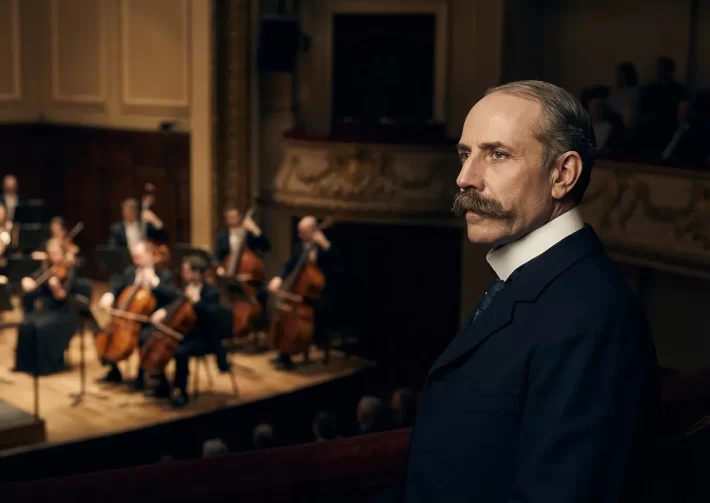
Top image ©️ The Classic Review, AI generated