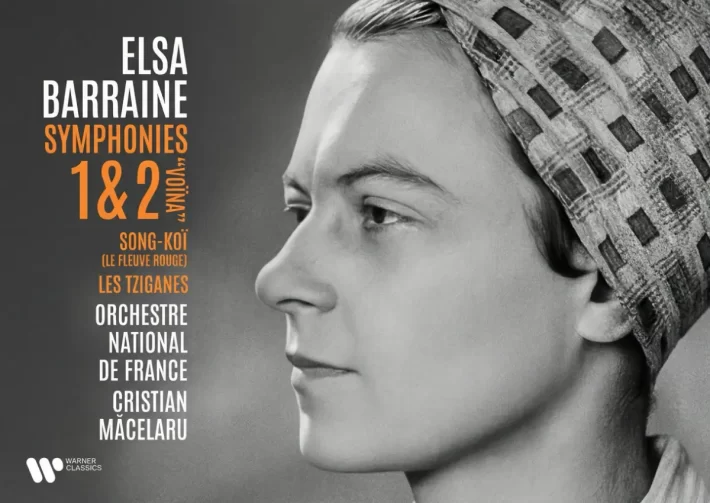
Last July the WDR Sinfonieorchester and Elena Schwarz released premiere recordings of these two symphonies on CPO. Now the same symphonies feature on this new album from the composer’s ‘hometown’ orchestra led by Cristian Măcelaru, which also includes premiere recordings of Song-Koï and Les tziganes.
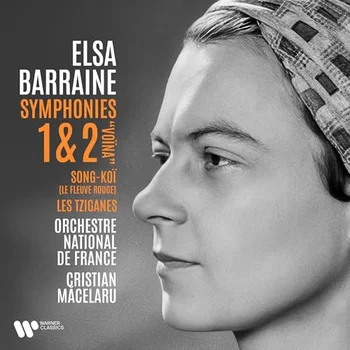
Born into a musical family (a pianist mother and principal cello at the Paris Opera father), Elsa Barraine entered the Paris Conservatoire at age nine, where she excelled in her studies. In 1925 she was awarded the Premier prix in harmony and two years later received the same award for counterpoint and fugue, and piano accompaniment. She then joined Paul Dukas’ composition class and in 1929 became the fourth woman to win the Grand Prix de Rome composition prize.
Barraine’s music employs a tonal harmonic language that nevertheless freely incorporates dissonance. Her refined and sophisticated orchestration clearly reflects Dukas’ influence. A penchant for angular melodic writing can yield to moments of achingly sweet lyricism. As a point of reference, her music inhabits the same sound world as Stravinsky (neo-classical period) and Poulenc, though she has her own distinct and impressive voice.
The album begins with Le Fleuve rouge (The Red River), a set of variations divided into eight brief movements. Inspired by Indochina’s struggle for independence, the ‘red’ of the title is most likely Barraine’s acknowledgement that the communist party led the fight. The various movements represent the river’s journey from its initial source to where it flows into the ocean. A ‘river’ theme is subjected to variations, though the composer offers no explicit program (as Smetana does for Vltava/Moldau in Má Vlast). If the music is not pictorial in the same way, it is certainly atmospheric, especially in this beautifully prepared performance.
Much of the first symphony (track 9) was composed during residency at the Villa Medici in Rome, though it was completed in Venice, 1931. The program notes, written for its 1937 premiere, describe the first movement’s introduction as grimacing and slow, followed by a furious allegro. The slow movement features a fast central section in which the brass ‘lampoons’ Beethoven’s Adelaide, answered by a “joyfully dancing” finale. Măcelaru leads an impeccably manicured performance that sounds cautious when compared to the earlier CPO recording. Schwarz’s first movement is faster and articulation is sharper, leaning into the angularity of the writing and its dissonances, whereas Măcelaru seems to soften the music’s edgier elements.
In Schwarz’s hands, the slow movement (8’46”) is urgent and impassioned; Măcelaru’s markedly different reading (10’34”) is more stoic and resigned. Both are convincing. The final Allegro giocoso e leggiero features excellent playing from both orchestras, though it is the WDR players who more successfully capturing the music’s humor.
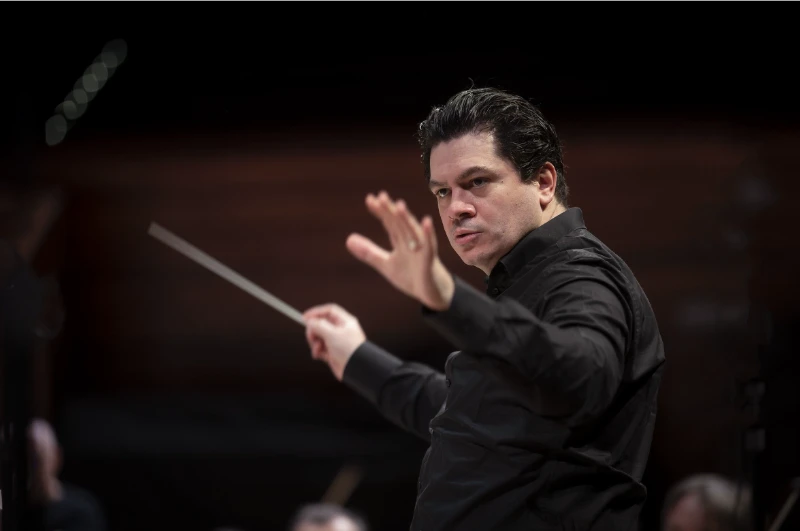
Cristian Măcelaru (© Radio France – Christophe Abramowitz)
The booklet notes for the new release suggest that the second symphony (subtitled ‘Voïna,’ Russian for ‘war’, track 12) has a clear program: “war in the first movement, death and bereavement in the second and finally a return to life in the third.” If this is indeed the case, its presence is subtle: readers looking for anything like Shostakovich’s vivid pictorialism are apt to be disappointed. This is, at least in part, because of Măcelaru’s preference for more rounded articulation, string-dominated balances, and precision over expression. Schwarz and the WDR unearth greater menace from the first movement; their slow movement is certainly funereal, though it never reaches the tragic expressionistic levels the work’s subtitle led me to expect.
Les Tziganes (The Gypsies, track 15) is the most extroverted piece in the album, and the Orchestre National de France make easy work of its especially virtuosic string writing. Again, the music’s ‘gypsy’ spirit is subtle, painted with watercolors versus the vivid oils used by Brahms, Liszt and (even) Ravel.
If I prefer Schwarz’s versions of the symphonies, I enjoyed hearing Măcelaru’s different interpretations, and I will want both in my library. The WDR/Schwarz recording also includes other works (Pogromes and Musique funèbre) that are well worth hearing. Barraine’s music rewards repeated listening, so the best solution is to own both recordings.
Recommended Comparisons
Elena Schwarz / WDR Sinfonieorchester Köln
Album Details |
|
|---|---|
| Album name | Elsa Barraine: Symphonies 1 & 2 |
| Label | Warner Classics |
| Catalogue No. | 2173255519 |
| Artists | Orchestre National de France, Cristian Măcelaru, conductor |