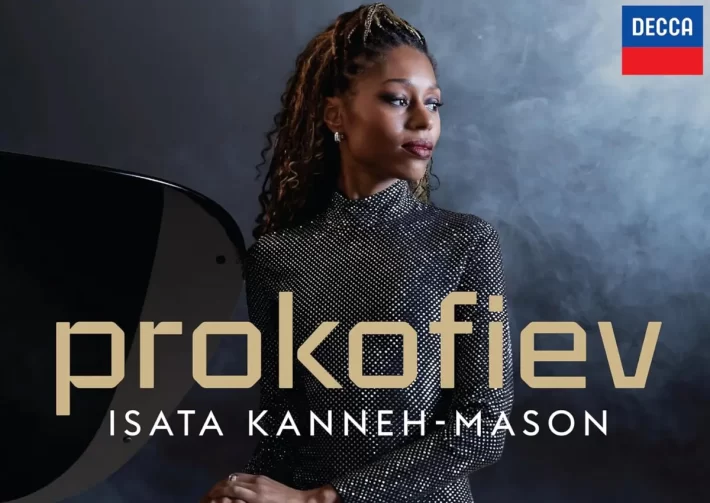
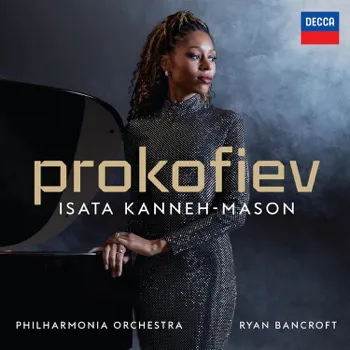
Isata Kanneh-Mason takes on Prokofiev‘s Piano Concerto No. 3 in C major with Ryan Bancroft and the Philharmonia Orchestra, in a generous program that also surveys the composer’s solo piano writing: the Toccata, the Prelude from 10 Pieces for Piano, the March and Scherzo from The Love for Three Oranges, selections from Romeo and Juliet and Cinderella, a piano version of Troika from Lieutenant Kijé, and the Piano Sonata No. 3 in A minor.
A combination of sardonic wit, nostalgic introspection, and something like electric abandon is needed to bring the concerto to life. The opening movement gets off to a promising start, the bustling energy well synchronized between soloist, conductor, and orchestra. Kanneh-Mason has an enviable technical command and tackles the challenging passagework with agility.
The reading is not only about scintillating fingerwork: about five minutes in, the dialogue between piano and bassoon carries an especially lovely vein of romanticism, and the relaxed tempo lets the intimacy of the exchange register.
A similar personal element emerges in the theme and variations of the middle movement. In the theme, the soloist finds mellow dynamic shades that pair beautifully with the flute’s line, though the tempo could flow a little more organically. Each ensuing variation is a character sketch in miniature, and Kanneh-Mason and the orchestra do solid work with the movement’s pointillistic urgency, somber lyricism, and cataclysmic discord.
The finale, like the first movement, is nicely rendered, but it tends to sit a little too long on some of the expansive sections; there are moments where the music could move along to preserve its momentum.
In some ways, the Piano Sonata No. 3 in A minor (track 17), an early twentieth-century showpiece, feels like the concerto in microcosm. The intensity we heard there makes itself felt at the sonata’s rousing finish and peak moments of chaos.
Given the high energy of the concerto, I was expecting comparable vitality in the solo instrumental program and ended up crestfallen: the overall impression errs on the refined side, not the most persuasive approach to Prokofiev’s Russian irony and tumult. The Toccata, Op. 11 (track 1) is precise and mechanical, as it should be, and shows Kanneh-Mason’s technical prowess; yet it feels a little too reined in throughout, and lacks the screaming chaos of the climactic sections — something Martha Argerich and Yuja Wang capture more vividly.
The March from The Love for Three Oranges (track 6) has a similar elegance that works well in the softer, more measured writing: we hear each note and chord in its well-balanced glory. In the more outgoing sections, though, the intensity falls short. The Scherzo (track 7), by nature more playful, suits her stylistic reading much better.
Kanneh-Mason portrays The Street Awakens (track 8) from Romeo and Juliet with innocence and peppy anticipation through crisp staccatos. Her Young Juliet (track 9) has a clear duality: in the outer sections she is spunky, hopeful, and a little headstrong, while the lyricism of the middle sections speaks to someone who dreams and reflects spontaneously.
I half-feared that Montagues and Capulets (track 10) might sound pale, as had been the case on some other tracks, but the stately dance arrives with assertion and austerity. The resonance of the heavy bass notes and the pronounced dotted rhythms is especially satisfying. Romeo and Juliet Before Parting (track 11) is rendered with a tenderness whose genuineness feels poignant given the lovers’ fate; the darker side of the story is felt in the disquiet Kanneh-Mason lets into the momentary dissonances.
Claire Jackson’s liner notes focus primarily on the concerto, which is somewhat odd given the generous sampling of Prokofiev’s other works on offer. In place of the standard artist foreword, the digital release closes with a short audio clip of Kanneh-Mason reflecting on her curation — a welcome addition.
The stylistic approach could use more vitality at times, but this remains a rewarding release, and the familiarity and finesse Kanneh-Mason brings to the music are never in doubt.
Album Details |
|
|---|---|
| Album name | Prokofiev: Piano Concerto No. 3 |
| Label | Decca Classics |
| Catalogue No. | 4871857 |
| Artists | Isata Kanneh-Mason, piano; Philharmonia Orchestra; Ryan Bancroft, conductor |