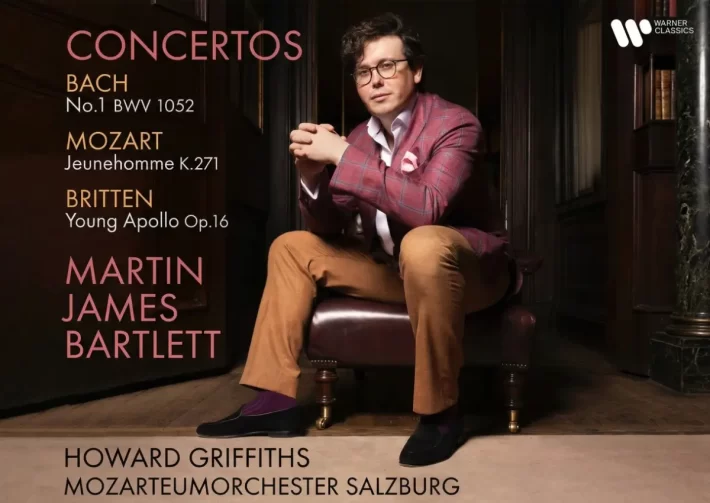
This is Bartlett’s fourth album. Winning the 2014 BBC Young Musician of the Year competition led to numerous engagements with orchestras throughout Britain and Europe, and in 2019 he signed a multi-album contract with Warner Classics. The program includes Bach’s Keyboard Concerto No. 1 (BWV 1052), Mozart’s Piano Concerto No. 9 (k. 271), and Britten’s Young Apollo (Op, 16).
The program opens with the Bach‘s Keyboard Concerto No. 1 in D minor. Despite some challenging quick tempos, passagework is clear, articulation is crisp, and there is an infectious joie de vivre in the outer movements. Griffiths and the players of the Mozarteum Orchestra Salzburg make excellent partners, matching Bartlett’s energy and clarity.
The orchestra plays modern instruments but adopts historically informed performance practices, so there is little real use of vibrato. That, along with a closely engineered recording that includes little room ambience, results in a string sound lacking the warmth and variety of colour found in performances by Perahia (Academy of St Martin in the Fields/Sony) and in the more recent album by Beatrice Rana (Amsterdam Sinfonietta/Warner Classics – review). And while the driven momentum of the outer movements is compelling, I wanted a more relaxed approach in the Adagio: Bartlett offers beautifully lyrical playing, but it misses some of the greater emotional depth found by Perahia and Rana.
Written in 1777, Mozart composed his ninth piano concerto for Victoire Jenamy, the daughter of Jean-Georges Noverre, a friend of Mozart and a ballet master. Listening to it, I am repeatedly struck by its innovative qualities: the piano’s entrance in the third bar of the first movement, interrupting the first full statement of the ritornello, and, in the final Rondeau (marked Presto), the sudden shift into a more delicate, sparkling minuet. Bartlett suggests in his notes that Mozart is honouring Noverre’s role as a ballet master.
Again, the outer movements feature playing of tremendous style and élan, and that minuet passage in the finale is beautifully managed. The balance between piano and orchestra is excellent, as is the soloist’s transparency and nimble articulation. But the slow movement is again too quick (Bartlett’s 8’40” versus Bavouzet’s 10’40” – review or Vogt’s 11’18”). I have nothing but praise for the beauty of tone and the chamber-music-like intimacy between soloist and ensemble. But I would argue that these same qualities distinguish Evren Ozel’s recording with the ORF Vienna Radio Symphony Orchestra, also led by Howard Griffiths (Alpha). That performance, however, features an orchestra with a larger string body that allows itself minimal vibrato, and Alpha’s engineering has a warmth that makes Bartlett’s reading seem almost clinical. Vogt’s slow movement, with the Orchestre de Chambre de Paris (Ondine), is utterly sublime.
Britten’s Young Apollo closes the program. Written in 1939, the music is a brilliant, almost brash display of extrovert virtuosity, perfectly suited to Bartlett’s technical prowess. The orchestration is impressive, but the music’s momentum is rather unrelenting, which is perhaps one reason Britten withdrew the work after only two performances. The piece was revived after Britten’s death and, in his notes, Bartlett explains that he plays from a new critical edition that “corrects numerous errors and omissions”, allowing us to hear the work as Britten intended.
Despite his obvious enthusiasm for and commitment to this music, the performance fails to convince me that Britten was wrong to withdraw the score. Part of my dissatisfaction comes from the chamber-sized orchestra, which lacks the power and weight the BBC Scottish Symphony Orchestra and Ilan Volkov provide for Stephen Osborne in his Hyperion recording.
Readers drawn to blazing technique and energetic tempos will surely love this album, and Bartlett is unquestionably a supremely gifted player. Nevertheless, I would not recommend these performances over those discussed above.
Recommended Comparisons
Bach: Perahia | Rana | Hewitt | Schiff
Mozart: Vogt | Bavouzet | Brendel | Uchida | Andsnes
Britten: Osborne
Martin James Bartlett, piano
Mozarteum Orchestra Salzburg & Howard Griffiths, conductor
Warner Classics 2173259344