Bartók wrote his Concerto for Orchestra in just under eight weeks during the late summer and early autumn of 1943, working at a Saranac Lake sanatorium in upstate New York while recovering from a serious illness. The score arrived after three near-silent years in American exile, where he had emigrated in 1940 to escape the spread of fascism in Europe and where his standing as a composer had largely stalled. Serge Koussevitzky’s commission, prompted by Joseph Szigeti and Fritz Reiner, did not simply produce a new piece but reopened a creative line that many feared was closed.
The work is cast in five movements and treats the orchestra as a federation of soloists rather than a single mass, a design Bartók himself described in concertante terms. The “Giuoco delle coppie” sends paired winds through the music at fixed intervals, the central Elegia sets shadowed night-music against shimmering harp and woodwind, and the “Intermezzo interrotto” interrupts a folk-tinted melody with a famously contested parody passage before the finale drives toward its fugal climax. Recordings respond to the score’s unusual layout in very different ways, ranging from analytical transparency to full symphonic weight.
Here are The Classic Review editorial team’s recommendations for the best recordings of Bartók’s Concerto for Orchestra.
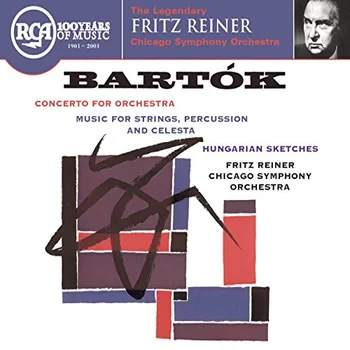
Chicago Symphony Orchestra, Fritz Reiner
Fritz Reiner’s 1955 recording remains the touchstone against which every other Concerto for Orchestra is measured. Its strengths are not folk warmth or theatrical heat, but analytical drive, rhythmic exactness and an orchestral transparency that still sounds remarkable seven decades later.
Reiner had been close to Bartók and helped urge the original commission, and the reading carries that authority without ever sounding ceremonial. The Chicago strings move with a precision that lets the fugal writing of the finale register cleanly, and the wind pairs in the Giuoco delle coppie are characterful without being caricatured. The Elegia is cool and exact rather than openly grieving, which is part of why the recording holds up to repeated listening. Coupled with Music for Strings, Percussion and Celesta and Hungarian Sketches, this is the strongest first choice for any listener building a Bartók library.
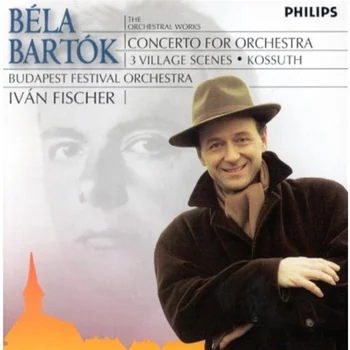
Budapest Festival Orchestra, Iván Fischer
In Iván Fischer’s hands, the Concerto for Orchestra sounds less like a showpiece and more like music drawn directly out of village speech and dance. This 1997 reading is not the most polished or the most overtly virtuosic on the list, but it is the one in which the folk roots of Bartók’s material are most clearly audible.
Where Reiner offers analytical drive, Fischer foregrounds inflection: rhythms lean and lift in the way village musicians shape them, and the wistful tune of the Intermezzo interrotto is sung rather than merely played. The Budapest Festival Orchestra responds with a sound that is bright but never brittle, and the Elegia has a quiet, ritual quality that few rivals match. Coupled with Three Village Scenes and Kossuth, the disc has long been one of the discographic touchstones for this work, and it remains the strongest choice for listeners who want the folk character of the music brought to the surface.
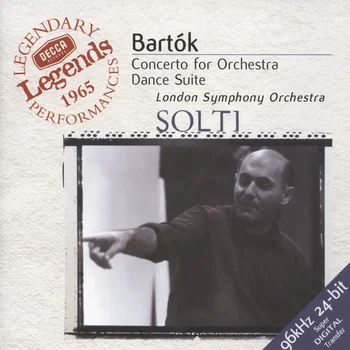
London Symphony Orchestra, Sir Georg Solti
Solti’s 1965 reading with the London Symphony Orchestra is the leaner, more dramatically direct of his two studio accounts of the work, and the one that has worn best. This is not the heavyweight orchestral statement of his later re-recording, but a vivid, propulsive performance that sits comfortably alongside Reiner’s analytical drive as a touchstone of the early-stereo era.
The London Symphony plays with attack and clarity rather than weight, and the wind pairs in the Giuoco delle coppie are characterful without being broadened into caricature. The Intermezzo interrotto moves more directly than Bernstein’s almost contemporary New York account, with the parody passage left to make its own point rather than underlined. The Elegia is shadowed but unsentimental, and the finale’s fugal climax is built on rhythmic precision rather than sheer volume. Coupled with the Dance Suite and the Miraculous Mandarin Suite, this is a strong choice for listeners who want a dramatic, forward-moving Bartók without the inflated scale of later studio readings.
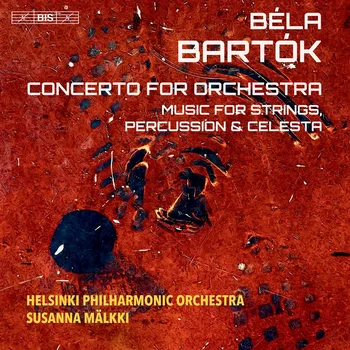
Helsinki Philharmonic Orchestra, Susanna Mälkki
The Helsinki Philharmonic’s 2021 recording brings the freshest perspective on the list and serves as the modern counterpart to Reiner’s 1955 touchstone. This is not a wholesale rethinking of the work, but a clarified, structurally lucid reading in which textures are kept open and inner lines are allowed to speak on their own terms.
Mälkki shapes the score for transparency rather than weight, and where Fischer foregrounds the folk inflection of Bartók’s material, she foregrounds its architecture. The Giuoco delle coppie is finely calibrated, with the wind pairs balanced so that the intervals between them register cleanly, and the Elegia is shadowed and exact rather than openly grieving. The Intermezzo interrotto is shaped without theatricality, the parody passage left to register on its own, and the finale’s fugal climax is built rather than hammered. Released as the third and final volume of her Bartók cycle with the orchestra, and coupled with Music for Strings, Percussion and Celesta, this is a worthwhile recent addition for listeners who want a cooler, more analytical view of the music.
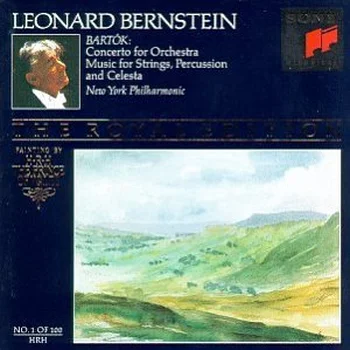
New York Philharmonic, Leonard Bernstein
Leonard Bernstein recorded the Concerto for Orchestra in 1959, in his second season as music director of the New York Philharmonic, and the reading has the heat and rhetorical commitment of a young conductor staking out repertoire. This is not the analytical, structurally lit Bartók of Reiner or Mälkki, but a frankly theatrical account in which gesture and contrast are foregrounded.
The New York strings dig in with a weight that suits Bernstein’s rhetorical approach, and the brass have a declamatory edge that he clearly relishes. The Intermezzo interrotto is the most overtly characterized of any reading on the list, with its parody passage played as a sardonic interruption rather than a structural episode, and the finale drives forward with rhythmic bite. The Elegia is dark and openly expressive, present but never heavy. Coupled with Music for Strings, Percussion and Celesta, this is a strong choice for listeners who want charisma and dramatic impulse rather than coolness or objectivity.
Top image ©️ The Classic Review, AI generated