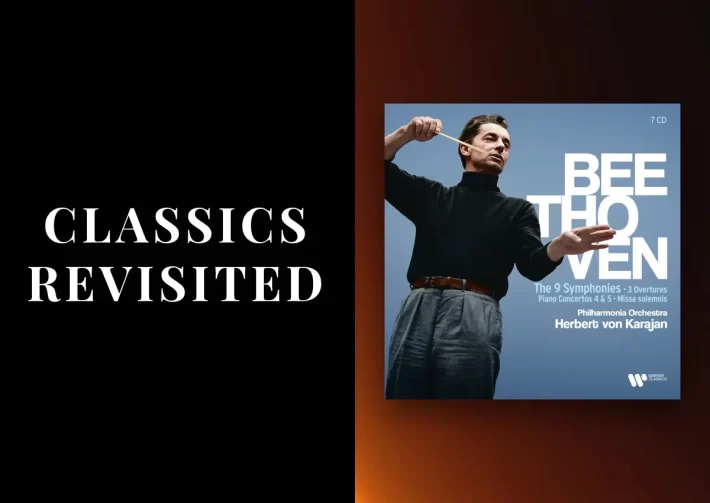
Karajan’s first complete Beethoven cycle, recorded with Walter Legge’s Philharmonia Orchestra between 1951 and 1955 and now reissued in a seven-disc box on Warner Classics, captures the conductor before the polished Berlin manner he became known for had taken hold. Seven decades on, the readings have not aged into archival objects.
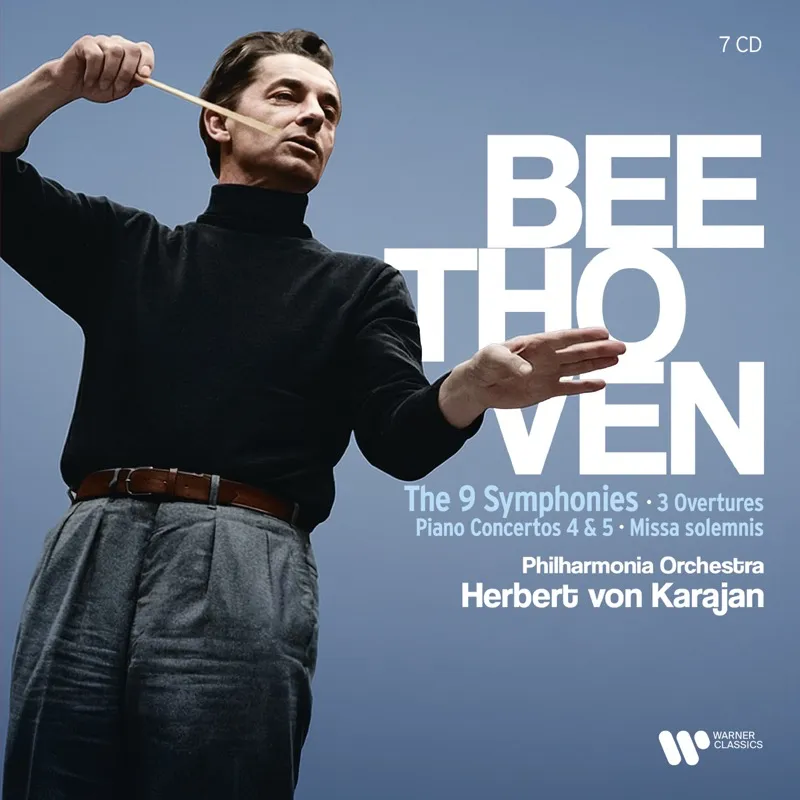
When Karajan booked Kingsway Hall in November 1951 to record Beethoven’s Symphony No. 7, he was forty-three and only beginning his real ascent. Walter Legge had founded the Philharmonia six years earlier as a recording orchestra for EMI Columbia; over the following four years, Legge produced the rest of the cycle in the same hall, with the Ninth decamping to the Musikverein in July 1955 to enlist the Wiener Singverein. The orchestra of these sessions was a chamber-virtuoso ensemble of named principals: Dennis Brain on horn, Bernard Walton on clarinet, Gareth Morris on flute, Sidney Sutcliffe on oboe.
The mid-1950s was a contested moment for Beethoven on disc. Furtwängler’s monumental, flexibly phrased readings on EMI/HMV stood for one tradition; Toscanini’s tight, fast, structurally driven NBC cycle on RCA stood for another. Erich Kleiber was assembling a partial Decca cycle in Vienna and Amsterdam, and Bruno Walter’s New York mono recordings were widely circulated. Karajan’s response, though not packaged with a manifesto, was a reading that took the precision of Toscanini and the breath of the Viennese tradition and let the Philharmonia’s wind-led transparency mediate between them.
The results are leaner and more rhythmically alive than any of Karajan’s three later DG cycles in Berlin. Tempi are brisk without sounding hurried; phrasing carries audible rubato that he would later flatten. The Eroica finale moves with a directness that early reviewers in 1953 preferred to Toscanini’s, and the slow movement of the Pastoral, recorded in the summer of 1953, has a lyrical inflection that the British press the following year placed above both Beecham and Kleiber.
In the Seventh, the dotted figure of the first movement bites, and the Allegretto keeps its tread without inflating. Brain’s horn calls in the Eroica‘s Scherzo and the Pastoral‘s peasant scene are still cited as among his finest moments on record. Brain died two years after the symphonic sessions finished, in September 1957.
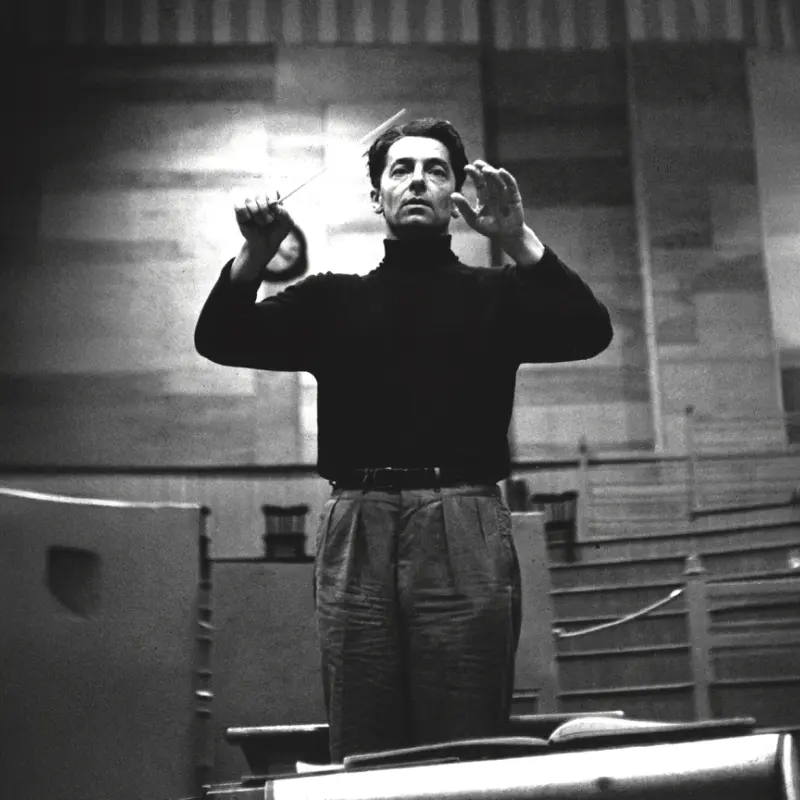
Herbert von Karajan in the 1950s.
Karajan recorded three more complete Beethoven cycles, all in Berlin and all for DG. The 1962 set is weightier and more legato than the Philharmonia readings, in the blended orchestral sound he refined for the rest of his career; the 1977 cycle is bigger and broader still, with a more monumental conception and a brass section that often dominates the texture; the 1984 digital cycle is the most polished but generally the least admired. The Philharmonia readings catch a sharper-edged Karajan, quicker to inflect a phrase and slower to smooth out an accent, and that is the central interest of the set.
Reception was strong from the start. British and U.S. reviewers praised the instalments as they appeared, singling out the Eroica (released summer 1953) as a benchmark, the Pastoral (1954) as the best then on disc, and the Fifth (late 1955) as comparable to any. The Penguin Guide carried three-star ratings into the CD era, and Richard Osborne, the veteran Karajan biographer, has long argued that this is the conductor’s most musically alive Beethoven. The 1962 Berlin cycle remains the more commonly cited Karajan Beethoven; the Philharmonia set sits behind it as a serious alternative that has continued to attract reissues and reassessment.
The Warner Classics edition presents the cycle in the 2014 Abbey Road remastering of the original tapes. The Kingsway Hall mono has the warmth and orchestral perspective for which Legge’s productions were known: strings present, winds clearly placed, brass full but unforced. The Vienna Ninth carries the bloom of the Musikverein and a touch of the hall’s lower-mid resonance (the timpani tends to be boomy). The 1955 Eighth and Ninth and the 1958 Missa solemnis used Legge’s experimental stereo equipment alongside the standard mono masters and now appear in their stereo mixes; the spread is narrow by modern standards, but the depth and instrumental separation are realistic enough, and the Missa‘s choral writing benefits especially. The soloists, though, sound far away from the mics.
Around the symphonies the box adds three overtures (Egmont, Leonore No. 3, Coriolan) and the last two piano concertos with Walter Gieseking, retouched at Art & Son in 2022 and sounding a shade more present than the symphonies. Revisited in 2026, the cycle holds up as a clear alternative to the more frequently named Berlin readings: leaner, sharper-edged, and quicker to move.
Recommended Comparisons
Karajan (1962) | Karajan (1977) | Karajan (1984) | Klemperer | Furtwängler
Album Details |
|
|---|---|
| Album name | Beethoven: The 9 Symphonies, 3 Overtures, Piano Concertos 4 & 5, Missa solemnis |
| Label | Warner Classics |
| Catalogue No. | 5026854276700 |
| Artists | Herbert von Karajan, conductor; Philharmonia Orchestra; Walter Gieseking, piano; Elisabeth Schwarzkopf, soprano; Marga Höffgen, contralto; Ernst Haefliger, tenor; Otto Edelmann, bass; Christa Ludwig, mezzo-soprano; Nicolai Gedda, tenor; Nicola Zaccaria, bass; Chor der Gesellschaft der Musikfreunde in Wien; Singverein der Gesellschaft der Musikfreunde |