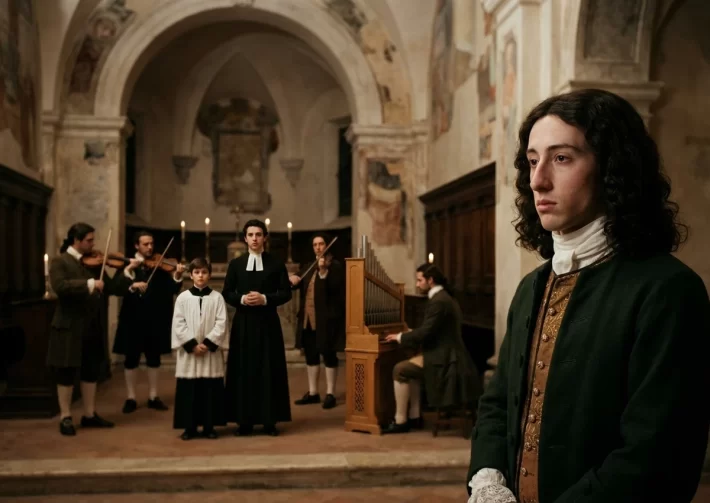
Pergolesi‘s Stabat Mater was written in 1736, during the final weeks of the composer’s short life. He was only twenty-six, already seriously ill, and had withdrawn to a Franciscan monastery in Pozzuoli, near Naples. The work quickly became one of the most widely circulated sacred pieces of the eighteenth century, admired not for grandeur or liturgical weight, but for the directness with which it brings operatic expressivity into a devotional setting.
The scoring is unusually intimate: soprano and alto soloists, two violins, viola and continuo, with no choir and no wind instruments. The twelve movements alternate between duets and solo arias, moving from the suspended grief of the opening “Stabat Mater dolorosa” to the quieter resignation of the final “Quando corpus morietur.” As in much Italian sacred music of the period, the original vocal forces would almost certainly have used male singers; modern recordings have responded to that fact in different ways, from soprano-and-countertenor pairings to more traditional soprano-and-mezzo combinations.
Here are The Classic Review editorial team’s recommendations for the best recordings of Pergolesi’s Stabat Mater.
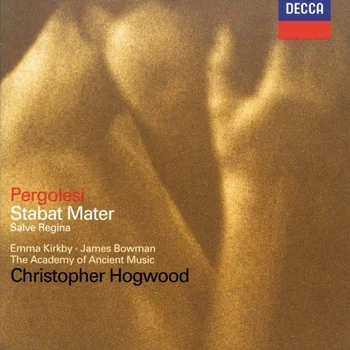
Emma Kirkby, James Bowman, Academy of Ancient Music, Christopher Hogwood
Christopher Hogwood’s 1988 recording remains one of the most persuasive period-instrument accounts of the work. Its virtues are not theatrical intensity or overt sorrow, but poise, clarity and a kind of devotional restraint that suits the score particularly well.
Emma Kirkby’s soprano is pure without sounding anonymous, and James Bowman’s countertenor brings warmth without over-darkening the texture. Their blend in the opening duet is one of the recording’s lasting strengths: the dissonances register clearly, but the line is never burdened by expressive underlining. Hogwood’s Academy of Ancient Music keeps the string sound light and articulate, with continuo support that is present but never heavy. The result is a reading that helped define how the work could sound on period instruments, and it still wears its scholarship lightly.
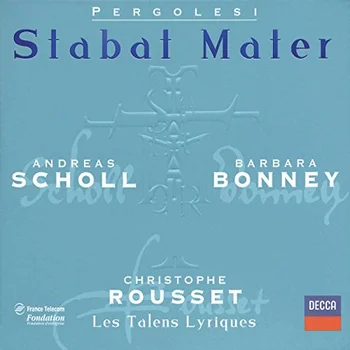
Barbara Bonney, Andreas Scholl, Les Talens Lyriques, Christophe Rousset
Christophe Rousset’s recording with Les Talens Lyriques offers a more polished, vocally luxurious view of the Stabat Mater. It is historically aware, but less austere than Hogwood, with a smoother surface and a stronger sense of vocal beauty.
Barbara Bonney and Andreas Scholl are especially well matched. Bonney’s bright lyric soprano and Scholl’s even, finely controlled countertenor meet in the duets without forcing contrast for its own sake. “Quis est homo” and “Sancta Mater” are shaped as inward exchanges rather than scenes of operatic confrontation, and Rousset supports them with playing that is lean but not dry. The continuo has enough weight to give the slower numbers gravity, while the strings retain a fine, silvery edge. It is one of the most balanced modern accounts: elegant, controlled and deeply musical without becoming precious.
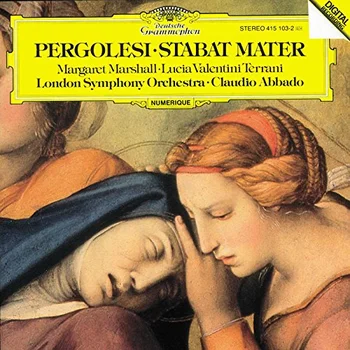
Margaret Marshall, Lucia Valentini-Terrani, London Symphony Orchestra, Claudio Abbado
Claudio Abbado’s 1983 recording is the strongest choice for listeners who prefer a fuller, modern-instrument sound. It does not try to turn Pergolesi into a large-scale sacred drama, but it allows the music a warmth and breadth that period-instrument readings often avoid.
Margaret Marshall’s clear soprano is set against Lucia Valentini-Terrani’s darker mezzo-soprano, and that contrast gives the duets a more human, dramatic profile. Abbado keeps the London Symphony Orchestra strings on a chamber scale, but the sonority is broader and more rounded than in Hogwood or Rousset. The slower movements have an unforced seriousness, particularly “Vidit suum dulcem natum” and “Eja Mater fons amoris,” while the closing “Quando corpus morietur” is shaped with quiet dignity. It is not the most historically pointed performance, but it remains one of the most affecting.
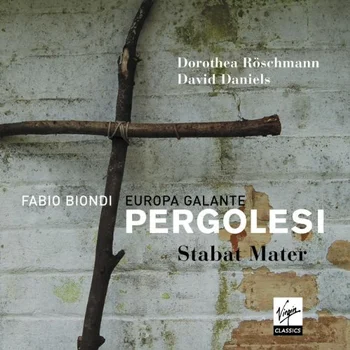
Dorothea Röschmann, David Daniels, Europa Galante, Fabio Biondi
Fabio Biondi’s recording with Europa Galante brings the work closer to the opera house. That approach can easily become exaggerated in Pergolesi, but here the dramatic impulse is mostly kept under control, and the small forces give the performance immediacy rather than heaviness.
Dorothea Röschmann’s soprano has a richer, more rounded presence than many singers in this work, and David Daniels’s countertenor supplies a cleaner, more contained line beside her. The contrast between them is part of the performance’s character: the duets feel less like blended prayer than an emotional dialogue. Biondi’s continuo group, with theorbo and organ, adds color and momentum, and the single strings sharpen the harmonic tension. This is not the most meditative Stabat Mater, but it is one of the most vivid, especially for listeners drawn to the work’s theatrical undercurrent.
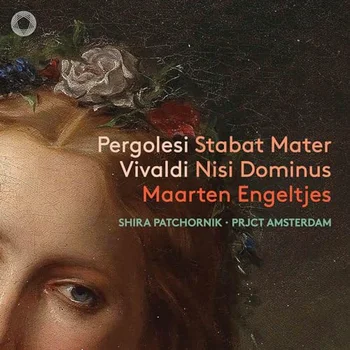
Shira Patchornik, Maarten Engeltjes, PRJCT Amsterdam
PRJCT Amsterdam’s 2024 recording brings a recent perspective without trying to remake the work. The ensemble, founded around countertenor Maarten Engeltjes, favors transparency, quick responses and a close relationship between the voices and the instrumental line.
The pairing of Engeltjes with Israeli soprano Shira Patchornik is the recording’s main distinction. In the opening duet, the two voices are so closely balanced that the grief of the text seems to emerge from a single line rather than from two soloists in dialogue. The small ensemble keeps textures open, allowing suspensions and resolutions to speak clearly without being exaggerated. Tempos are generally on the swift side, especially in the alto numbers, but the final “Quando corpus morietur” is allowed to settle rather than simply press forward. Coupled with Vivaldi’s Nisi Dominus, this is a fresh and finely focused account, and a worthwhile modern addition to the discography. — Read the full review of this album here.
Top image ©️ The Classic Review, AI generated