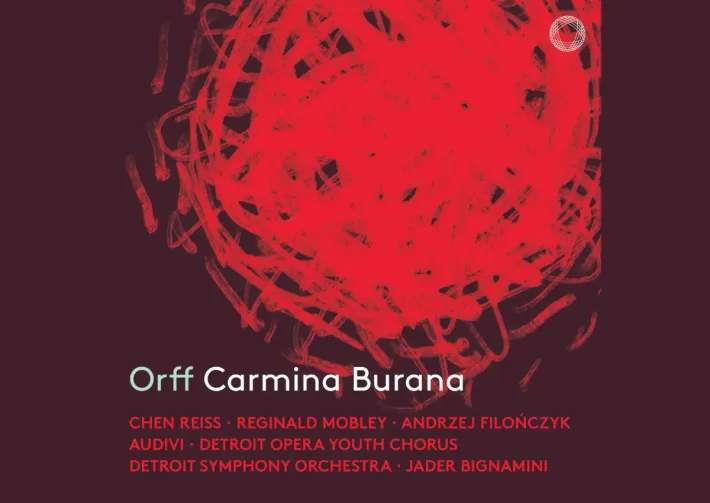
Let me say straight away that this is a very good performance of Carmina Burana. The choral singing is excellent, the singers balanced well forward so we hear them at every dynamic level. The soloists sing well, each having clearly thought about the text and its characterization. The orchestra plays with energy and exactitude. The wide, deep soundstage lets us hear its tummy-rumbling power at climaxes, but there are quieter moments where the ensemble and solo playing is finely turned. The different components come together in the second part (In Taberna) and through much of the third (Cour d’amours). Conductor Jader Bignamini has a sharp vision of how this music should sound, and has convinced his performers to realize it.
But his interpretation too often strays from what Orff intends. Some tempos are slower than they should be, but more troubling is Bignamini’s unwillingness to generate enough forward momentum. Readers might argue that this is an issue of personal preference, and it is true that all this listener’s favorite performances of Carmina take under an hour (Bignamini takes just under 61 minutes). But there is a reference recording, endorsed by the composer, which should perhaps serve as a guide for how this music is meant to be performed.
Orff was present for Eugen Jochum’s 1967 DG recording with the Chorus and Orchestra of the Deutsche Oper Berlin and three stellar soloists. It has remained in the catalogue ever since, rightly hailed as a classic. That is, at least in part, because Orff was thrilled by the drive and rhythmic verve of Jochum’s interpretation, which takes less than 56 minutes. Jochum highlights the music’s primitivism, the purposeful stripping away of sophistication in favor of raw, elemental force. Orff’s incessant ostinatos and percussive orchestration create earthy, visceral energy, and Jochum understands that, even if the 1960s sound cannot capture it all as well as a digital recording.
Bignamini, on the other hand, often seeks to add sophistication back into the score, to make it more profound than Orff intends. Compare his opening chorus with performances by Ozawa and Rattle (Philips/Universal and Warner Classics). Neither conductor is significantly faster than Bignamini, but both push forward in a way that creates a frenetic atmosphere that makes the Detroit performance seem cautious.
Bignamini’s second movement is not significantly slower than Ozawa, Rattle, Blomstedt (Decca) or Muti (Warner Classics), but his more legato phrasing and articulation weigh the music down. And in the sixth-movement orchestral dance, he suddenly slows for the flute and timpani duet — why? The flute playing is beautiful, but are beauty and shapeliness what the composer wanted? Again, it strikes me as adding sophistication to music that is expressly meant to reject that quality.
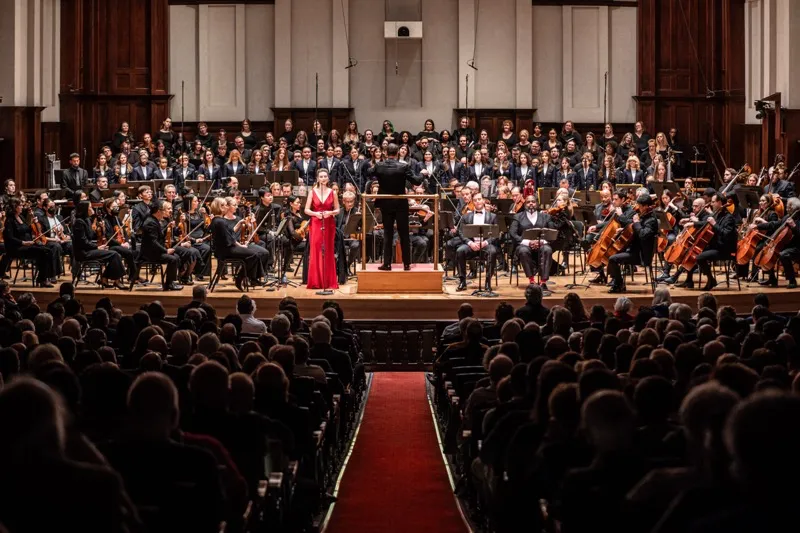
The Detroit Symphony Orchestra. Photo © Sarah Smarch.
The use of a countertenor (Reginald Mobley) instead of a tenor also goes against the score. The tessitura of “Olim lacus colueram” is infamously high for a reason — the swan is lamenting that it is being roasted to death over a fire. Most tenors sound uncomfortable singing it, which is exactly what Orff wanted. Mobley, by contrast, sounds too beautiful. Baritone Andrzej Filończyk offers vivid characterization, painted in bold colors, but Fischer-Dieskau (Jochum), Hampson (Ozawa) and Gerhaher (Rattle), all of them excellent Lieder singers, find greater textual expression. And in the final movements (tracks 21–23), soprano Chen Reiss lacks the vocal mastery that makes Gundula Janowitz (Jochum) and, most especially, Arleen Auger (Muti) so ravishing.
The strongest part of the performance is the choral and orchestral work, though I cannot say it betters what we hear from San Francisco (Blomstedt), London (Muti), or Berlin (Ozawa and Rattle). Pentatone’s engineering is truthful and makes no effort to turn the production into a ‘sonic blockbuster.’ First-rate liner notes often point the reader toward the text, yet this booklet offers neither text nor translation. In an already crowded field, this very good performance does not challenge existing recommendations.
Album Details |
|
|---|---|
| Album name | Orff: Carmina Burana |
| Label | Pentatone |
| Catalogue No. | PTC5187519 |
| Artists | Chen Reiss (soprano), Reginald Mobley (countertenor), Andrzej Filończyk (baritone), Audivi, Detroit Opera Youth Chorus, Detroit Symphony Orchestra; Jader Bignamini, conductor |