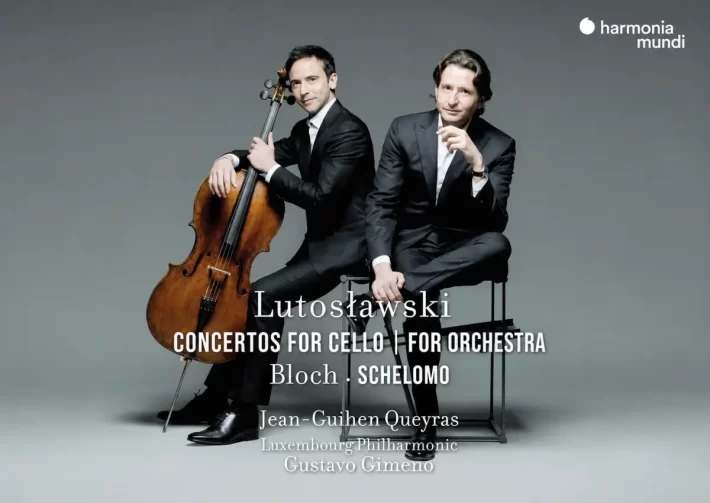
Having enjoyed Gimeno’s recent recordings of Bartók (Toronto SO/Harmonia Mundi – review) and Messiaen (Toronto SO/Harmonia Mundi – review), I was keen to hear this new album with the Luxembourg Philharmonic, where Gimeno served as Music Director from 2015–2025. This same artistic team released an all-Dutilleux album in 2024 that included Tout un monde lointain played by Jean-Guihen Queyras. That work, like the concerto on this new release, was written for and premiered by Mstislav Rostropovich.
Concerto for Orchestra is the best-known work from Lutosławski‘s early period: the harmonic language is dissonant but tonal, with melodic writing that reflects his study of Polish folksong and the use of older Baroque and Classical forms. The bass drum thwack that opens the Intrada has tremendous impact, signaling a wide and deep soundstage. The layered contrapuntal string entries that follow show Gimeno’s care for textural transparency, though I wanted more snarl from the brass interjections. Indeed, throughout the concerto there were moments where I craved a more garish response from the brass, though the orchestra’s gossamer colors around 5’12” are sensually impressive.
The scurrying Capriccio highlights the unanimity of the orchestra’s playing, and Gimeno is sensitive to the darker, mysterious notturno e arioso passages. The Passacaglia has an organic flow and good characterization, though at 16’21” it lacks the driving momentum found in the faster performances by the composer (Polish RSO/Warner Classics); Tortelier (BBC Philharmonic/Chandos); and Dohnányi (Cleveland SO/Decca).
The compositional style of the Cello Concerto (1970) is entirely different, the writing far more dissonant (including the use of quarter tones) and contrapuntal. It also features Lutosławski’s aleatoric (sometimes referred to as ‘controlled chaos’) technique. From its inception, the composer claimed it was pure, abstract music, but this has not stopped people (including Rostropovich) from suggesting that the almost constant strife between soloist and orchestra represents the individual’s struggle for freedom within an oppressive political system (a situation which both musicians experienced).
The Introduction opens with the soloist’s personal musings around a repeated D, but conflict begins when the cello is chastised by angry trumpets. I must acknowledge that I connect with this music more readily through the unauthorized program; as abstract art, it is less compelling. Rostropovich’s recording, with the Orchestre de Paris conducted by the composer, is an obvious reference performance against which every subsequent release is compared. It is not that every soloist must match Rostropovich’s ‘larger than life’ persona, but there must be a palpable connection with and commitment to this difficult music. I find that in three other readings: Pieter Wispelwey (Netherlands RPO/van Steen/Channel Classics), Paul Watkins (BBC SO/Gardner/Chandos), and Andrzej Bauer (Polish NRSO/Wit/Naxos).
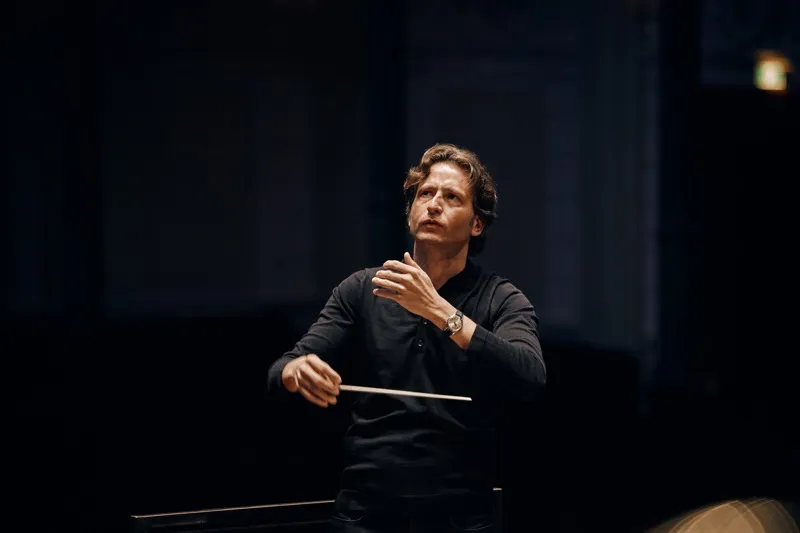
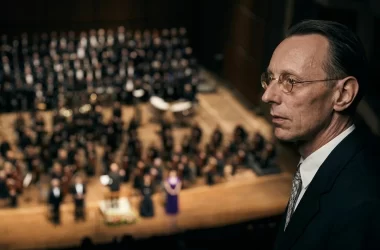
Gustavo Gimeno. Photo © Anne Dokter.
Wispelwey is especially good at capturing the music’s shifts in atmosphere, and his gorgeous playing in the Cantilena even outshines Rostropovich. Queyras’s technique is beyond reproach, and his reading has plenty of character (as do the orchestra and conductor). Nevertheless, the reading is not as uniquely compelling as those others listed, and both Wit and Gardner inspire greater drama and character from their orchestras.
Ernest Bloch‘s Schelomo is based on music originally intended for King Solomon in an unfinished opera, Jezabel. Nicholas Reyland’s liner notes tell us that the cellist Alexandre Barjansky convinced Bloch the cello “could convey Solomon’s meditations ‘just as expressively, if less specifically,’ freeing the depiction from language.”
This is sumptuous, emotionally extroverted music. Rostropovich’s reading with Bernstein and the Orchestre National de France (Warner Classics) is considered a classic recording, though I find Bernstein’s effort to wring every ounce of emotion from the performance draws attention away from the music. My favorite performance (also on Warner) features Steven Isserlis, accompanied by the London SO under Richard Hickox. Queyras’ reading is similarly moving, if more inward looking than Isserlis or Sol Gabetta (Orchestre National de Lyon/Slatkin/Sony Classical), and Gimeno ensures that the complexity and richness of the orchestral part is more than mere accompaniment.
In short, these are exceptionally fine performances, which nonetheless fail to displace current frontrunners.
Recommended Comparisons
Lutosławski: Concerto for Orchestra
Lutosławski / Polish Radio Symphony | Tortelier / BBC Philharmonic | Dohnányi / Cleveland Orchestra | Barenboim / Chicago Symphony
Lutosławski: Cello Concerto
Mstislav Rostropovich | Pieter Wispelwey | Paul Watkins | Andrzej Bauer
Bloch: Schelomo
Mstislav Rostropovich | Steven Isserlis | Sol Gabetta | Yo-Yo Ma
Album Details |
|
|---|---|
| Album name | Lutosławski: Cello Concerto, Concerto for Orchestra – Bloch: Schelomo |
| Label | Harmonia Mundi |
| Catalogue No. | HMM902714 |
| Artists | Jean-Guihen Queyras (cello), Luxembourg Philharmonic, Gustavo Gimeno (conductor) |