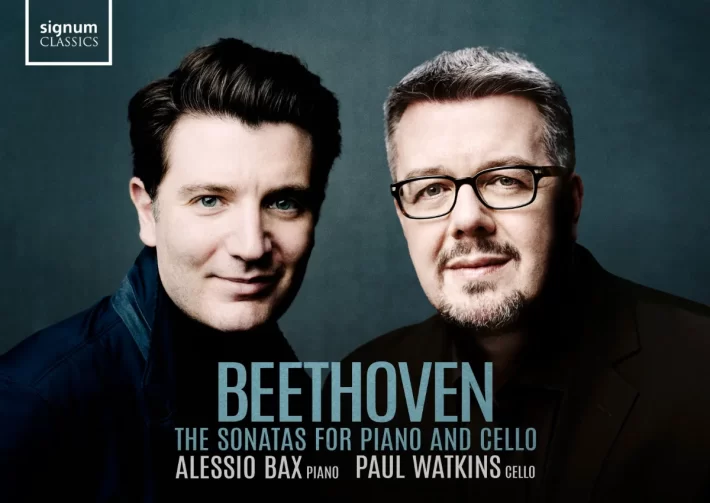
Paul Watkins and Alessio Bax’s complete set of Beethoven‘s Cello Sonatas follows a succession of notable cycles reviewed in these pages in recent years, including those by Leonard Elschenbroich and Alexei Grynyuk (2019), Marc Coppey and Peter Laul (2019), Yo-Yo Ma and Emanuel Ax (2021 – review), and Alisa Weilerstein and Inon Barnatan (2022 – review). While some of these pieces may not be the most prominent of the composer’s chamber works, they remain an essential gem. In this new recording, Watkins and Bax offer a compelling journey through Beethoven’s stylistic evolution, effectively tracing his development across his three distinct periods.
The Sonata in F Major, Op. 5 No. 1 establishes a strong foundation for the cycle, with the warmth of Watkins’s tone beautifully mirrored in Bax’s keyboard approach. While such resonant warmth in a classically oriented work might invite scrutiny, the duo navigates the inherently static nature of the Adagio Sostenuto with ease. They prevent the phrasing from stagnating by applying varied dynamic shading and a remarkably smooth legato. As the tempo accelerates in the Allegro, the underlying lyricism is recast within a buoyant framework that evokes the optimism of the “Spring” Violin Sonata, Op. 24.
This movement allows the piano to come to the forefront, and Bax maintains an idiomatic grace while injecting necessary energy into the rapid passages. Watkins complements this refreshing character with precise ornamentation and highly articulate bowing. The concluding Rondo further intensifies their approach, as the articulation from both musicians sharpens, and a touch of roughness in Watkins’s technique proves well-suited to the brisk pacing.
Turning to the Sonata in G minor, Op. 5 No. 2, the musicians seamlessly capture its inherent Sturm und Drang character. True pathos and gravitas emerge in the solemn Adagio, where Watkins leverages the full weight of the cello to underscore the music’s linear intensity. The subsequent Allegro unfolds as a cohesive, deeply engaged discourse between piano and cello; their seamless call-and-response exchanges point to a profound familiarity between the two performers. Eventually, a subtle, dance-like sway lightens the prevailing mood, smoothly paving the way for the arrival of the brighter Rondo.
The Sonata in A Major, Op. 69, stemming from the height of Beethoven’s middle period, marks a distinct shift toward a more orchestral sound profile that the duo eagerly embraces. Watkins’s opening cello solo in the Allegro signifies a clear transition from youthful exuberance to a more mature, declamatory stance, while Bax concurrently adopts an ensemble-driven sonority. Together, their partnership yields greater dimensionality and an expanded expressive range, qualities most evident in the Scherzo. Even as they navigate the sharp alternations between the assertive minor and playful major sections, the contrasting characters remain fully integrated. Their boldness is consistently tempered by delicate touches of grace, resulting in a performance of striking emotional unity.
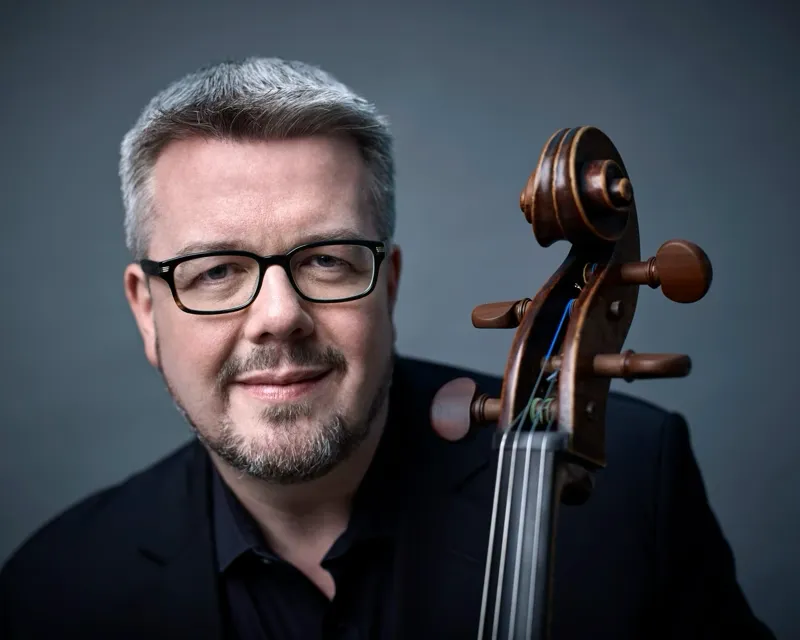
Paul Watkins. Photo © Jürgen Frank.
Moving into the late-period works, the Sonata in C Major, Op. 102 No. 1 reveals an even further broadening and deepening of sentiment. The declamatory style achieves profound maturity in Watkins’s opening solo, where his use of rich vibrato imparts a distinctly vocal quality to the cello. While maintaining an overarching sense of nobility, the duo never shies away from quintessential Beethovenian elements, leaning into subito dynamic shifts and the dogged insistence of the triplet figures in the Allegro vivace.
What truly distinguishes this interpretation is its remarkable clarity: synchronized contrapuntal passages are flawlessly precise, and the musicians treat silence with the same reverence as sound. By clearly demarcating the rests, they ensure that every note carries intentional, enduring significance.
The final Sonata in D Major serves as a deeply satisfying conclusion to the preceding performances. Its slow movement stands out as a pinnacle of artistry, with the duo’s profound approach underscoring the wisdom and quiet contemplation that define Beethoven’s late-period writing.
Ultimately, the high-quality sound engineering further elevates these five readings, magnifying a performance already distinguished by its depth, sensitivity, and formidable musicianship. Even within an extensive catalogue of Beethoven cello sonatas, this contribution from Watkins and Bax stands out as a substantial and worthy addition.
Recommended Comparisons
Beethoven: Cello Sonatas
Yo-Yo Ma, Emanuel Ax | Alisa Weilerstein, Inon Barnatan | Pierre Fournier, Wilhelm Kempff | Jean-Guihen Queyras, Alexander Melnikov
Album Details |
|
|---|---|
| Album name | Beethoven: The Sonatas for Piano and Cello |
| Label | Signum Classics |
| Catalogue No. | SIGCD969 |
| Artists | Paul Watkins (cello), Alessio Bax (piano) |