Gabriel Fauré composed his Requiem in stages between 1887 and 1890, during his years as choirmaster at the Madeleine in Paris. The first version was heard at the church on 16 January 1888, when the composer was forty-two. Often called “a lullaby of death,” the work has been valued ever since not as a dramatic confrontation with judgement, but as a meditation on consolation.
More Best-Of Guides
The Requiem is cast in seven movements and famously omits the Dies irae, moving from the Introit et Kyrie through the Pie Jesu and Agnus Dei to the closing In paradisum. Fauré revised the scoring twice. The 1888 chamber version uses a small ensemble with no violin section and no woodwind, the 1893 reworking expands those forces modestly while keeping the chamber character, and the 1900 publication adds full violins, woodwind and brass. Modern recordings have responded to those choices in different ways, from lean chamber readings to the broader symphonic version that defined the work through the twentieth century.
Here are The Classic Review editorial team’s recommendations for the best recordings of Fauré’s Requiem.
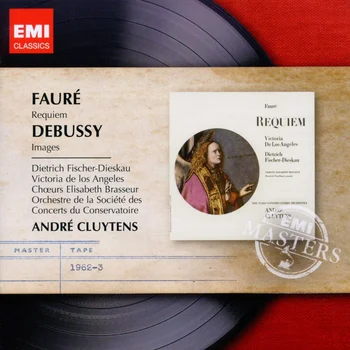
Victoria de los Ángeles, Dietrich Fischer-Dieskau, Société des Concerts du Conservatoire, André Cluytens
André Cluytens’s 1962 recording is the historic reference for Fauré’s full-orchestra version of the Requiem, and the only reading on this list to use the 1900 score. Its strengths are not chamber intimacy or HIP austerity, but breadth, weight and the kind of unhurried French choral phrasing that the work’s later chamber-scale advocates have largely set aside.
Victoria de los Ángeles brings a warm, slightly veiled soprano to the Pie Jesu that sounds consoled rather than childlike, and Dietrich Fischer-Dieskau’s Libera me is grave without ever turning operatic. The Chœurs Élisabeth Brasseur sing with a soft-grained, idiomatic French tone that Tenebrae and the Corydon Singers (see below) can match for polish but not for native inflection. Tempos are broad, the Sanctus opens out with real symphonic glow, and the closing In paradisum settles on the harp figuration without pressing forward. It is the symphonic-version reference in the catalogue, and the standard against which the four chamber-version readings on this list define themselves.
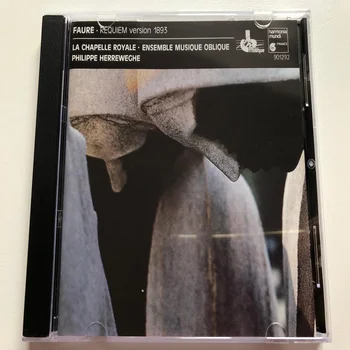
Agnès Mellon, Peter Kooy, La Chapelle Royale, Ensemble Musique Oblique, Philippe Herreweghe
Philippe Herreweghe’s 1988 reading remains the period-instrument touchstone for the chamber version of the Requiem and the recording that established how the 1893 score could sound on period instruments rather than modern ones. Its virtues are not warmth or consolation, but austerity, transparency and a devotional restraint that the work’s later historically imformed advocates, Romano included, are still measured against.
Agnès Mellon’s soprano in the Pie Jesu is cool and unforced, deliberately pitched closer to a choirboy line than to lyric maturity, and Peter Kooy’s Libera me is straight-toned and unhistrionic, present but never heavy. La Chapelle Royale sings with the lean, blended sonority that defines Herreweghe’s choral work, and the period strings of Ensemble Musique Oblique keep the Offertoire and Sanctus clear of the haze that fuller readings can lend them. Where Cluytens broadens the In paradisum into a long arc, Herreweghe lets it move quickly and lightly, with the harp figuration set forward in the texture. Herreweghe remains the reference for the chamber score’s original sound world.
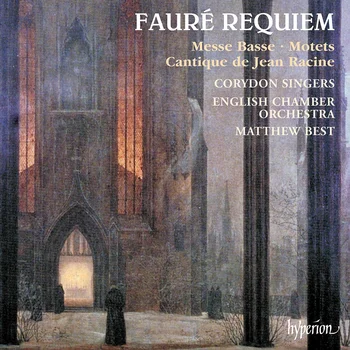
Mary Seers, Michael George, Corydon Singers, English Chamber Orchestra, Matthew Best
In Matthew Best’s hands, the chamber version of the Requiem sounds less like a corrective to the symphonic score than a self-sufficient work of consolation. This is not the most austere reading on the list, but it is the warmest and the most overtly contemplative chamber account, and it remains the modern-instrument benchmark for the 1893 edition.
Mary Seers’s soprano in the Pie Jesu is rounded and gently inflected, more womanly than Mellon’s chorister line for Herreweghe and closer in spirit to de los Ángeles’s veiled tone for Cluytens. Michael George’s Libera me is grave and unforced, with a baritone weight that gives the movement gravity without ever tipping into theatre. The Corydon Singers bring the kind of finely tuned English choral discipline that suits Fauré’s quiet polyphony, and the English Chamber Orchestra plays with warmth without over-darkening the texture. The substantial coupling of shorter sacred works, including the Cantique de Jean Racine and the Messe basse, makes the disc one of the most comprehensive Fauré sacred programs in the catalogue.
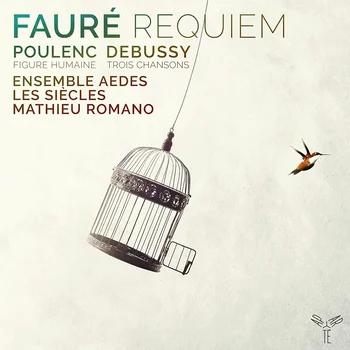
Roxane Chalard, Mathieu Dubroca, Ensemble Aedes, Les Siècles, Mathieu Romano
Mathieu Romano’s 2018 recording is the most recent serious period-instrument account of the Requiem and the strongest contemporary heir to the line Herreweghe opened thirty years earlier. It does not try to soften Fauré’s chamber score into easy consolation, but presses the music’s grief and harmonic edge forward in a way that the older historically informed readings often did not.
Roxane Chalard’s soprano in the Pie Jesu is slender and slightly astringent, deliberately stripped of the rounded lyric tone Seers brings for Best, and Mathieu Dubroca’s Libera me is shaped as a spoken-toned plea rather than a bel canto line. Les Siècles play on historical instruments that were contemporary with the score, and the restored French-Latin pronunciation that Ensemble Aedes adopts changes the choral color audibly, especially in the Introit et Kyrie and the Agnus Dei. Where Best aims at warmth and Herreweghe at clean transparency, Romano aims at concentration: the textures are spare, the climaxes pointed, the In paradisum inward rather than radiant. Coupled with Poulenc’s Figure humaine and Debussy’s Trois Chansons de Charles d’Orléans, the disc is a worthwhile recent period-instrument addition to the discography, and the most current statement of how the 1893 score can sound in that tradition. — Read the full review of this album.
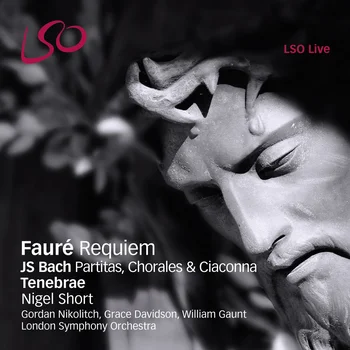
Grace Davidson, William Gaunt, Tenebrae, London Symphony Orchestra Chamber Ensemble, Nigel Short
Tenebrae’s 2012 recording with Nigel Short is the most refined of the three chamber readings on this list and the one that has settled into the recent critical consensus for the work. It is not as austere as Herreweghe and not as overtly warm as Best, but it sits between them with a polish and tonal control that the other two do not quite share.
Grace Davidson’s soprano in the Pie Jesu is pure without sounding anonymous, floated above the ensemble in a way that recalls the choirboy tradition without imitating it, and William Gaunt’s Libera me is straight and unforced, weighted closer to Kooy than to Fischer-Dieskau. The London Symphony Orchestra Chamber Ensemble plays with the same precision Tenebrae bring to the choir, and the Sanctus and In paradisum are shaped for line rather than for atmosphere. The disc’s most distinctive feature is its programming: the first half builds a Bach Partita No. 2 in D minor interleaved with four chorales and a Ciaccona that draws choral interpolations from those same chorale themes, and the Requiem is then played complete as the second half, framing Fauré inside a longer D-minor meditation. For listeners who prefer polish and tonal control to either Herreweghe’s austerity or Best’s warmth, this is the recent chamber account to reach for.
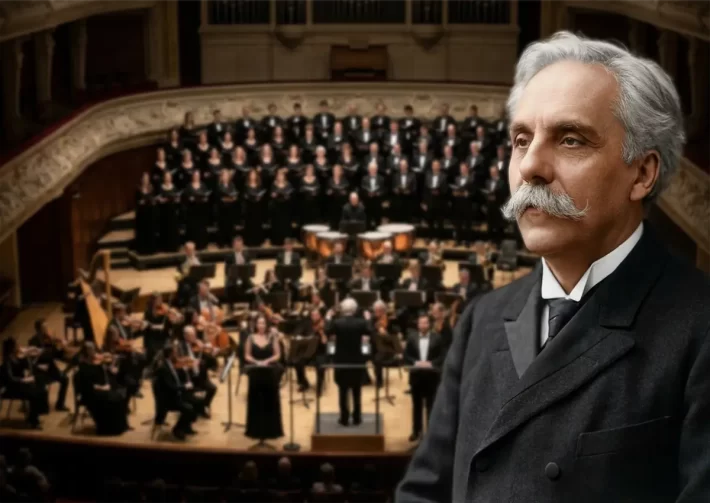
Top image ©️ The Classic Review, AI generated