
Metanoia, Yulianna Avdeeva’s new album for Pentatone, focuses on the transformation of Liszt’s style between his Weimar and late periods. Liszt had already shown an experimental curiosity with structure and form in the Sonata in B minor—a work presented here alongside later pieces such as the Bagatelle sans tonalité and Nuages gris.

Given the many versions available, Avdeeva’s B minor sonata is impressive. Some renditions are either entirely too heavy or too light, but hers strikes a sensible balance of power, speed, and musicality. There are admittedly some moments where velocity comes at the expense of clarity, but the furious and urgent spirit is aptly captured.
Avdeeva shows firm command in the first section (track 1). The octave passages are bold and brash, while the runs remain light, agile, and effortless. I did find the lead-up to the second theme somewhat rushed: the Grandioso (track 2) is rousing but needs more breadth for us to fully appreciate the arrival of the D major section—something Argerich’s 1971 recording does so well. The more tender moments of the section, however, are exquisitely rendered with translucent passagework.
Fortunately, Avdeeva does not rush the Andante (track 3). Its blend of nostalgia, reverie, and introspection offers a much-needed respite from the frenetic parts of the sonata and leaves enough space for the return of drama in the finale. The fugue (track 4), meticulous in its rhythm and articulation, gives a powerful drive back to the recapitulation but never leaves us with any sense of uncomfortable volatility.
The late works begin with La lugubre gondola II (track 5), whose origins are as dark as the music. In 1882, Liszt is said to have had an eerie vision that his son-in-law Richard Wagner would die and that his body would be carried on a black gondola. The vision came true a few months later, in early 1883. Avdeeva reflects the grim nature of this realization as she highlights the starkness of the sparse textures and the austerity, foreboding, and finality of the monophony. The work is as much an homage to Wagner as it is a premonition, and the second half is where we hear more elements of tonality and lyricism.
R.W. – Venezia (track 9), the companion work to La lugubre gondola, was written after Wagner’s death. While just as somber and still minimalistic, the piece lies largely in the lower register. Avdeeva gives the left-hand octave ostinato plenty of depth but also a necessary sense of severity.
The brighter Bagatelle sans tonalité (track 6) recalls the showmanship of earlier works, though the bravado now takes the form of a more elegant virtuosity. The unmistakable element of caprice is well evoked.
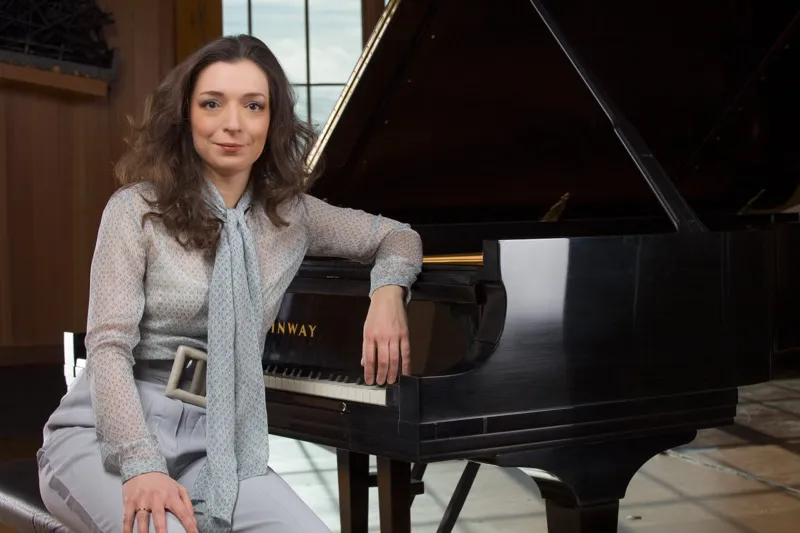
Yulianna Avdeeva. Photo © Kevin Kinzley.
Nuages gris (track 7), like La lugubre gondola, has sinister undertones amid its minimalism. Avdeeva still finds a way to create some breathtaking tone colors; the final two mysterious chords are a good example, offering a fleeting sense of whimsy quite different from the ominous mood that pervades most of the piece.
The Hungarian Rhapsody No. 17 (track 10), written just a few years before Liszt’s death, diverges considerably in character from the earlier rhapsodies, Nos. 1–15. The flamboyant, fiery, and playful profile gives way to more ominous undertones and an atonal base. Avdeeva brings out a threatening and even aggressive nature: accents and dissonances carry a stinging sharpness, and the octave passages at the end are adamant and tumultuous.
Unstern! – Sinistre (track 11) is perhaps the most jarring of the late pieces, owing to its harsh atonality and even harsher textures. The accents and chords here are abrasive (as they should be), yet never become too strident on the ears. Unlike some of the other works, whose endings offer some form of catharsis, the latter sections here only prolong the doubt and disquiet, a distinction Avdeeva makes clear.
The juxtaposition of works from different eras is well judged. In one sitting, the heavy mood of the late works may become a bit overbearing, but this only goes to show the effectiveness of Avdeeva’s interpretations. All in all, a series of excellent performances that should find a place on the shelf of any Liszt enthusiast.
Recommended Comparisons
Liszt: Piano Sonata in B minor
Martha Argerich | Krystian Zimerman | Vladimir Horowitz | Stephen Hough
Liszt: Late Piano Works
Alfred Brendel | Maurizio Pollini | Leslie Howard | Arcadi Volodos