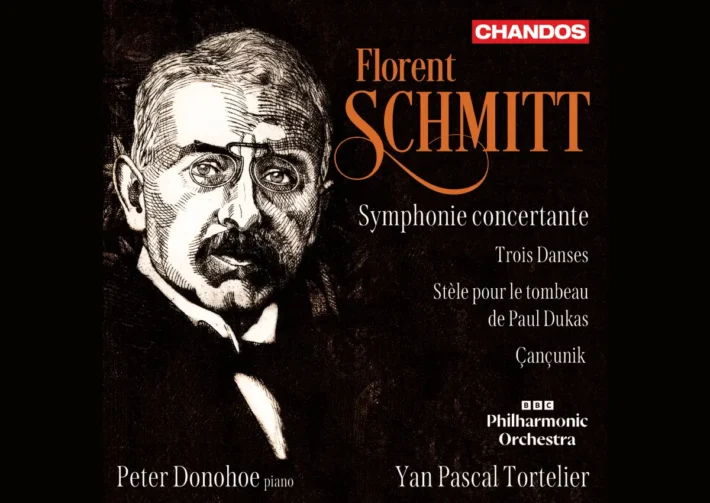
I own several Schmitt recordings, including two wonderful albums played by the Buffalo Philharmonic under Falletta (Naxos), two led by Jacques Mercier (Timpani) and the earlier albums released by Chandos. The engineering on those earlier releases serves Schmitt’s opulent orchestrations particularly well, and the same holds true here.
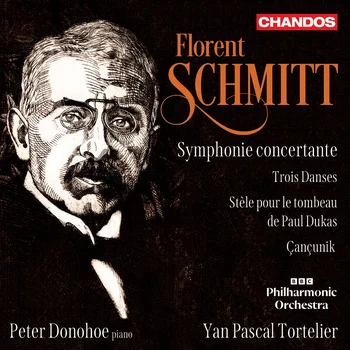
Moreover, just about all the repertoire in this program is new to the catalogue: a premiere recording of Çançunik (Op. 79), alongside first recordings of Schmitt’s orchestrations of two piano works, Trois Danses (Op. 86) and Stèle pour le tombeau de Paul Dukas (Op. 87 No. 1), as well as the second recording of the Symphonie concertante (Op. 82).
The program opens with that Symphonie concertante for Orchestra and Piano. The wording is important because, as Nicolas Southon’s booklet note puts it, “the work is in every respect a ‘symphony’.” Written for and premiered by Serge Koussevitzky and the Boston Symphony Orchestra, the piece was poorly received, and even those of us who admire Schmitt’s music may find it difficult to love.
The first movement’s harmonic language is surprisingly dissonant, especially in louder, more complicated passages. These sections continually alternate with softer, more sweetly harmonized passages that feature some gorgeous lyricism. I looked for a kinship between this work and Szymanowski’s Symphony No. 4 (subtitled Sinfonia concertante) but found a stronger connection with Messiaen’s Turangalîla-Symphonie.
Both works are built on the alternation of high-volume ferocity and calmer lyricism. The vivid and subtle colorings of Schmitt’s large post-Romantic orchestra summon a sound world like Messiaen’s masterpiece, especially the use of celesta in the slow second movement. As with so much of Schmitt’s music, the work requires the listener’s full attention, but repeated listening always reveals something new to appreciate and admire.
The earlier recording, played by Hüseyin Sermet and the Orchestre Philharmonique de Monte-Carlo under David Robertson (Auvidis Valois), is fine, but is readily superseded in both performance and sound by this new performance. The engineers find just the right balance for the piano, ensuring it is always clearly heard without ever taking the spotlight of a concerto recording.
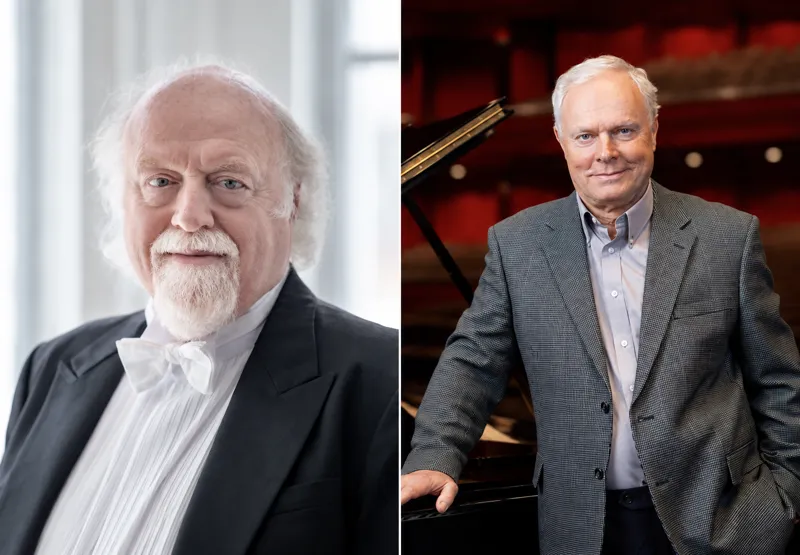
Peter Donohoe (left, photo © Sim Canetty-Clarke) and Yan Pascal Tortelier.
Schmitt dedicated each movement of his piano score for the Trois Danses (Three Dances) to a female pianist he admired. The music is not lighthearted or playful; instead, the outer movements have a somewhat brash, sarcastic humor that reminded me of Poulenc’s acerbic wit. Schmitt’s orchestrations, completed two years after the piano originals, are so idiomatic one suspects the music was always intended for orchestra (much the same can be said about Ravel’s orchestrated piano works).
I was particularly taken with the darkly atmospheric Bocane (Mvt. 2) and the final Danse de corde, its powerful march-like striding suddenly interrupted by a passage of quiet rumination, ending with a bombastic restatement of the march material.
Schmitt’s Stèle pour le tombeau de Paul Dukas (Memorial for the Tomb of Paul Dukas) explores both private and public grief. There is a lovely string chorale, richly harmonized, followed by a slow funereal march that carefully builds in intensity, both kinds of grief fully captured in this reading.
This album ends with the premiere recording of Çançunik, an orchestral suite in two parts. Written in 1927, the work was submitted to a Compagnie française de radiophonie competition, which asked for submissions that would be immediately popular (‘music for the masses’) and would not “suffer in effect through transmission over the airwaves.” Schmitt won first prize, and this music features gorgeous writing for the first-chair woodwinds, which the BBC players clearly enjoy, accompanied by gossamer string textures.
I can imagine performances a touch more animated and impassioned (a consistent characteristic of Tortelier’s Debussy and Ravel recordings with the Ulster Orchestra on Chandos). But that is a nitpicking comment — these are thoroughly musical readings that introduce us to new repertoire and give us a better picture of Schmitt’s compositional brilliance — warmly recommended.
Recommended Comparisons
Schmitt: Symphonie concertante
Schmitt: Orchestral Works
JoAnn Falletta (Antoine et Cléopâtre) | JoAnn Falletta (La Tragédie de Salomé) | Jacques Mercier | Yan Pascal Tortelier (La Tragédie de Salomé)