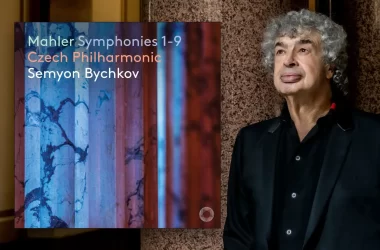
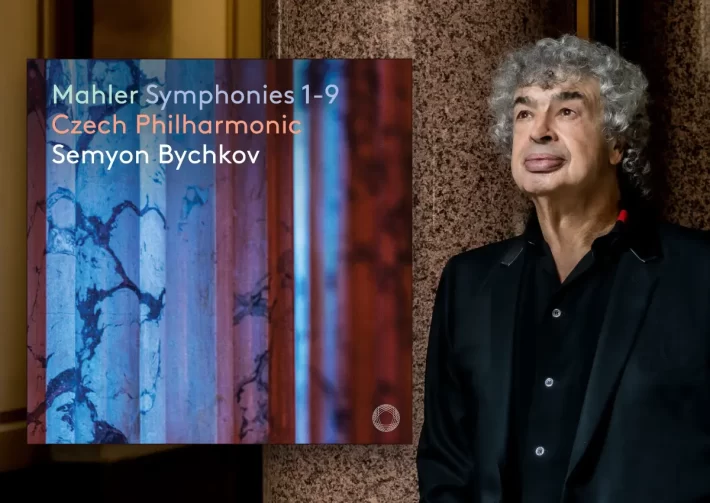
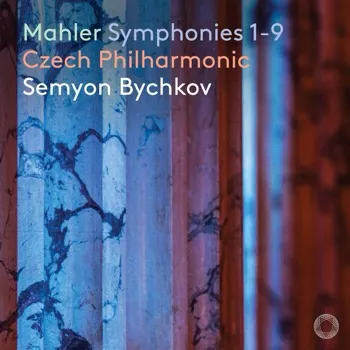
This marks the completion of Semyon Bychkov’s Mahler cycle with the Czech Philharmonic Orchestra. The first five symphonies were released separately, but it appears the final four will only appear in this box, which surely frustrates those who have collected the earlier CD releases. We reviewed the five individual releases when they were released, so this review focuses on symphonies 6-9. The set does not include Das Lied von der Erde or even the tenth symphony’s Adagio.
Taking almost 25 minutes, the sixth’s opening movement feels slow, but more troubling than tempo is the smoothed-out string articulation. Bernstein described the brutal striding of the lower strings as a prophecy of Nazis marching, and his New York and Vienna recordings certainly convey that horrific image. Here the tread is not nearly ominous enough, and the moderated characterization of this first theme diminishes the emotional impact of the gorgeously played second theme (which Alma claimed was Mahler’s expression of his love for her). That romantic ardor is far more persuasive in the recordings by Abbado, Karajan (both Berlin/DG) and Tennstedt (LPO/LPO Live).
A lack of emotional conviction is also evident in the Scherzo, but the Andante Moderato brings a notable rise in emotional temperature wedded to gorgeous playing from all sections. The Finale is even better, Bychkov bringing out a wealth of orchestral detail as he sustains the dramatic arch of this sprawling movement. (The final trombone threnody is particularly desolate.) I want to understand the change in emotional connection: is it an interpretative decision? Were the movements recorded on different days? The result is an emotionally lopsided reading, a fine performance that should have been exceptional.
The seventh symphony is far more successful. Bychkov simply takes this ‘problematic’ work as it is: a highly original, brilliantly orchestrated, disjointed, bipolar emotional journey. Some conductors try to smooth the music’s awkwardness, but Bychkov accepts and even welcomes these elements. Brass is less reined in; strings use sharper articulation; rabble-rousing is accepted rather than tamed. The recent performances by Kirill Petrenko (review), Paavo Järvi (review), and Rattle (review) take 75 minutes or less, whereas Bychkov takes over 78 minutes. But every movement has energy, momentum, and palpable engagement.
The second movement revels in the music’s more spectral qualities. The Scherzo is a bit slow, requiring a more maniacal quality (again, more bite from the strings). But winds, especially in solos, offer vivid characterization, even when it means sounding less than beautiful. The second Nachtmusik, gentler and more subtly inflected, is touching, while the Rondo-Finale‘s wild mood swings and disruptive nature are embraced rather than mollified.
Symphony No. 8 is the highlight of the set. The superb engineering has clarity, depth, and richness of sound even in the most massive climaxes. In many recordings the extra brass that enters in the last moments of both movements sounds anemic — not here. Bychkov’s pacing is excellent and the singing (fabulous choral work and eight exceptional soloists) conveys the emotional and spiritual import of the text. Recently I listened to Mäkelä’s live recording (Concertgebouw/Decca, digital only), a reading that struck me as exciting, flashy but emotionally superficial; Bychkov is just as thrilling and more spiritually questing, so that the final Chorus Mysticus is a true moment of spiritual transcendence.
I wanted the performance of the ninth to be just as powerful, but instead there is a return to emotional temperance. Writing about their performance of the third symphony, I argued the expressive range felt reined in, a performance unwilling to accept or embrace the music’s heightened emotional state. The same is true here, in a symphony that explores an even greater, darker range of emotions. This is not moderate music.
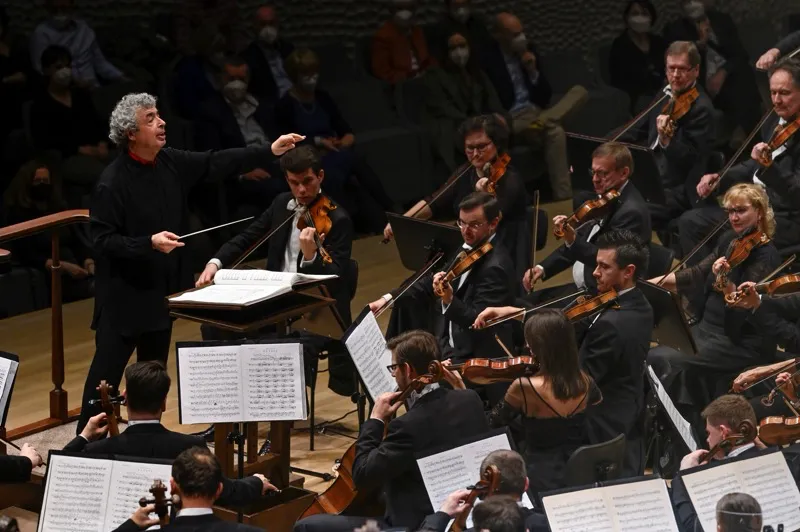
Semyon Bychkov and the Czech Philharmonic Orchestra (©️ Petr Kadlec)
A few months ago, I wrote glowingly about Jurowski’s ninth with the LPO, a reading that consistently engages the music’s emotional and spiritual journey. That is what is missing here: trombones are too polite in the first movement’s central climax; the off-kilter phrasing of the second movement’s first Ländler is smoothed over, and the second dance needs sharper contrast; the third movement never feels wild, its Coda reined in just when it should threaten to go off the rails. As in the sixth, the final Adagio brings greater emotional connection. But in the final minutes, Bychkov chooses a daringly slow tempo, elongating rests and pauses. Some readers may find this does express the sought-after acceptance of fate, but it struck me as maudlin and sentimental. Jurowski’s recent recording, as well as Karajan’s classic live Berlin recording (DG), are far more affecting.
Pentatone’s typically excellent ancillary materials are, in this instance, disappointing. Texts and translations are not provided (as they were for the individual releases); there are no biographies for soloists, choirs, conductor, or orchestra. Gavin Plumley, who provided thorough and thoughtful notes for the initial releases, is here limited to cursory discussions of each symphony. This is a mistake for what is surely one of Pentatone’s most high-profile projects.
No Mahler set is perfect; every cycle has its highlights and disappointments. There is much to admire here, and few sets on the market can boast such excellent sound. I will undoubtedly return to some of these readings. But I will also wonder about what it could have been if only Bychkov and the orchestra had been more consistently engaged.
Recommended Comparisons
Symphony No. 6
Bernstein / VPO | Abbado / BPO | Karajan / BPO | Tennstedt / LPO
Symphony No. 7
Petrenko / BSO | Järvi / Tonhalle Zürich | Rattle / BRSO
Symphony No. 9
Top image: ©️ Marco-Borggreve | Mahler Symphonies Bychkov
Album Details |
|
|---|---|
| Album name | Mahler: Symphonies Nos. 1-9 |
| Label | Pentatone |
| Catalogue No. | PTC5187490 |
| Artists | Czech Philharmonic Orchestra; Semyon Bychkov, conductor |