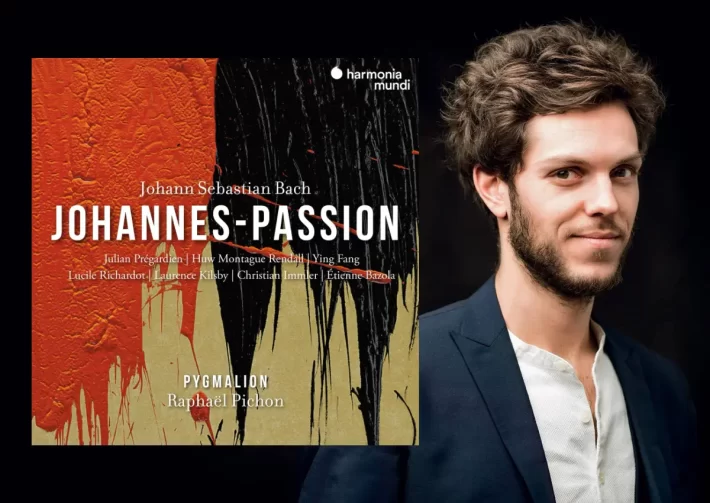
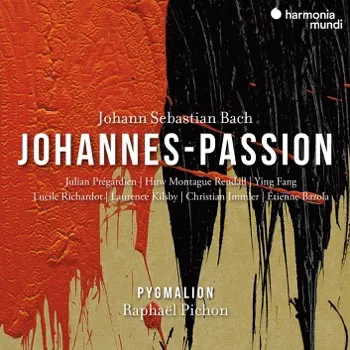
Pygmalion and Raphaël Pichon continue their series of Bach‘s major choral works with this new Johannes-Passion. Having reviewed most of their earlier recordings, I came to this one with certain expectations, yet was still caught off guard by the searing intensity of the reading.
The opening chorus, Herr, unser Herrscher, is faster (7’48”) than any other recording I know. The orchestra leans into the dissonances, the interweaving violin lines articulated with grim determination while the lower strings and contrabassoon positively growl. The text, here and throughout, is delivered with almost missionary zeal.
Julian Prégardien’s Evangelist uses the widest possible emotional scale, with a dynamic range extending from the merest whisper to a wailing outcry, as when the crowd demands the release of Barabbas over Jesus (Nos. 18b–c). Previous Evangelists have also been highly dramatic: Lothar Odinius (Minkowski/Erato), Mark Padmore (Gardiner/SDG — review), and Werner Güra (Jacobs/Harmonia Mundi) readily spring to mind. But none is quite as theatrical as Prégardien. Some listeners may find him occasionally histrionic, as I did on first hearing. On repeated listening, however, I became increasingly convinced; the more I listened, the more he held me spellbound.
The continuo group includes three harmonic instruments: organ, harpsichord, and theorbo. Their differing colors and articulations are used to reflect or foreshadow the story. Pichon often asks for sustained playing that creates a halo of sound, almost like the accompanied string recitative Bach uses for the words of Jesus in the St Matthew Passion. During the first part, I found the organist’s ornamentation excessive, often drawing focus away from the text, though this was less of an issue, or perhaps I had simply grown accustomed to it, in the second part.
The Pygmalion musicians offer a detailed, sophisticated, and emotionally full performance. Instrumental solos are never mere accompaniment; they seem instead to interact with the singers. I would not be surprised to learn that in performance instrumentalist and soloist stand side by side. My understanding is that these forces have lived with this work for some time before bringing it into the studio, and one senses that every musical and dramatic effect has been considered and rehearsed for maximum impact. Yet the reading still manages to feel spontaneous and raw.
A highlight of Suzuki’s second BIS recording (review) was its madrigalian treatment of the chorales. Pichon takes a similar approach, but in more extreme fashion, making the chorales feel less like commentary on the story than part of the action itself. Some Bach scholars might object to this, and indeed there were moments when I wanted the chorale to provide a measure of reflection away from the intensity of the drama. How effective this proves will depend on the listener.
There is not a weak link among the soloists. I wrote glowingly of Christian Immler’s performance of Betrachte, meine Seel in Suzuki’s recording, yet this version, taken at a slightly slower tempo, uncovers a deeper strain of emotion. Lucile Richardot’s Es ist vollbracht! has grief and anger, as if she cannot, and does not want to, believe what she has just witnessed. And listen to the numbed sorrow conveyed by Laurence Kilsby in Mein Herz, in dem die ganze Welt and Ying Fang in Zerfließe, mein Herze.
Huw Montague Rendall’s Jesus is vividly characterized, though at times this may go beyond what the Gospel writer intended. John’s Gospel is distinctive in that, from its opening lines, it stresses Christ’s divinity. Put in non-theological terms, Jesus knows what will happen to him and therefore shows an almost superhuman acceptance of it. I sense this more strongly in Christian Immler’s Jesus for Suzuki, whereas Rendall can sound, on occasion, more human than I would expect. But Pichon’s interpretation is so compelling precisely because it is so human; in his own words, it “whispers in your ear… a universal cry… [and] allows a glimpse of the faint imprint of human transcendence.”
When the Leipzig town council hired Bach, they made it clear that his sacred music should not be too operatic. This performance would surely have confirmed their fears. But we do not live in 1720s Leipzig, and I, for one, found this a particularly involving and moving account of Bach’s masterpiece.
Album Details |
|
|---|---|
| Album name | JS Bach: Johannes-Passion |
| Label | Harmonia Mundi |
| Catalogue No. | HMM90277475 |
| Artists | Julian Prégardien, Evangelist; Huw Montague Rendall, Jesus; Ying Fang, soprano; Lucile Richardot, mezzo-soprano; Laurence Kilsby, tenor; Christian Immler, bass-baritone; Etienne Bazola, baritone; Ensemble Pygmalion; Raphaël Pichon, conductor |