Bohuslav Martinů’s symphonies are some of the finest written in the last century. All were composed during his time in America and date from his mature period (the first was written when he was 51). They show his gift for building melody and structure from minimal material, and his tonal harmony, vital rhythm, and luminous orchestration reveal a generally optimistic outlook — surely most readers will agree this is a time when we need to hear and feel more optimism.
Commissioned by Serge Koussevitzky, the Symphony No. 1 was written in 1942. Timings run from Thomson’s brisk 34’44” (Royal Scottish NO/Chandos) to Válek’s ponderous 39’03” (Prague RSO/Supraphon). Hrůša’s 35’37” feels exactly right: the Scherzo (7’08”) is a touch faster than the norm, though sharp articulation and transparent textures make it feel even quicker.
Lasting a little over nine minutes, the Largo unearths darker emotions, perhaps expressing Martinů’s grief on learning of the recent Nazi massacre in Lidice, a Czech village close to his birthplace (his masterwork, Memorial to Lidice, was written one year later). It has devastating power in this performance, answered by a final movement that sweeps that darkness away in its celebratory close.
The Symphony No. 2 combines elements of symphonic and concerto grosso form, with smaller groups of instruments often set against the full orchestra. It is also more introverted; conductor Jiří Bělohlávek described the work as “lyric, poetic and vivid” in an introductory note to his excellent BBC SO cycle on Onyx. Hrůša’s interpretation is just as fine, and the Bamberg players cover themselves in glory, with playing of refinement and sophistication that often surpasses what one hears from the BBC.
I admit I was initially disappointed to learn Hrůša did not record this cycle with the Czech Philharmonic (he becomes its Music Director in the fall of 2028), but the gossamer sheen of the strings and the characterful woodwinds (sample the second symphony’s first movement), beautifully captured by DG and BR Klassik engineers, more than rival what one hears from the more illustrious ensemble. Listen to the sparkle and impish humor of the third movement, or to how timpani and brass rise up in the final movement’s Coda: this is fabulous, life-affirming music-making.
The Symphony No. 3 is more enigmatic. The opening movement has a tense and anxious mood, with a greater use of dissonance. The Largo that follows has a Sibelian astringency; never have I sensed such strong parallels to the Finnish composer’s fourth symphony. The final movement opens with an aggressive chordal outburst and an Allegro that continues the angst of the earlier movements. When the music slows (Andante, 4’10”) the agitation gradually drains away as the music works its way to a gently radiant E major, disrupted by two dissonant chords from the piano as the final chord dies away.
The Symphony No. 4 answers the third’s uncertainty with joy and hopefulness. Hrůša’s reading is the fastest I know, reveling in the music’s jazzy syncopations and driving motor rhythms. It captures the music’s elation and playfulness, with intensely lyrical playing. As much as I admire Bělohlávek’s recordings of this music, I have always felt he refuses to embrace the wilder moments: the joyfulness stays contained. Not so with Hrůša, who not only allows that wildness but seems to encourage it (listen to the Scherzo to hear what I mean). The playing has an energy and animation that suggest the players themselves are having the best time, and that comes across in the vividness of these readings.

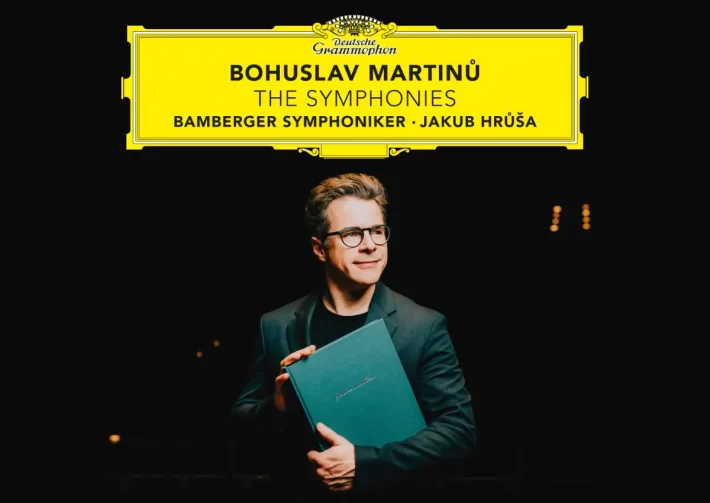
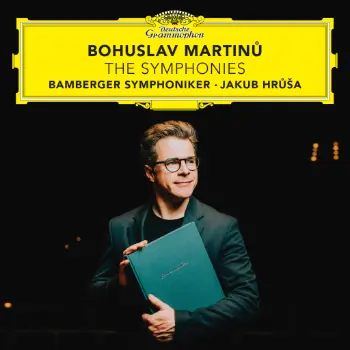
Jakub Hrůša. Photo © Ian Ehm.
Like the third, the emotional trajectory of the Symphony No. 5 is more circumspect. Written in three movements, it has no slow movement, though there are substantial passages of slow music in the outer movements. This is arguably Martinů’s most abstract work, and in this new reading I sense a constant struggle, or pull, between positivity and pessimism. The playing is refined yet full-blooded, with transparent textures and ideal tempos. Meister, leading the ORF Vienna RSO (Capriccio), is slower and also heavier, lacking the rhythmic buoyancy of Hrůša’s reading.
Martinů’s final symphony, titled Fantaisies symphoniques, was written between 1951 and 1953 and is dedicated to Charles Munch. The composer described the work as “without form. And yet something holds it together, I don’t know what, but it has a single line, and I have really expressed something in it.” He felt the free, fantastic nature of the music suited Munch’s way of interpreting, and if Hrůša’s reading does not eclipse Munch’s 1956 Boston Symphony recording (RCA), he leads the music with a similar sense of spontaneity and energy, with playing that more than equals Boston.
Notably, this is the first Martinů symphony cycle in DG’s catalogue. For me, it is the new benchmark recording of these works, and it is urgently recommended.
Album Details |
|
|---|---|
| Album name | Martinů: The Symphonies |
| Label | Deutsche Grammophon |
| Catalogue No. | 4867810 |
| Artists | Bamberger Symphoniker; Jakub Hrůša, conductor |