Impressed by this partnership’s Dvořák Ninth (review), I was eager to hear their Bruckner fourth, surely the composer’s most popular symphony both in the concert hall and on record. This new reading, while impressive, is not a complete success.
This reading lacks the instrumental weight and depth of color that I would argue makes for an authentic Bruckner sound. Having grown up listening to many Telarc recordings of this orchestra, I lay the blame for this deficiency on the engineering. The mics are placed too close to the musicians, surely to minimize audience noise during this live recording. There is little bloom to the sound, and no real hall ambience. Climaxes feel contained, and softer dynamics are limited by the proximity of the mics. Bruckner’s music was written with a warm, reverberant acoustic in mind, and that acoustic is an integral part of the sound. Not so here.
Instead, it is like standing one foot away from Seurat’s A Sunday Afternoon on the Island of La Grande Jatte: every brush stroke is visible, and we might appreciate how the painting is assembled, but it comes at the cost of the image’s beauty, mystery and expression.
The second issue has to do with the edition. There are now ten different editions of the fourth symphony to choose from. Stutzmann uses the late Benjamin-Gunnar Cohrs’ 2021 critical edition of the 1878–81 version, which has been recorded only once before, by Simon Rattle with the LSO (LSO Live). For that album Cohrs described his edition as “the second version of the ‘Romantic’ Symphony as it stood by the end of 1881,” including “Bruckner’s own suggested cut in the Finale.” But Stutzmann does not take the cut — why not? Why embrace a little-known version and then ignore one of its most significant, composer-sanctioned changes? The liner notes offer no discussion of the edition, nor is it listed on either side of the booklet cover.
As to the performance itself, I had initially intended to limit comparisons to other American recordings, but it now seems best to set Stutzmann against Rattle (details – review). His performance is faster, with an overall timing of 61’30” against Stutzmann’s 71’39”, and the largest difference comes in the final movement, where Stutzmann restores the passage Bruckner marked for cutting. Each conductor belongs to a different interpretive school. Rattle recalls Karajan: a subtle use of rubato, polished orchestral sound with resplendent brass and gossamer strings, a unified pulse that keeps the structure in view. Stutzmann is far closer to Jochum: much freer rubato, a more heterogeneous orchestral sound and, more distinctively, an intensely songful rendering of Bruckner’s score.
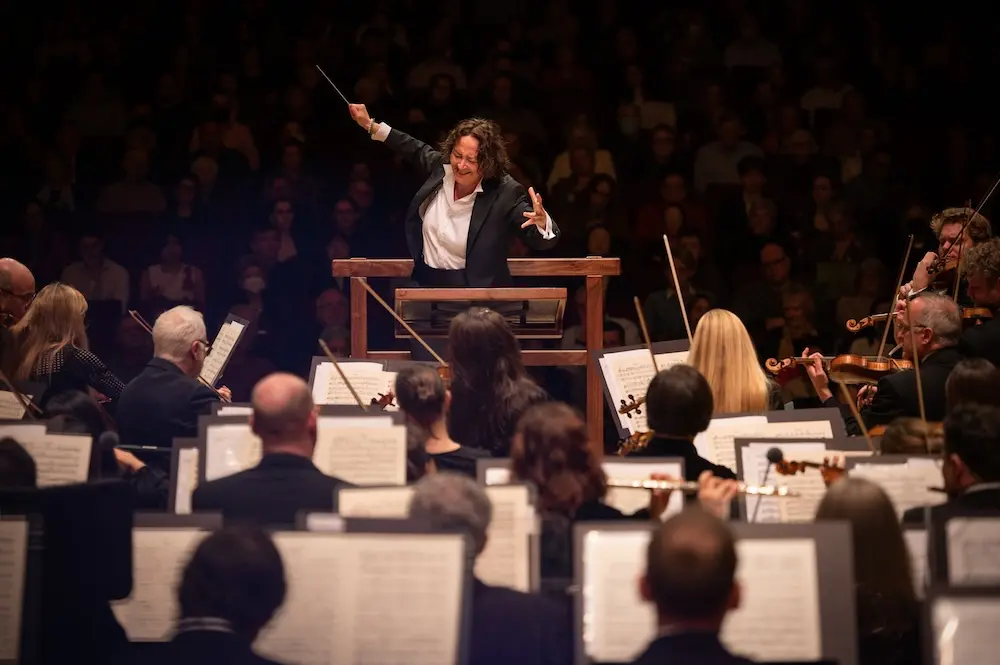
Nathalie Stutzmann conducts the Atlanta Symphony Orchestra. Photo © Rand Lines.
Stutzmann’s approach is compelling in the second movement, though at 17’05” it feels more Adagio than Bruckner’s Andante quasi Allegretto. In the finale the flexibility sometimes compromises a sense of the overarching structure, and there are moments when the energy level dips precipitously low. This is less of an issue in the opening movement, where one does get to hear much of the contrapuntal inner voices.
Both Rattle and Stutzmann solicit rounded articulation, and I often missed the cut and thrust of Blomstedt’s San Francisco account on Decca and Honeck’s Pittsburgh performance on Reference, especially in the Scherzo. Both drive the music harder, encouraging more wildness in the trumpet-capped climaxes. Bruckner described the Trio as “how a barrel-organ plays during the midday meal in the forest.” Honeck is perhaps best at capturing this rustic picture, even if he is reticent to allow an earthier, less refined sound. Stutzmann conjures a poised, lightly sprung elegance that I enjoyed, even though it hardly captures the composer’s description.
In short, I find Stutzmann’s performance the more compelling of the two. Yet if I want to hear this edition, surely I want Bruckner’s cut in the finale. Rattle’s release adds to the symphony itself the discarded 1874/76 Scherzo and the 1878 Volksfest Finale, an extended early version of the Andante, and the unabridged 1881 Finale, a valuable addition for Bruckner specialists.
Ultimately, neither recording compels me to embrace this version over the more familiar Haas and Nowak editions, and neither matches the brilliance of Blomstedt, Honeck, or the classic Böhm/Vienna/Decca.