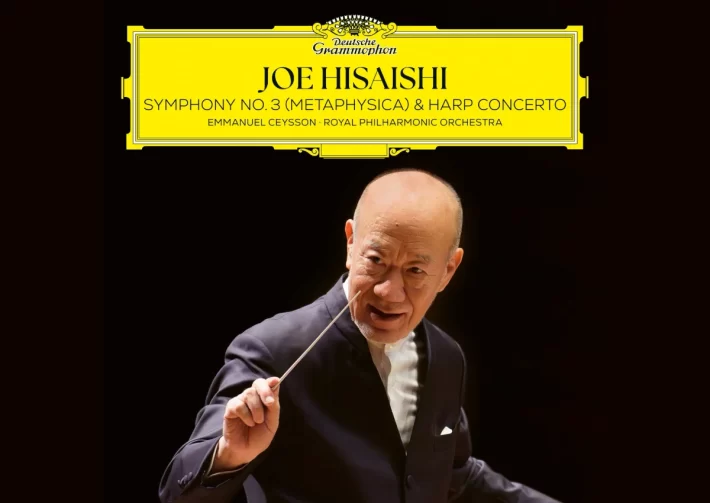
This is Deutsche Grammophon’s fourth album of Joe Hisaishi’s music. One recording (played by the Royal Philharmonic) is A Symphonic Celebration of selected film scores, but the others, including this latest release, focus on concert music.
The album opens with Hisaishi’s Symphony No. 3 “Metaphysica”. The work was premiered by the New Japan Philharmonic in 2021 and was inspired by the music of Gustav Mahler: Hisaishi says it uses the same orchestration as Mahler’s first symphony, and it was programmed with that work at the premiere. The composer writes that the subtitle “Metaphysica” (Latin for “metaphysics”) refers to a philosophy “concerning the understanding of existence and knowledge.” The music “emphasizes logic that transcends sensation and experience,” and, in his words, “I aimed to create music composed solely of the movement of sound.”
In three movements, the first (titled “existence”) is built around a rhythm “consisting of three sixteenth notes” that is heard in each movement, with “melodic movements that transform upon this foundation.” The second (“where are we going?”) grows from a single 26-measure phrase subjected to all manner of variations. The finale (“substance”) is built on a hexatonic scale which, in the composer’s words, is “placed on both the time and spatial axis.”
I am hesitant to critique a composer’s style, as listeners’ tastes differ and my reaction may not be shared by others. So let me state straight away that Hisaishi is a minimalist, a school of composition I have struggled to understand and appreciate for most of my life. His orchestration is expert and was the most enjoyable aspect of my listening. One can find online descriptions of his memorable melodies, but I did not find that to be the case here. Nor does the symphony use expected Classical-Romantic structures: in the outer movements I listened for elements of sonata form, in which multiple themes are presented, developed, and recapitulated. Instead, Hisaishi builds his music by presenting a melodic motive and subjecting it to coloristic variation.
That orchestration held my interest for a long stretch; Hisaishi’s music is atmospheric and cinematic. But the three-note rhythm meant to bind the three movements together was not evident to me, even after repeated listening, nor was the melodic writing memorable. The ostinatos and continuing variations felt overused, and by the third movement I struggled to stay focused on the music. Excepting continuous variation, I am not sure how Hisaishi’s music connects to Mahler’s symphonic world, though his notes on the symphony suggest that was his intent. Not a revelatory discovery for me, though others may react differently.
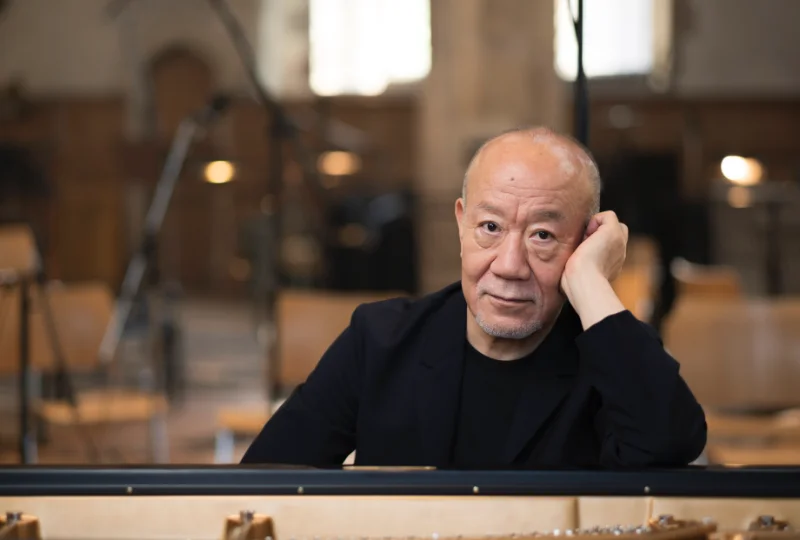
Joe Hisaishi. Photo © Nick Rutter.
The Harp Concerto was a joint commission by the Los Angeles Philharmonic, the Bordeaux National Opera, the Philharmonie de Paris, and the Singapore Symphony Orchestra, written for Emmanuel Ceysson, the Los Angeles Philharmonic’s principal harpist. Ceysson collaborated with the composer, both in Los Angeles and Japan, during its composition. Deutsche Grammophon’s notes state that the work “reimagines the expressive possibilities of the harp,” replacing “conventional notions of delicacy with driving rhythms, bold gestures, and striking emotional intensity.”
The concerto proved a more engaging listening experience. I sensed less reliance on ostinato writing — or perhaps the more substantial melodic writing and Western harmonic progressions made it seem so. The writing is more memorable; even after the first listening, parts of the work remained in my head. And the music does succeed in reimagining the instrument’s expressive possibilities, especially in the outer movements, which feature dazzling playing from Ceysson. The highlight for me, though, was the poignant second movement, which ends with a substantial coda demonstrating both the technique and musicianship of the soloist.
Disappointingly, the digital release does not include any liner notes. The Royal Philharmonic play splendidly, though they sound more engaged by the concerto than the symphony. The recording is spacious and clear. One assumes that with the composer conducting, the music goes exactly as he intends.
If you enjoyed this album, also hear
Joe Hisaishi in Vienna (Symphony No. 2, Viola Saga) | Joe Hisaishi Conducts (Hisaishi & Reich) | A Symphonic Celebration (Studio Ghibli) | de Maistre: Harp Concertos (Glière, Mosolov)
Album Details |
|
|---|---|
| Album name | Joe Hisaishi: Symphony No. 3 (Metaphysica) & Harp Concerto |
| Label | Deutsche Grammophon |
| Catalogue No. | 4878667 |
| Artists | Emmanuel Ceysson (harp), Royal Philharmonic Orchestra, Joe Hisaishi (conductor) |