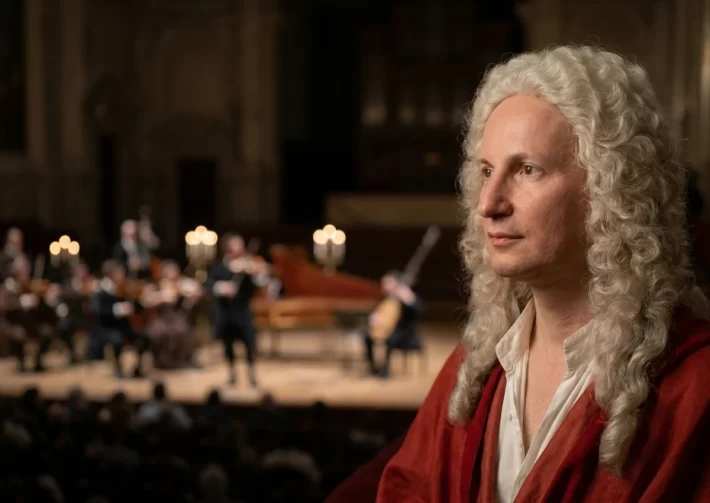
Antonio Vivaldi, the red-haired priest and virtuoso violinist, spent much of his career as music master at the Ospedale della Pietà, a Venetian orphanage famous for its music. He composed The Four Seasons around 1720, while serving as court chapel master in Mantua. In 1725 they were published in Amsterdam as the opening concertos of his Op. 8, a set of twelve titled Il cimento dell’armonia e dell’inventione. After Vivaldi’s death in 1741 his music was largely forgotten for nearly two centuries, and the Seasons returned with the revival of his work in the twentieth century.
Each concerto follows the same plan of three movements, fast, slow and fast, for solo violin, strings and continuo. Each was also printed with a sonnet, and Vivaldi set its images in the music: birdsong, a summer storm, peasants dancing at the harvest, teeth chattering in the winter cold. Few works have been recorded more often, and the versions range from full modern string orchestras to small groups with one player on each part, on modern or period instruments. Nigel Kennedy’s 1989 album alone sold millions of copies and brought the music to a huge new audience.
Here are The Classic Review editorial team’s recommendations for the 10 best recordings of Vivaldi’s The Four Seasons.
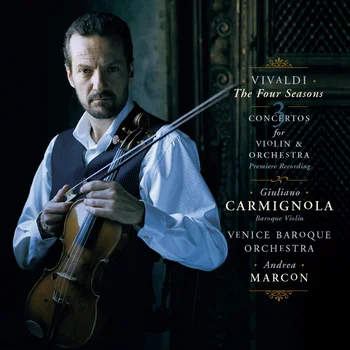
Giuliano Carmignola, Venice Baroque Orchestra, Andrea Marcon
Giuliano Carmignola’s 1999 recording with Andrea Marcon and the Venice Baroque Orchestra is the natural first choice. Carmignola takes the fast movements at high speed and with great energy, yet the textures stay light and the playing crisp. The tension mounts steadily through each concerto, and Winter is especially gripping. At times the pace is pushed almost too far, but the excitement more than makes up for it. The disc also includes three other Vivaldi violin concertos, recorded here for the first time.
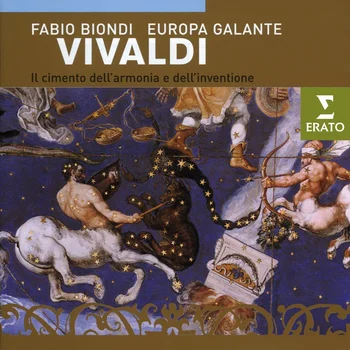
Fabio Biondi, Europa Galante
Fabio Biondi and Europa Galante first recorded the Seasons in 1991, in a celebrated version. Nine years later they returned to the work, once more playing from Vivaldi’s manuscripts rather than the printed edition. Compared with Carmignola, the performance is freer and less predictable. Biondi’s bowing is full of surprises, the bass lines are attacked almost like percussion, and the storm that ends Summer is fierce and very fast. The slow movements, in contrast, are tender and deeply felt. Not everyone will enjoy its liberties, but it is one of the most imaginative recordings of the work.
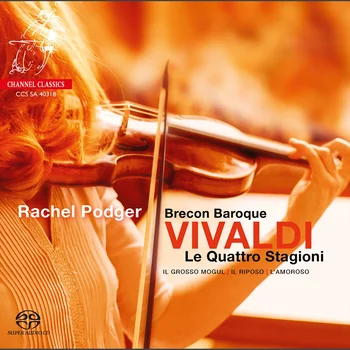
Rachel Podger, Brecon Baroque
Rachel Podger’s 2017 recording with Brecon Baroque uses just one player on each part, which turns the Seasons into chamber music. Even so, the sound is full rather than thin, helped by an excellent recording. Podger plays with easy brilliance and obvious pleasure, and the rest of the group is just as lively. The birdsong in the first movement of Spring is especially vivid. For all its small scale, this is not a radical reading: it stays closer to tradition than some other recent versions.
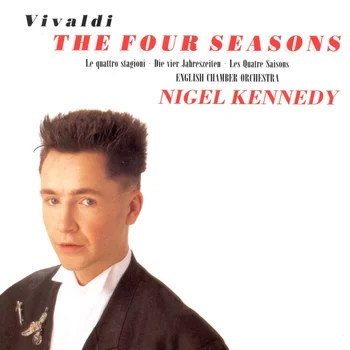
Nigel Kennedy, English Chamber Orchestra
This 1989 album owed much of its huge success to Nigel Kennedy’s personality. He directs the English Chamber Orchestra himself, and the recording places his violin firmly in the foreground. Kennedy adds his own ornaments and treats the tempo freely, yet the playing remains disciplined. The heavy vibrato is a matter of taste, and from Autumn onward a few added effects sound odd. Even so, the performance is as lively as ever.
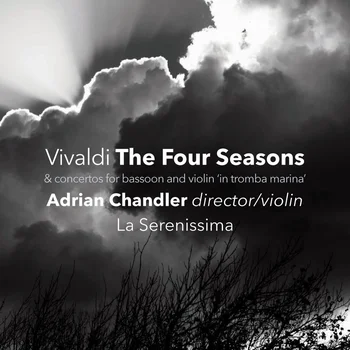
Adrian Chandler, La Serenissima
This 2015 recording with La Serenissima is the first of Adrian Chandler’s two versions of the work. Like Biondi, he worked from Vivaldi’s manuscript parts and prepared his own edition, but the result is very different. Chandler lets the sonnets guide the performance, and his phrasing often recalls folk song. The rhythms are taut, the textures transparent, and he adds very few ornaments of his own. The biggest surprise comes at the very start of Autumn, where a Baroque guitar joins the accompaniment and the familiar opening tune is phrased in an unexpected way. The disc also includes two bassoon concertos with Peter Whelan. For anyone who thinks they know the Seasons too well, this is the recording to hear.
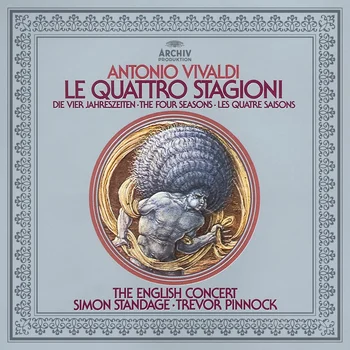
Simon Standage, The English Concert, Trevor Pinnock
Trevor Pinnock’s 1981 recording with the English Concert was one of the early period-instrument versions, and it has aged well. Pinnock directs from the harpsichord, and Simon Standage plays the solo part with confidence and bite. The ensemble sound is warm and full, but never heavy. The performance avoids sudden shocks and extremes, so it can seem a little plain compared with the bolder recordings that came later. In return, it offers a balanced and deeply satisfying account of all four concertos.
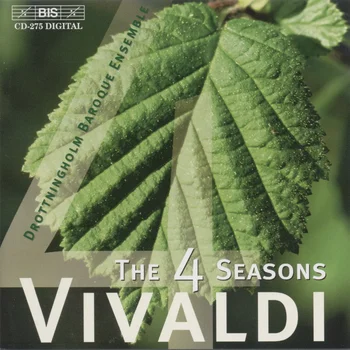
Nils-Erik Sparf, Drottningholm Baroque Ensemble
The Drottningholm Baroque Ensemble’s 1984 recording, led from the violin by Nils-Erik Sparf, is understated by design, and that is its charm. Sparf shapes the phrases with subtle changes of speed and volume, and he never hurries. In the accompaniment, a pipe organ is often heard prominently instead of the more common harpsichord, which gives the performance a softer edge. The tuning is excellent, the tone rounder than usual for period instruments, and the players sound as if they enjoy every moment. Those who want high drama should look elsewhere, but this is a recording to come back to.
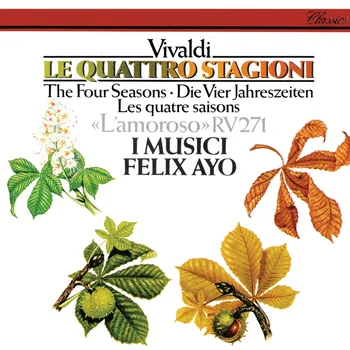
Felix Ayo, I Musici
I Musici’s 1959 recording with Felix Ayo was a best seller long before period instruments changed how this music is performed, and its elegance has not dated. The players work without a conductor and move as one, and Ayo’s solos are full of feeling, his virtuosity never put on show for its own sake. The scenes in the sonnets are painted with care: in the slow movement of Spring, the barking of the goatherd’s dog, played by the viola, comes through clearly. The vibrato is moderate and the tempos are generally relaxed. It remains one of the most rewarding of the traditional versions.
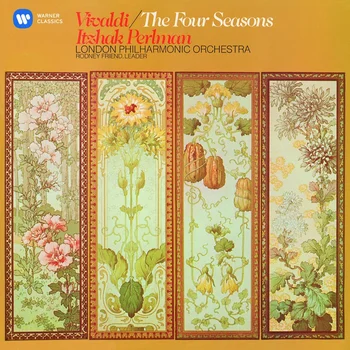
Itzhak Perlman, London Philharmonic Orchestra
Where Ayo is restrained, Itzhak Perlman’s 1976 recording with the London Philharmonic is unashamedly lavish: a full string orchestra, a sweet tone and a soloist in the grand manner. The slow movements are the heart of the recording, with Perlman shaping each melody in long, unbroken lines. Next to the smaller groups, it can feel heavy, and the fast movements have less bite. For listeners who care more about beauty of sound than period style, it remains a strong old-school choice.
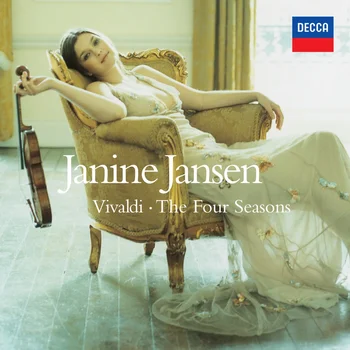
Janine Jansen
As in Podger’s version, Janine Jansen’s 2004 recording uses just one player on each part, but here the instruments are modern. Her small group, which includes her brother on cello and her father at the keyboard, plays with clean textures and plenty of vigor. Jansen is at her finest in the quiet music, where her playing has a rare delicacy. Some accents are overstated, and the tempos are on the safe side. The disc is also short, with nothing but the four concertos in under forty minutes, but it is a performance with a character of its own.
Top image ©️ The Classic Review, AI generated