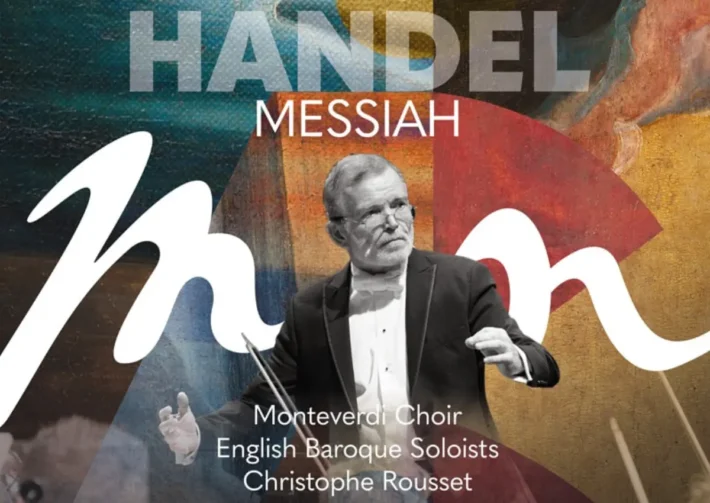
For many collectors, their first period-instrument recording of Handel’s Messiah came from this same choir and orchestra under John Eliot Gardiner (Philips, 1983). The performance was a revelation: listeners who grew up with the Bernstein and Ormandy recordings were bowled over by the tempos, colors and sheer drama of Gardiner’s reading. This new release therefore has much to live up to, entering a field of well over 150 competing recordings (messiahguide.com).
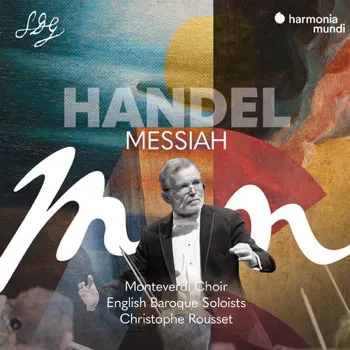
When Messiah reached London in 1743, some critics objected to a sacred text being sung in a playhouse, without the decorum the subject required. The Monteverdi Choir has lost none of the technical precision and emphatic diction it developed under Gardiner, and the clarity of text and sheer gusto of its singing heighten the theatrical element of the libretto. While many will enjoy this, others may find it overly operatic.
Soprano Ana Vieira Leite is consistently excellent. Rejoice Greatly and How Beautiful Are the Feet are nimble and gorgeous by turns, performances that make sure we understand and feel the text. I Know That My Redeemer Liveth, taken faster than usual, has an exquisite lyricism.
Tenor Andrew Staples impresses in the opening solos (Comfort Ye and Ev’ry Valley), yet I found his work in Part II, especially Thou Shalt Break Them, lacking in dramatic involvement. Fine as his singing is, it does not match the burnished intensity of Anthony Rolfe Johnson (Gardiner) or Charles Daniels on Paul McCreesh’s brilliant recording (DG Archiv). The velvety richness of bass William Thomas also has a woolly quality that lessens clarity in many passages. Neal Davies (McCreesh) comes far closer to the ideal.
And I take no pleasure in noting that Sarah Connolly, whom I have long admired, has a wobble that proves distracting, even with her obvious emotional connection to the text. Much of her melismatic singing sounds labored (perhaps “cautious” is the better word), especially next to the ease of her earlier Handel oratorio recordings: Saul with Harry Christophers (2012) and Solomon with Daniel Reuss (2007).
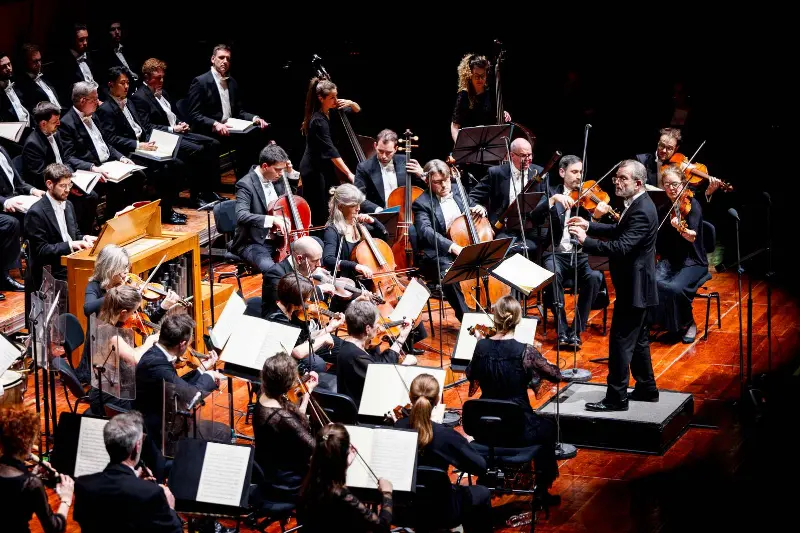
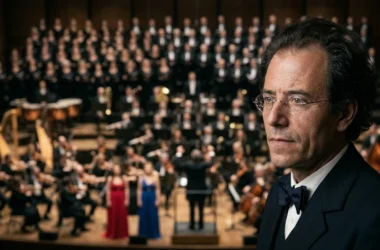
Christophe Rousset conducts Messiah with the Monteverdi Choir and English Baroque Soloists in Rome, December 2025. Photo © Musacchio & Pasqualini / MUSA.
Christophe Rousset avoids both the overly brisk readings of his French colleagues Hervé Niquet (Alpha) and Marc Minkowski (DG Archiv), whose tempo for the Hallelujah still astounds, and the overly reverential slowness of Christophers (Coro) and Trevor Pinnock (DG Archiv). The story keeps moving, each movement flowing into the next, yet I sense little awareness of the work’s structure (Part I has five scenes, Part II seven and Part III four). Gardiner, McCreesh, Pinnock and William Christie are far better at giving us the shape of each scene.
Those conductors also take a more line-by-line approach to shaping the sentiment of the text, whereas Rousset often seems content to establish an opening mood and stay with it. This is not to suggest he is insensitive to the text, but rather that his approach is more generalized than theirs.
The choir does adopt several choral ornaments, a nod to Rousset’s work in French Baroque music. I do wish Rousset had chosen some of the lesser-known versions of the arias, and I was disappointed by his decision to have the choir sing “us” as an eighth note rather than the written quarter note in For Unto Us a Child Is Born. Why adopt this misreading of Handel’s score?
Finally, releases by these forces on their own Soli Deo Gloria label always came with lengthy, erudite notes. On this first release of their new partnership with Harmonia Mundi, we get a brief note on the music, though thankfully the texts and translations are provided.
Overall, this is an energetic, fully professional performance that lacks the interpretive imagination of earlier recordings.
Album Details |
|
|---|---|
| Album name | Handel: Messiah |
| Label | Harmonia Mundi |
| Catalogue No. | HMM 905428.29 |
| Artists | Ana Vieira Leite (soprano), Sarah Connolly (mezzo-soprano), Andrew Staples (tenor), William Thomas (bass), Monteverdi Choir, English Baroque Soloists, Christophe Rousset (conductor) |