
Susan Tomes conceived this album while preparing to write a book about the history of women playing the piano (Women and the Piano: A History in 50 Lives). Although the book was meant to cover women as pianists rather than as composers, her curiosity eventually led her to a diverse array of female composers. Some included here, such as Fanny Mendelssohn, Clara Schumann and Amy Beach, have thankfully begun to enter the piano repertoire, but others, like Marianne Martínez and Raie Da Costa, remain largely unexplored.

Martínez’s Sonata in A major opens the program in lovely fashion. Having had direct associations with Haydn, Salieri and Mozart, she writes in a style that reflects the defining influences of the high Classical era. Tomes brings out the elegance of the Allegro (track 1) through a remarkable level of clarity: textures and notes are well defined yet possess a bell-like resonance, and the gaily chirping motif evokes an optimistic, idyllic character.
The minor-key Rondo (track 2) is approached with sensible idiomatic restraint and is reminiscent of the light melancholy we might hear in the slow movement of a Haydn sonata.
Marianna von Auenbrugger studied composition with Salieri, who, at his own expense, published her Sonata in E-flat major (tracks 4–6). While similar in era and style to the Martínez, von Auenbrugger’s language seems to reflect more of a Beethovenian personality. (Tomes, in her liner notes, muses about what sort of composer she might have been had she lived to be a colleague of Beethoven.) Tomes brings out the bolder, more assertive sound profile and also highlights the orchestral quality that runs through the work.
Fanny Mendelssohn’s Abschied von Rom (track 9) takes us away from the reserve of the Classical fare and into the more emotive Romantic idiom. While the work is still gentle and by no means dramatic or passionate, Tomes conveys a more prominent shade of sadness, particularly through the dissonances that Mendelssohn employs throughout the piece. The tone, too, takes on more resonance and body, which heightens the poignancy.
Clara Schumann’s Notturno that follows is even more harmonically adventurous, and Tomes brings to the melody a rhapsodic yearning that is more cogent than the bel canto we might hear in a Chopin nocturne.
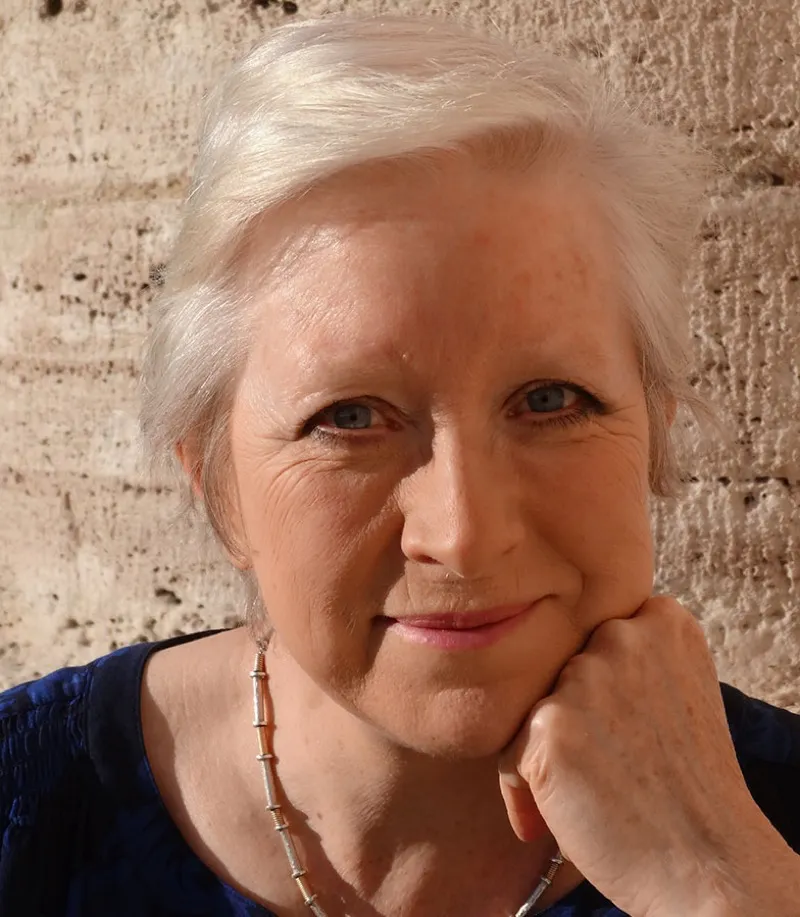
Susan Tomes. Photo © Robert Philip.
Although she never officially studied with Liszt, he called Sophie Menter ‘my only legitimate piano daughter.’ Like Liszt, she seems to have had a captivating effect on audiences wherever she went. Her Romance, Op. 5 (track 12) certainly has charm, but in Tomes’ hands its character is mostly one of coyness and innocence.
Teresa Carreño’s Un bal en rêve (track 13) is another delightful track, portraying different phases of the night; Tomes brings plenty of imagination to her interpretation, with moments of playfulness and whimsy. On the note of sleep, Amy Beach’s Dreaming (track 15) offers a very different and perhaps more complex take: the piece is less outwardly joyful, but Tomes creates a rich tapestry of lyricism amid the calm.
Cécile Chaminade’s Automne, from her Études de concert (track 16), is one of the more dynamic works in the set for its portrayal of different perspectives of autumn. Melodious, thoughtfully shaped sections alternate with more emphatic ones, yet the juxtaposition never feels forced or abrupt. Tomes’ vivid rendering calls to mind gusts of wind amid an otherwise pastoral scene.
The program ends on a fun note with South African pianist Raie Da Costa’s jaunty and occasionally flashy Razor Blades (track 17). There is much to enjoy in its jazzy, ragtime vibe, and it is evident that Tomes has full command of the virtuosic elements too.
The liner notes, written by Tomes herself, are an essential companion to the tracks. She provides concise but helpful descriptions of each composer and her musical and career influences. Although most of the works here are quite short, they are sincerely rendered in excellent performances. I would be quite interested to read Tomes’ accompanying book, and I hope she will release future installments celebrating more female composers.