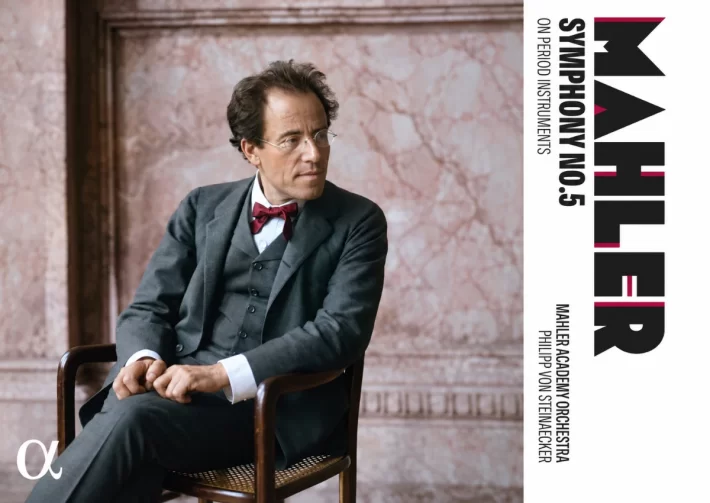
Two years ago I reviewed the first release in this series, a Mahler Ninth (Alpha, 2024 – review), arguing that many of Philipp von Steinaecker’s contentions for “period performance” Mahler were unconvincing. There is no need to rehash those points here. In the liner notes for this release, Steinaecker describes the scholarly work done to ensure that the Mahler Academy Orchestra’s playing (vibrato, bowings, articulation, portamento, and the instruments themselves) matches what Mahler worked with at the time of composition.
But the conceit that the instruments and playing techniques of Mahler’s time result in a more accurate and successful performance is wrong-headed. Ultimately, the point of any recording is its worthiness for repeated listening. The playing here is good, and we hear the scholarship in action throughout. I find this performance more convincing than the team’s Ninth, but as a Mahler Fifth it does not match, let alone eclipse, the performances from Tilson Thomas in San Francisco, Tennstedt in London, Chailly in Amsterdam, Abbado in Berlin, and Bernstein in Vienna, to list just a few.
The scholarship is on display right after the opening movement’s trumpet fanfare: the strings play the first theme (track 1, 1’10”) with minimal vibrato, heightened articulation, shorter bow strokes, and added portamento. But it comes across as a lecture demonstration rather than a musical performance. Where is the numbed grief heard in the Bernstein and Tennstedt readings? Both conductors use articulation, vibrato, and a little portamento to conjure that grief, more successfully than Steinaecker does here. He keeps tight control throughout the faster middle section (5’35”), never letting the music feel as if it might go off the rails. Yet we have a piano roll of Mahler playing a transcription of this music in which he creates a wildness suggesting derailment is imminent. The composer wanted emotional extremes. Should that not be the goal of every conductor of this music?
The second movement takes off at a fast tempo but again lacks that last ounce of wildness. The playing is impressive, but I doubt any composer would choose technical perfection over emotional expression. As the fury subsides, Steinaecker chooses a dramatically slower tempo that loses momentum, and too little is made of the cellos’ lament a few minutes later. After the chorale climax, the opening music returns, finally as unhinged as it should have been at the start of the movement.
The Scherzo brings two interpretive issues into focus. Steinaecker sets significant contrasts of tempo, surely intended for a more impassioned reading, but all too often the slower tempos bring a loss of energy and momentum. Bernstein and Tennstedt adopt tempos just as slow, if not slower, yet the tension never slackens as it does here. There is plenty of character when the orchestra is not focused on scholarly point-making, but just as often the playing seems intent on demonstrating “authentic” differences at the expense of the music’s emotional arc.
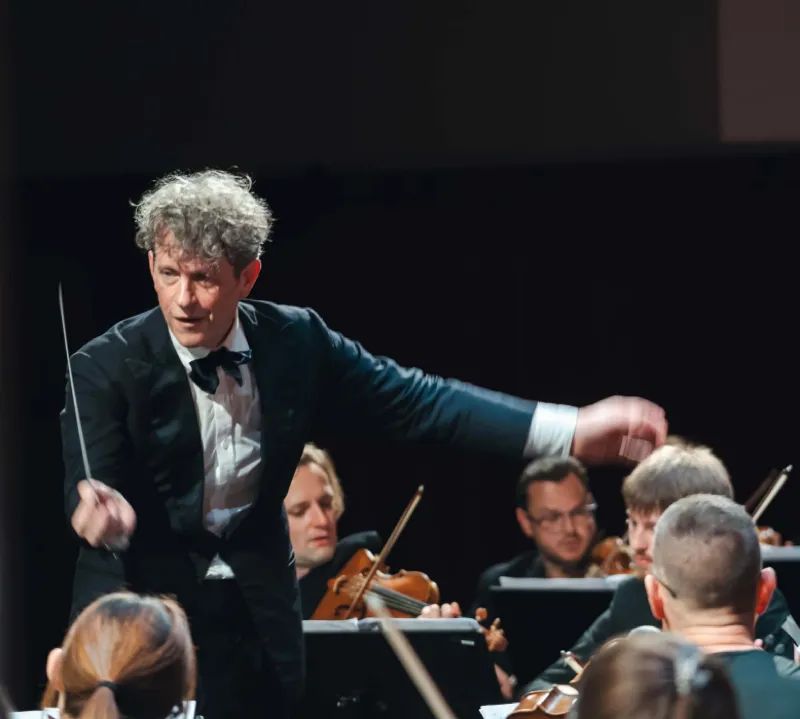
Philipp von Steinaecker.
The Adagietto, chaste and sweetly sung, frustrates: in a reading intent on honoring what Mahler intended, the speed is too slow. Two Mahler disciples with distinctly different interpretive styles recorded this movement within three decades of the composer’s death. Willem Mengelberg’s 1926 reading takes roughly seven minutes, and Bruno Walter’s 1938 reading roughly eight. Both had heard Mahler conduct this music, and in a performance predicated on honoring Mahler’s intentions, surely Steinaecker (9’05”) should be faster, which would arguably suit his orchestra’s less resonant gut strings. In a reading so focused on point-making, this tempo feels willfully out of place.
In the Rondo-Finale Steinaecker finally loosens the reins, and the orchestra clearly revels in playing this music at a driven tempo. At last I sense the energy and power missing from the earlier movements. Steinaecker’s Coda is perhaps the most compelling and distinctive aspect of his interpretation; it would certainly bring any audience to its feet. If only the same freedom and imagination had been applied to the earlier movements.
While I found more to appreciate here than in the team’s earlier Ninth, I remain unconvinced of any greater authenticity, and cannot recommend this performance ahead of those mentioned above.
Recommended Comparisons
Mahler: Symphony No. 5
Bernstein | Tennstedt | Chailly | Abbado | Tilson Thomas