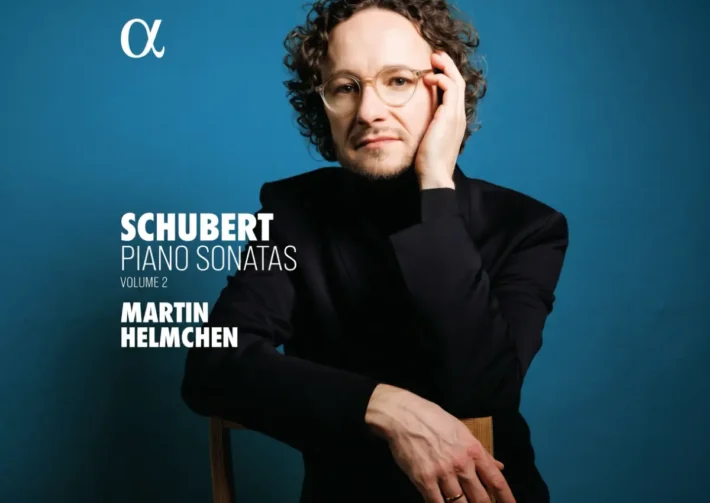
This is the second installment of Martin Helmchen’s four-part journey through Schubert’s complete piano sonatas. His first volume (review) was covered on these pages by Tal Agam back in October 2025. As on that album, Helmchen plays a Bösendorfer 280.
The Sonata in E-flat major, D. 568, was born of a period of determination for the composer: the year before its composition, his friend Josef von Spaun had sent some of his settings of Goethe’s writings to the poet himself, only to receive the cold shoulder. The energy of the Allegro moderato (CD 1, track 1) reflects an undeterred resolve, and Helmchen’s reading takes advantage of the instrument’s crystalline clarity: plucky, with dry articulation and defined staccatos. It is bubbly and effusive, but the running passages often sound too dry and acutely sharp. András Schiff’s 1992 Decca recording (also on a Bösendorfer) offers a different perspective, which I prefer: while energetic and exciting, it consciously rounds off the edges of the sound, giving a greater sense of charm and a more orchestral profile.
In the slow movement, the melodic lines are clearly defined and contoured, but are too forceful at times; some of the accents feel contrived and confrontational, robbing the movement of its sensitivity. The finale (CD 1, track 4) does offer lovely relief, and here we finally get to hear much-needed nuance. The more delicate passages sparkle with a refinement and transparency I’d hoped to hear earlier.
The Sonata in A minor, D. 845, is one of Schubert’s most assertive and dramatic sonatas, but also highly multidimensional. It is this latter quality that gives movements like the Moderato (CD 1, track 5) the basis for their momentum. I have always felt that a successful rendition emphasizes contrast, yet ensures the transitions are smooth. Helmchen’s interpretation satisfies in the power department, and the serious demeanor at its most intense is persuasively fierce. The lyricism is cut off by a series of coercive interjections, which is perhaps what the score calls for, but the entire movement could use a few more shades of character to balance out the predominant heaviness. Listen to Maurizio Pollini in this sonata: he transcends a simple statement of contrast and expresses everything in between, including enigma and contemplation.
The Andante poco mosso (CD 1, track 6) is immaculately defined. Each voice and its trajectory are neatly crafted and mindfully placed in the larger contrapuntal tapestry. As for the finale, Helmchen faithfully evokes the vivace marking. The softer sections are imaginative, reminiscent of bird chirps. The more intense moments display a spicy virtuosity we don’t always get to hear in Schubert’s stylistic language.

Martin Helmchen. Photo © Peter Rigaud.
As he did in the previous installment, Helmchen supplies his own completion (alongside Paul Badura-Skoda’s) in the Sonata in F minor, D. 625, whose ordering of the movements remains unclear. Despite the uncertainty, these compositional supplements are musically well-informed. Unexpected harmonic twists and turns are among Schubert’s quintessential markers; these offer the pianist chances to respond just as compellingly in dynamics and character, chances Helmchen doesn’t always take.
His reading of the Scherzo (CD 2, track 2) immediately calls to mind a Beethovenian perspective, where the movement becomes much more than just a ‘joke’: there is an undeniable audacity and flourish that commands attention. The urgency of the Rondo (CD 2, track 4) seamlessly channels the electricity of the Scherzo and offers a thrilling conclusion to the entire sonata.
The Sonata in G major, D. 894, is the most mature and, dare I say, the most successful composition in the program. It decidedly belongs to the group of the supreme late piano sonatas, D. 958–960, offering a most welcome reflective perspective that balances out the vigor heard elsewhere. Helmchen also saves his best performance of the album for this sonata. He captures well the peace of the hymnal textures in the Molto moderato (CD 2, track 5), and the following Andante derives grace through simplicity. Helmchen responds well to the surprises that await in the charged sections throughout this movement.
While clarity, power, and ensuing excitement are well rendered in the sonatas on this volume, they don’t bring the same sense of nuance and discovery that benchmark recordings offer. Given the more memorable previous volume and the fine performance of D. 894, perhaps a more persuasive embodiment of the elegance in Schubert’s idiom awaits us in future installments.
Recommended Comparisons
Schubert: Sonata in E-flat major, D. 568
András Schiff | Wilhelm Kempff
Schubert: Sonata in A minor, D. 845
Maurizio Pollini | Mitsuko Uchida | Maria João Pires | Alfred Brendel