
After a warmly received recording of Brahms’ Piano Concerto No. 2 (review), Francesco Piemontesi returns with Manfred Honeck and the Gewandhausorchester Leipzig to complete the cycle. As on the previous installment, the release includes a set of companion pieces, this time the Six Piano Pieces, Op. 118.

Twenty-some years separate the two concertos, and while the second is decidedly more optimistic, the first reflects Brahms’ period of personal turmoil and grief following the breakdown and death of his mentor, Robert Schumann. Brahms had intended the work to be his first symphony but ultimately decided otherwise. The dense profile, however, remains its defining feature: an effective performance treats the piano as very much a part of the orchestral fabric.
Upon listening to the orchestral introduction of the opening movement, I was taken aback, having expected an entrance far more heady and powerful. Think of Lars Vogt’s 2019 recording with the Royal Northern Sinfonia (review), or better still, Szell with the London Symphony Orchestra for Curzon and Sawallisch with the London Philharmonic for Kovacevich. Critical driving points like weighty accents, timpani swells, or horn blasts are disappointingly subdued. Honeck seems intent on a more smoothly blended sound, one that doesn’t capture the necessary angst and urgency.
Things change for the better when the soloist joins. Piemontesi does much of the heavy lifting, establishing a staunch presence through a resonant tone and well-structured phrases. This seems to encourage the orchestra to reach for a more assertive character and more deliberate articulation; moments eventually arise that match the emotional demands. By the end of the long first movement, the ensemble has finally found its footing. Could this be a byproduct of the live recording?
In the Adagio (track 2), the Gewandhaus players show how individual horizontal layers of sound move and intertwine, highlighting Brahms’ signature contrapuntal voice. Piemontesi adds to this in nuance and in depth: through delicate gradations of soft dynamics, but also the ability to lean into thicker sonorities, he upholds the dignified spirit of the movement. One of the most beautiful passages (6’18” onwards) brings lovely exchanges between parts, though the clarinets need to come through better.
The finale gets off to a fine start with Piemontesi’s unapologetic entrance, and the ensemble builds on that energy organically. The Rondo derives its suspense from the ever-changing personality of each episode. The one built on the orchestral fugato (from 5’06”) is well executed and speaks to a high level of intricacy and detail from the strings. Later, the cadenza offers a smooth transition from minor to major while setting up a meteoric rise toward the conclusion. By the close, pianist and orchestra generate exhilarating energy, becoming an undeniable force.

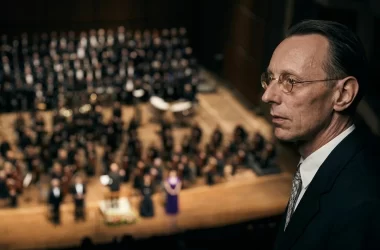
Manfred Honeck and Francesco Piemontesi in rehearsal. Photo © Patrick Wack.
Piemontesi explains in his foreword his choice to include the Six Piano Pieces, Op. 118: their underlying restraint offers a contrast to the more open anguish of the concerto. Yet the set itself is very much about opposites too: extroversion against introversion, rhapsody against reflection are but two of the themes Piemontesi captures solidly in his reading. The Intermezzo in A minor (track 4) may not have the persuasive clamor of Murray Perahia’s account, but the sweeping phrases balance power with lyricism.
The Intermezzo in A major (track 5) shows thoughtful attention to large-scale structure. Well-timed development of long lines and emotional high points captures the right amount of intensity. What could be better are the finer details: while Piemontesi upholds continuity, more delicate responses to certain harmonic color shifts are needed, alongside tasteful moments of pause to contour individual phrases. These would help make some of the lines feel less uniform.
The only piece I didn’t find convincing was the Ballade in G minor (track 6), whose relatively legato approach detracts from the zest and makes things sound heavy instead. While Perahia’s reading reflects an optimal combination of speed and articulation, even slower versions from Emanuel Ax and Igor Levit (review) show how a drier, more angular touch can preserve the verve.
The Romance in F major (track 8), despite its gentle nature, has a pleasing orchestral profile, thanks to Piemontesi’s nicely voiced chords and cohesive integration of multiple voices. The middle section especially reveals an active, fluttery dialogue that complements the placid warmth of the outer sections.
The liner notes are an excellent companion to the music, complete with forewords from Piemontesi and Honeck and analysis from Jan Brachmann. There are a handful of stylistic missteps, but they are outweighed by much stronger points throughout the performances. A recording worth a dedicated listen.
Recommended Comparisons
Brahms: Piano Concerto No. 1
Lars Vogt | Clifford Curzon | Stephen Kovacevich | Nelson Freire
Brahms: Six Piano Pieces, Op. 118
Album Details |
|
|---|---|
| Album name | Brahms: Piano Concerto No. 1 & Six Piano Pieces, Op. 118 |
| Label | Pentatone |
| Catalogue No. | PTC 5187417 |
| Artists | Francesco Piemontesi (piano); Gewandhausorchester Leipzig; Manfred Honeck, conductor |