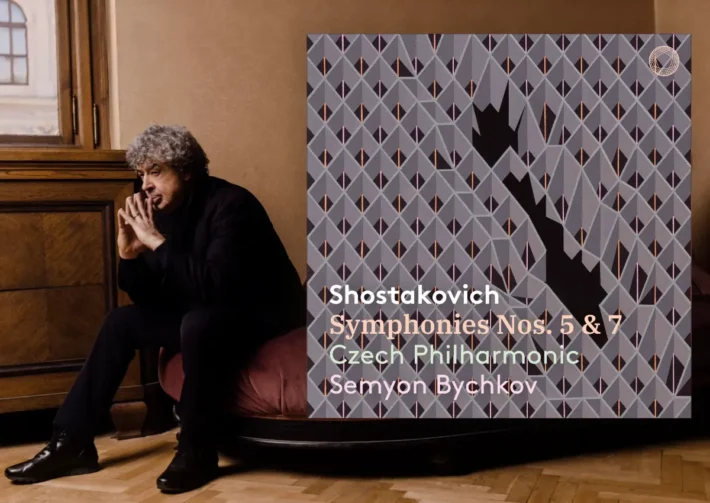
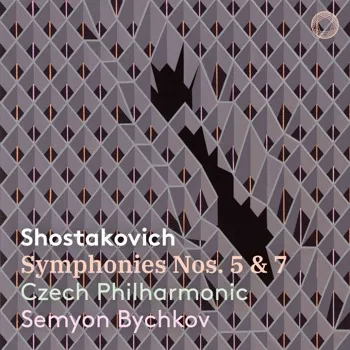
Semyon Bychkov has recorded both these symphonies before: the fifth with the Berlin Philharmonic (Philips, 1986) and the seventh with the WDR Cologne Symphony Orchestra (Avie, 2003). These new recordings, made in the Dvořák Hall of the Rudolfinum, include significant room ambience in the engineered sound. Although there is impressive clarity and a wide dynamic range, I found some of Shostakovich’s angular, sharp-edged writing smoothed down to a burnished gleam, which arguably does not serve the music’s emotional intent. The earlier Berlin performance lacks the depth and clarity heard here, but the sound in Berlin has more bite and a darker color.
Bychkov’s new fifth symphony is one minute slower than in Berlin; most of the difference is in the timings for the opening movement. The Berlin reading has greater drive and a more formidable sense of foreboding. The Czech performance is set at a lower emotional temperature, though the central climax still has terrific power, thanks in no small part to the weightiness of the sound.
The second movement is a dance of mockery, dripping with ironic sarcasm, but one would never know that from either of Bychkov’s performances. Undeniably, Bychkov and his orchestra let us hear every shift in color and articulation, but it feels polite, too slow, and ponderous. Neeme Järvi (Chandos), Rudolf Barshai (Brilliant Classics) and more recently Alain Altinoglu (Alpha) are but three conductors who bring out far more of the music’s snide darkness.
As often happened in their recent Mahler cycle, the slow movement brings out the best from both Bychkov and the orchestra. There is greater emotional investment in the playing: the beauty of the strings, even at the softest dynamics, completely draws one in. The first-chair woodwinds play with an imploring, forlorn quality. This is a notable improvement on the Berlin performance.
The final movement has the same strengths and weaknesses as the first. Excellent playing and well-judged tempos cannot disguise a lack of emotional connection. The Coda is especially frustrating: it can carry a devastating yet defiant power when it sounds hollow and forced, but what I sense here is ambiguity, as if Bychkov is unsure about what he wants to convey. It certainly does not match performances by Manfred Honeck, Kurt Sanderling and Vasily Petrenko. In a crowded field, this reading falls short of the many excellent performances already available.
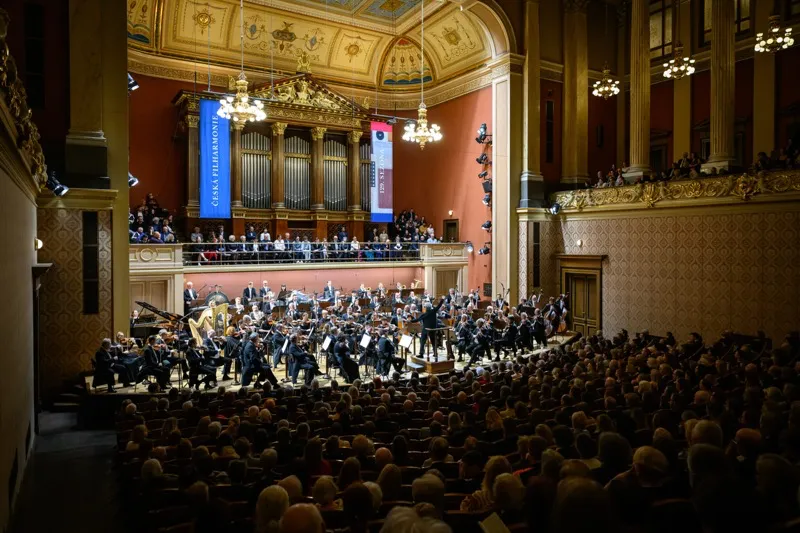
Semyon Bychkov and the Czech Philharmonic in the Dvořák Hall of the Rudolfinum, Prague. Photo © Petra Hajská.
The performance of the seventh symphony is more distinguished. Bychkov’s earlier account of the first movement is impressive, brilliantly played and mostly well paced, but a few awkward gear shifts there are now better integrated, and the slow crescendo is masterfully managed. While the two timings differ little, tension sometimes sags in Cologne. The Czech reading has more consistent drive and emotional thrust.
The same is true of the Moderato — the interpretation is basically unchanged, but the Czech Philharmonic plays with more character. The new Adagio is almost two minutes slower than in Cologne, but energy and tension are better sustained, and the orchestra sounds breathtakingly beautiful. The faster passage, with its driving ostinato pattern in the lower strings, lacks the frantic wildness of other performances, and no other version I know approaches the passionate desperation heard in Bernstein’s famous Chicago version (DG). Nevertheless, the Czech reading has a moving emotional honesty.
Bychkov shapes the Finale carefully to avoid any sense of bombast — the final peroration feels noble and empowering, just as Shostakovich intends.
Pentatone’s ancillary materials are excellent. Assuming this is a one-off recording and not the beginning of a new Shostakovich cycle, it offers up a middle-of-the-road fifth partnered to a more distinguished seventh. Readers using online media can choose to download only the seventh, while collectors of physical product have a harder decision to make.