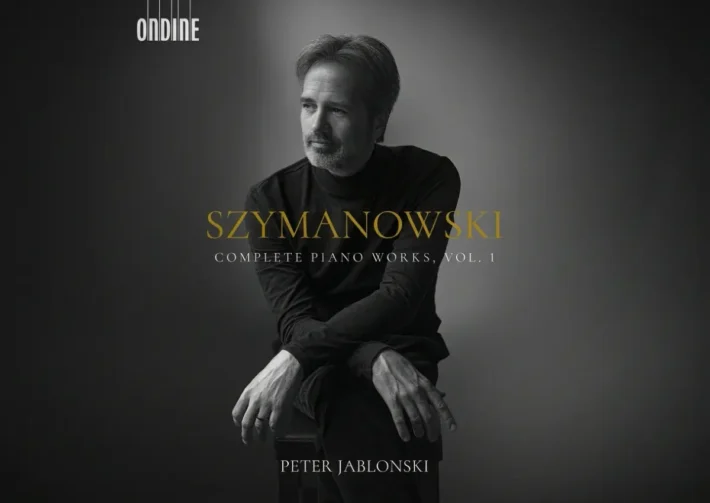
In 2022, I reviewed Peter Jablonski’s volume of Chopin Mazurkas for Ondine (review), remarking on his high level of musicianship and artistry. I was therefore excited to learn of his latest project to record the complete piano works of Karol Szymanowski. This first installment contains two sets of variations, Métopes, Op. 29, and Masques, Op. 34, works that were influenced by both his homeland and his travels abroad.
The Op. 3 Variations in B-flat minor (track 1) feature a theme of the composer’s own creation, and his harmonic flavors come through saliently. They are emphasized to an even greater extent, courtesy of Jablonski’s wide palette of dynamic colors, an observation consistent with what I’d noticed in the Chopin recording.
Although each of the twelve subsequent variations has its own distinct personality, a common thread lies in the importance of voice leading to bring out thematic elements. Whether that’s in between interweaving contrapuntal voices, in a more vertical hymnal texture, or built across more fractured, scampering chords, the pianist upholds the integrity of the theme where it appears, skillfully unifying the set. While most of the work takes on a lightly doleful quality in the minor key, the few moments of major tonality definitely have a different, coyly charming aura.
Another early work, the Op. 10 Variations on a Polish Folk Theme (track 2), has a theme that draws upon Polish folk elements. Although the character is not entirely different from its sister set, Szymanowski does attempt to extend the bounds of his compositional language and style with greater reaches of contrast and chromatic exploration. Jablonski takes note of these developments, particularly in the heavily somber Variation 8 (Marcia funebre), beginning at 11’11”.
The imaginative rendering calls to mind the clanging of large bells, and the surge in intensity results in a calamitous high point. While not as powerfully strident as Krystian Zimerman’s account, it is equally impressive for its reconciliation between tone quality and dramatic effect. While the Zimerman version overall is more raw, unhinged and exciting at choice moments, Jablonski’s performance brings balance to the introverted and extroverted sides of the work in an effective yet polished fashion.
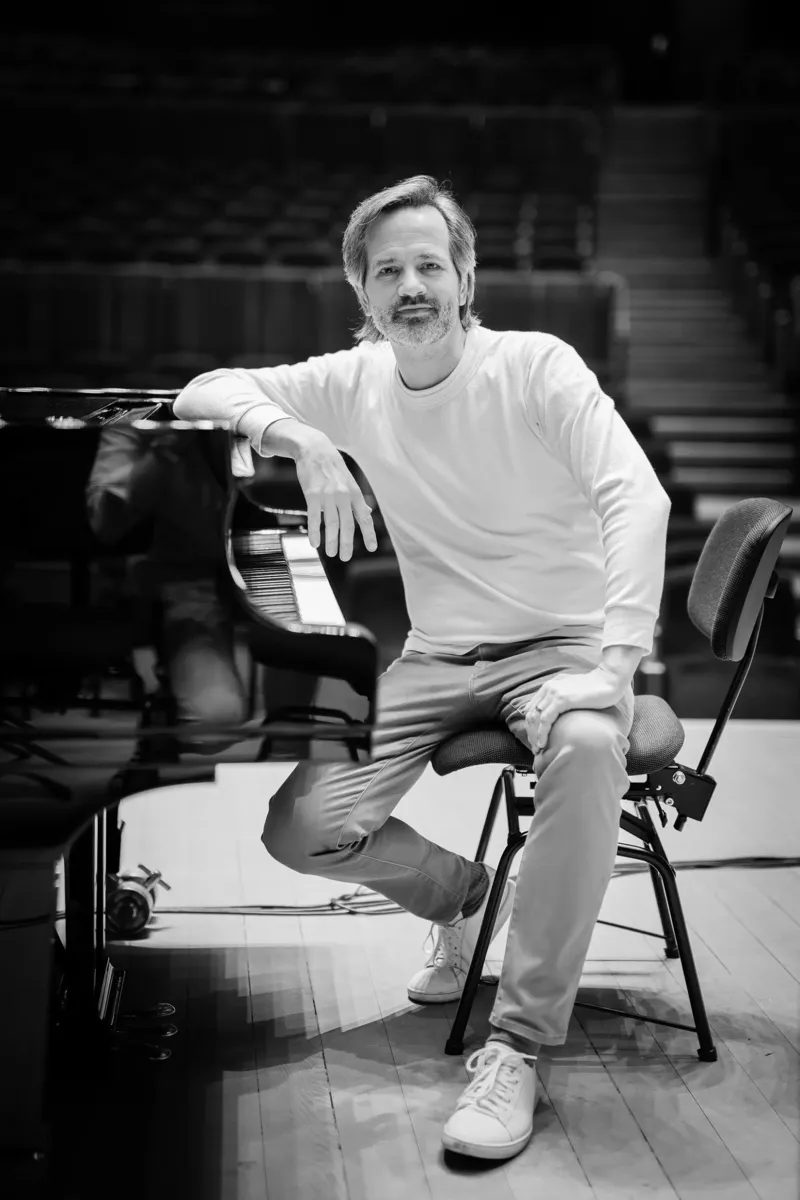
Peter Jablonski. Photo © Radosław Kaźmierczak.
Szymanowski’s travels to Sicily’s ancient temples inspired the Métopes, Op. 29. The triptych takes its name directly from a specific part of their famous bas-reliefs. In translating visual art into an aural medium, the composer uses a musical style quite different from what we heard in the variations: while varied tonality was already a signature part of these earlier works, L’île des Sirènes (track 3) has a much more eclectic sound, calling to mind the language of Scriabin’s later sonatas. Jablonski has recorded Scriabin’s Mazurkas, and while that music is much more tonal, the same sort of effortless fluidity presents itself in Sirènes.
Calypso (track 4) is equally mysterious and, despite the gossamer beauty of Jablonski’s tone, inherently disquieting, which only adds to its allure. In Nausicaa (track 5), he brings out a more playful character through fresh staccatos and attention to the underlying rhythmic material.
As for comparisons, Piotr Anderszewski has a finessed performance of the set, though I found Jablonski’s reading even more inviting in terms of its melodic freedom and the effective use of rubato to create natural ebbs and flows. Sviatoslav Richter’s live performances of the first two Métopes feel more brisk and breezy at times, where Jablonski seems to take more time to contemplate.
The three Masques, Op. 34, share the angular and crystalline sound of Métopes, but Shéhérazade (track 6) ventures into much more ferocious territory. While Jablonski has always been one to pay mindful attention to producing a well-rounded tone, this is an instance in which he gives full force to the textures. The result is rousing and at times terrifying.
Tantris le Bouffon (track 7) has an unmistakably peppery and dance-like flair, while in Sérénade de Don Juan (track 8), we can hear the snappy Spanish folk influences against the increasingly atonal backdrop. Much of the tension through all three works is driven by the volatile relationship between melody and dissonance, which Jablonski manages so well through a distinct treatment of each.
Anastasia Belina’s liner notes are a generous and helpful guide, giving context on the composer’s life before delving into descriptions of each work. In line with his previous recordings, Jablonski upholds a high level of artistry in these performances, and I certainly look forward to future installments in this series.
Recommended Comparisons
Szymanowski: Variations, Opp. 3 & 10
Krystian Zimerman | Martin Jones | Martin Roscoe
Szymanowski: Métopes, Op. 29
Piotr Anderszewski | Cédric Tiberghien | Martin Jones | Martin Roscoe
Szymanowski: Masques, Op. 34
Krystian Zimerman | Piotr Anderszewski | Cédric Tiberghien | Barbara Karaśkiewicz