Robert Schumann wrote his Symphony No. 3 in the autumn of 1850, soon after moving to Düsseldorf to take up his only post as a municipal music director. The Rhineland lifted his spirits, and the symphony poured out in little more than a month. It was the last of his four symphonies to be composed, though it went to press as the third, and it is the most extroverted of them, admired not for inward struggle but for its open, public warmth. Schumann drew its spirit from the life of the great river, and it has long been known as the “Rhenish.”
Unusually, the Rhenish runs to five movements rather than four. The first sets the tone at once, its broad main theme striding across the bar-lines in bold cross-rhythms so that the music seems to surge forward on a single current. A good-humored second movement leans on the swing of a Rhineland folk tune, and a tender intermezzo follows. The fourth movement is the one listeners remember, a slow, chorale-like processional of real solemnity. Its trombones enter for the first time here, and the movement has long been linked to the grandeur of Cologne Cathedral, which had deeply impressed Schumann on a recent visit. A festive finale then clears the air. Schumann’s orchestration was for generations thought thick and hard to balance, and that verdict is exactly where recordings part company. Some conductors lighten or retouch the scoring for clarity, while others trust the original and let its full textures ring.
Here are The Classic Review editorial team’s recommendations for the best recordings of Schumann’s Symphony No. 3 (“Rhenish”).
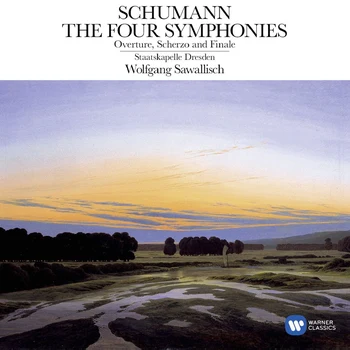
Staatskapelle Dresden, Wolfgang Sawallisch
More than fifty years on, Sawallisch’s Dresden recording is still the one other Rhenishes are measured against. He launches the first movement with headlong momentum, yet the heart of the performance is the solemn fourth movement, where the great Dresden brass and its three trombones give the Cologne Cathedral music a nobility few rivals match. The finale then trips home, light on its feet. Nothing sounds forced or overdriven. It is superbly played and big-hearted, and its long reign at the top of the discography is well earned.
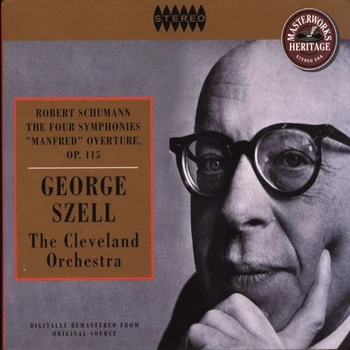
Cleveland Orchestra, George Szell
Nothing in Szell’s Cleveland reading is left to chance. The famous first movement flies, its cross-rhythms placed with an articulation so clean that not a note blurs, and the disciplined finale powers home on the burnished sound of the Cleveland brass. Szell quietly retouched Schumann’s orchestration to clear the textures, a practice he applied across all four symphonies. Some hear the results as cool. In fact the precision generates its own electricity, and it stands among the two or three cornerstone recordings of the work.
Orchestre Révolutionnaire et Romantique, John Eliot Gardiner
Period instruments change the whole argument in Gardiner’s 1997 cycle. Schumann’s scoring was long called thick and clumsy, and the leaner gut strings and period brass answer that charge directly, letting the inner parts register with unusual definition. Gardiner sets out to prove the composer no poor orchestrator, and the Rhenish, with its outdoor energy, makes his case persuasively. The set has the further attraction of gathering both versions of the Fourth. For anyone curious how the symphony sounds without its Romantic upholstery, Gardiner is the essential period choice.
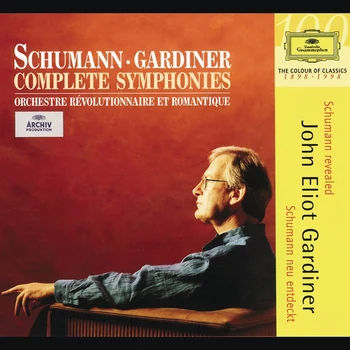
Berlin Philharmonic, Rafael Kubelík
Warmth and geniality run through Kubelík’s account with the Berlin Philharmonic. This is a poet’s Rhenish rather than a virtuoso’s, its big, kindly strings and gently forward woodwinds giving the music a pastoral glow. Where Sawallisch pushes hard, Kubelík takes a mellower, more affectionate view. The finale is the delight, building to a broad, radiant close of real exuberance. The vintage sound has aged gracefully, and nothing here is easier to love.
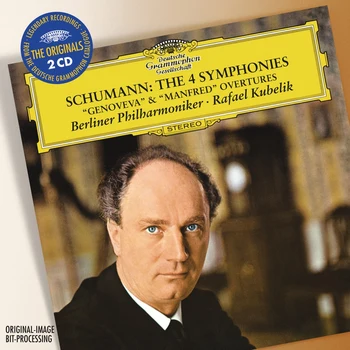
Vienna Philharmonic, Leonard Bernstein
Recorded live in 1984, Bernstein’s Vienna reading is the most spontaneous and openly Romantic on this list. He takes the syncopated opening at a broad, elastic tempo and lets the playing surge and relax with the freedom of the concert hall, and the finale unfolds with a stately, almost ceremonial grandeur. Not everyone takes to the expansive late-Bernstein manner, which lingers where others press on. But few feel so alive to the joy in the music, and none makes a grander case for the Rhenish as pure Romantic celebration.
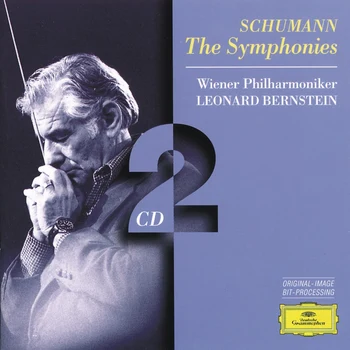
Scottish Chamber Orchestra, Robin Ticciati
Ticciati and his chamber-sized Scottish orchestra strip away the Romantic varnish for a brighter, more transparent Rhenish. Minimal vibrato and roughly sixty players let the winds and timpani speak with real character, and the results are consistently exhilarating. The slow movement carries a surprising depth of feeling, and the airborne finale caps a performance of real vitality. Of the recent small-scale versions it is the front-runner, and a fine place to meet the piece at chamber scale.
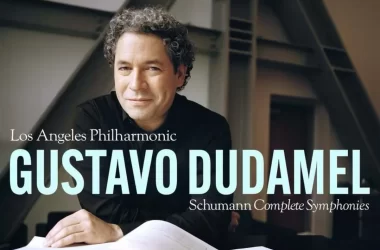
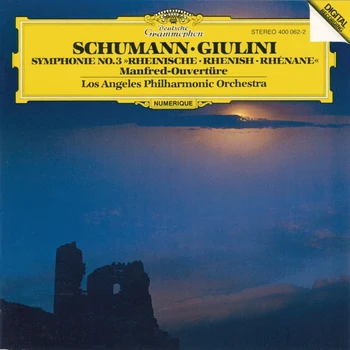
Los Angeles Philharmonic, Carlo Maria Giulini
Giulini takes the opposite path from the chamber sets, and his Los Angeles account is the grandest here. Recorded in the early 1980s, it is weighty and serious yet clear in balance, so the fullness of tone never turns to mud. It unfolds patiently, letting the music expand. Listeners who want urgency and bite may find it too measured, but for sheer breadth and weight of line it has few equals, a reading to sink into rather than be startled by.
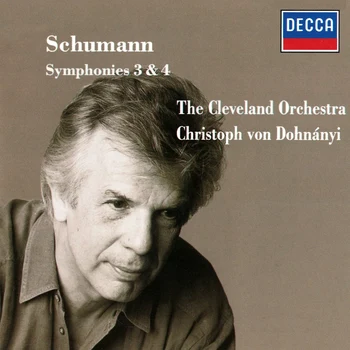
Cleveland Orchestra, Christoph von Dohnányi
The Cleveland Orchestra returned to this music under Dohnányi with the same affinity it had shown for Szell, now caught in bright, modern sound. The playing is alert and responsive, the tempos ideally judged. His touch shows in the first movement, where he thins the horns just after they state the main theme so the woodwind answers come through clearly. It is a cleaner, more measured reading than Szell’s, less overtly driven. Many rate it the equal of the older Cleveland classic, and a few prefer it.
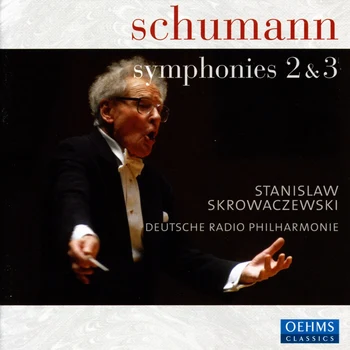
Deutsche Radio Philharmonie, Stanisław Skrowaczewski
Skrowaczewski’s is the surprise of the list, a modern account of blazing energy from an orchestra outside the celebrity circuit. He weds an old-school command to the transparency of period-informed practice, adjusting the scoring here and there so the inner lines stay vivid. The first movement is tautly argued and gripping, and the finale is where he lets loose, driving it from a genial ramble to a rousing, full-throated close. For sheer precision the playing stands comparison with Szell’s Cleveland, and the warm, open sound seals it. Sharing a disc with the Second Symphony, it is a genuine find.
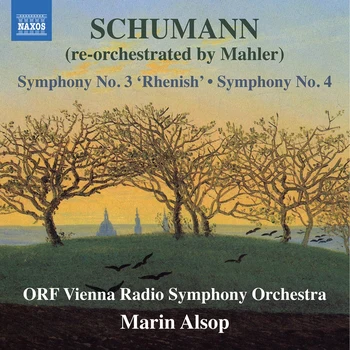
ORF Vienna Radio Symphony Orchestra, Marin Alsop
Alsop offers the symphony in Mahler’s re-orchestration, and this recent recording is the most accessible way to hear that version. The changes are more discreet than the idea suggests, and the music stays recognizably Schumann, but in the Rhenish they tell: the timpani at the very start are sharply pared back, and hand-stopped horns lend a new color as the first movement presses to its recapitulation. The scherzo swings along with a nimble, playful step, and the finale gathers real fire. The textures are light and lyrical, less full-blooded than some will want, but as a window onto Mahler’s rethinking it is hard to beat.
Top image ©️ The Classic Review, AI generated