Holst composed The Planets between 1914 and 1917, and it became by far the most popular music he ever wrote. His starting point was not astronomy but astrology, and each of the seven movements paints the character linked to a planet rather than the planet itself. The suite made him famous almost overnight, a success he came to view with some unease, since it overshadowed everything else he composed.
The score calls for a very large orchestra, including an organ, a pair of harps and, in the final movement, a hidden wordless female chorus. The seven movements run from Mars to Neptune in an order of Holst’s own, not the order of the solar system. There is no Earth, and no Pluto, which had not yet been discovered. The writing ranges from the hammering five-beat march of Mars to the broad hymn at the heart of Jupiter. It ends with the slow vanishing of Neptune, where the chorus fades into silence. That swing between spectacle and stillness is exactly where one recording parts company with another.
Here are The Classic Review editorial team’s recommendations for the best recordings of Holst’s The Planets.
Montreal Symphony Orchestra, Charles Dutoit
Dutoit’s 1986 recording is prized less for interpretive daring than for sheer beauty of sound. It presents the suite as pure orchestral color, captured with a spaciousness and richness that still works as a demonstration disc today.
The playing is refined and clear, with real heft in the loud passages and no loss of inner detail. Venus is a highlight, serene and tender, among the most beautiful on record, and in Neptune the women’s chorus enters almost unnoticed and trails away to nothing. Boult gives you the work with plain authority. Dutoit gives you its surface dazzle, glossy and warm. For opulence it is the one to reach for, one of the most atmospheric accounts of the five.
London Philharmonic Orchestra, Sir Adrian Boult
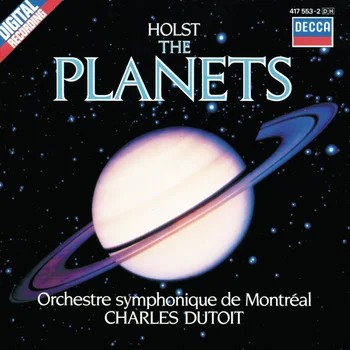
Boult has a claim on this music that no other conductor can match, having led its first performance in 1918 with Holst looking on. His final recording, made in his late eighties, gives the suite plain and sure, with nothing forced and nothing exaggerated.
He holds the shape of each movement with complete command, unhurried in the great slow music yet never letting it sag. The big tune at the heart of Jupiter flows rather than swells, grand without turning pompous. There is no point-making and no chasing of effect, only a conductor who knows exactly where every movement is going. This is not the most spectacular version on the list, but it is the most authoritative, the work heard from the inside.
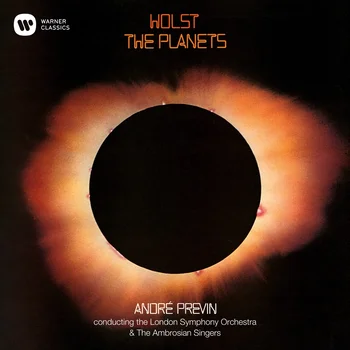
London Symphony Orchestra, André Previn
Power is the first thing you notice in Previn’s 1973 account, the most brass-led reading on the list. The LSO plays flat out, and the whole performance is built for impact.
The brass dominate, bold and blazing, and the orchestra plays with fire. Uranus is the showcase, its lumbering dance opening out into a tremendous organ-and-orchestra climax. Where Boult stays broad and controlled, Previn pushes forward and never lets the pressure drop. The sound has wide dynamic range and a rich, full-bodied bass, and the result is exciting and physical, a Planets with its sleeves rolled up.
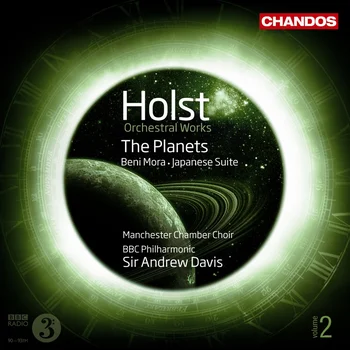
BBC Philharmonic Orchestra, Sir Andrew Davis
Davis and the BBC Philharmonic give a broad, weighty account, built around spectacular engineering. This is not a radical rethinking of the suite but a no-nonsense reading that lets the orchestra’s detail speak for itself.
The sound is the immediate draw, with huge dynamic range and a deep, room-filling bass. Saturn shows it best, where a slow, heavy tread and the toll of its bells build to a shattering climax before the music subsides. The disc also gathers two of Holst’s rarer orchestral pieces, so you come away with more music than the single-work rivals offer. It is the pick for anyone who wants state-of-the-art sound and a fuller portrait of the composer in one place.
Vienna Philharmonic Orchestra, Herbert von Karajan
No reading here has more personality than Karajan’s 1961 account. The Vienna playing has a sheen and tonal weight that set it apart from the plainer, more traditional readings around it.
From the first bar the reading holds a magnetic tension, urgent and tightly coiled. Mars is the touchstone, remorseless and faintly sinister, its heavy brass leaning hard into the music’s menace. The early stereo sound shows its age beside the digital rivals, yet it stays vivid and full-bodied, and the sense of a great orchestra working at its limit is thrilling. Come to it for interpretive personality and vintage glamour, not for the last word in recorded sound.
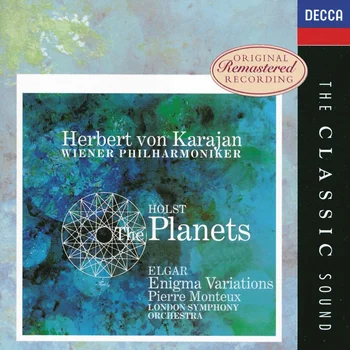
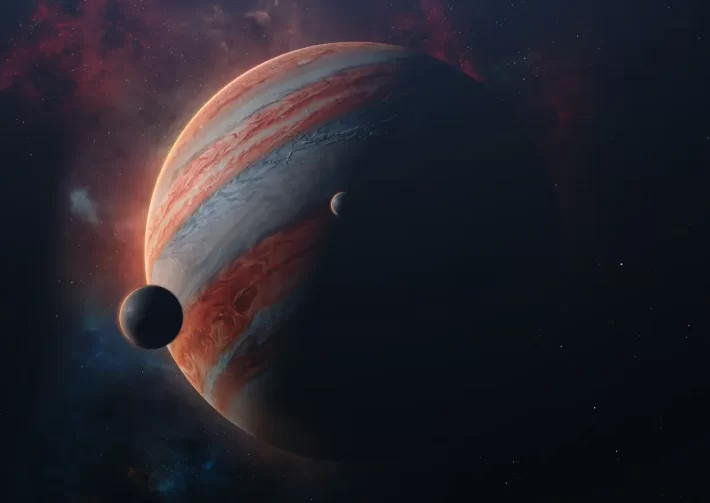
Photo by Javier Miranda on Unsplash