I first discovered the symphonic works of Mélanie Hélène Bonis on a CD featuring the Bucharest Symphony Orchestra conducted by Benoît Fromanger (Le Chant de Linos, 2013). Although Bonis composed over three hundred pieces throughout her lifetime, her entire orchestral output fits comfortably onto a single disc.
That recording had the field to itself until the 2023 release of Compositrices, an eight-disc boxed set from Palazzetto Bru Zane. Consisting entirely of music by French Romantic women, the collection includes Bonis’s ambitious Les femmes de légende. Each of its three movements presents a musical portrait of a female character: Ophélie, Salomé, and Le Songe de Cléopâtre. The impressionistic harmonies and orchestration are captivating, even if the performance by the Orchestre national du Capitole de Toulouse under Leo Hussain lacks the ardor of Fromanger’s reading.
Just a few weeks after the Bru Zane release came another recording, this time played by the Orchestre national de Metz Grand Est led by David Reiland (La Dolce Volta). Its evocative atmosphere and seductive playing make it an easy first choice.
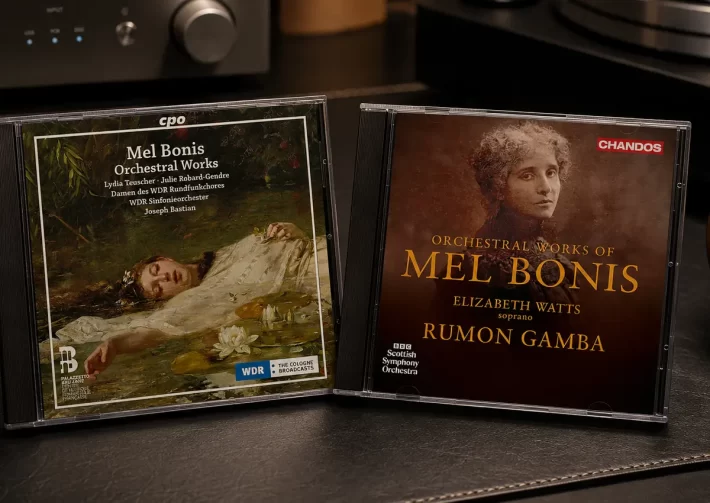
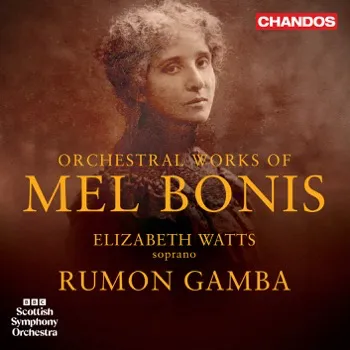
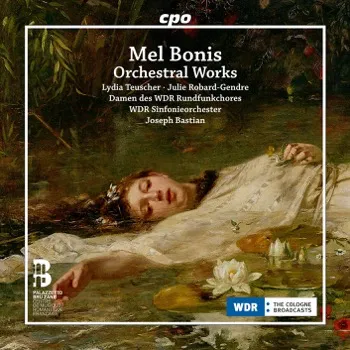
Now, in the space of just six weeks, two new releases of Bonis’s orchestral music have arrived. Both are splendidly played, offering first-class engineering and providing further confirmation that this repertoire deserves to be much better known.
The earliest work on the program, Les Gitanos, was originally written for piano and dedicated to the composer’s father. Its orchestration is not by Bonis, but rather by Adolphe Gauwin. Both ensembles play it well, but to different ends: the WDR musicians suggest the refined ambiance of a New Year’s Day concert in the Musikverein, whereas Gamba and his Scottish players locate a much more vibrant Moulin Rouge atmosphere.
Structured in three movements, the Suite en forme de valses consists of a Ballabile, an Interlude et Valse lente, and a Scherzo-Valse. Both readings impress, though here and throughout the album, I find the Chandos engineering more pleasing. The extra room ambiance warms the orchestral sound and better serves the music’s kaleidoscopic, impressionist hues. Gamba’s faster tempo in the Scherzo-Valse section produces a deft, felicitous quality that speaks with convincing French fluency.
The interpretations of the Suite orientale and Trois Danses are rather evenly matched. In neither performance do the oriental elements sound particularly vivid, at least compared to what Camille Saint-Saëns conjures in Samson et Dalila or his fifth piano concerto. Nevertheless, the opening Prélude, featuring a lovely solo for English horn, carries greater poignancy in the Köln recording.
Both albums include two songs with orchestra: Le Chat sur le toit (The Cat on the Roof) and Noël de la vierge Marie (Christmas Carol of the Virgin Mary). In Köln, soprano Lydia Teuscher performs the first song, while the second is taken by mezzo-soprano Julie Robard-Gendre. Elizabeth Watts sings both selections for Gamba. While Watts is her usual excellent self, I welcome hearing the differing vocal colorings on the CPO release. Teuscher proves slightly more uninhibited when navigating the winding chromaticism of Le Chat sur le toit.

Mel Bonis
(image reproduction: ©️ The Classic Review)
The subtlety of Bonis’s writing becomes most apparent in Salomé, the second movement of Les femmes de légende. This delicate nuance is perhaps striking because many of us listen with Richard Strauss’s famous musical portrayal of the character firmly in mind. Bonis paints a contrasting picture. Her Salomé is not overtly sexual but deeply sensual, devoid of evil intent or manipulative edge. While there is greater eroticism and opulence in the portrayal of Le Songe de Cléopâtre, she remains chaste, appearing more human than archetypal femme fatale. It makes for fascinating listening, and both of these new readings are more than a match for Reiland’s previously mentioned performance.
Excellent liner notes accompany both albums. While the CPO engineering is commendable, the super-audio sound provided by Chandos is finer still.
Gratitude is also due to Rumon Gamba for his consistent efforts to record music by women composers. His four albums dedicated to English composer Ruth Gipps, alongside works by Icelandic composer Jórunn Viðar and English composer Dorothy Howell, show real thought and care, and that commitment carries from the podium to the orchestra.
How, then, to choose? The CPO recording offers an additional work, Le Ruisseau (The Brook). Originally conceived as a duet for soprano and alto, it is affectingly sung here by the women of the WDR Rundfunkchor. While I ultimately find the Chandos audio quality and Gamba’s Gallic elegance more appealing, there is gladly room on my shelves for both albums.
Album Details — Gamba (Chandos) |
|
|---|---|
| Album name | Mel Bonis: Orchestral Works |
| Label | Chandos |
| Catalogue No. | CHSA 5381 |
| Artists | BBC Scottish Symphony Orchestra, Elizabeth Watts (soprano), Rumon Gamba (conductor) |
Album Details — Bastian (CPO) |
|
|---|---|
| Album name | Mel Bonis: Orchestral Works |
| Label | CPO |
| Catalogue No. | 555 752-2 |
| Artists | WDR Sinfonieorchester Köln, Damen des WDR Rundfunkchores, Lydia Teuscher (soprano), Julie Robard-Gendre (mezzo-soprano), Joseph Bastian (conductor) |