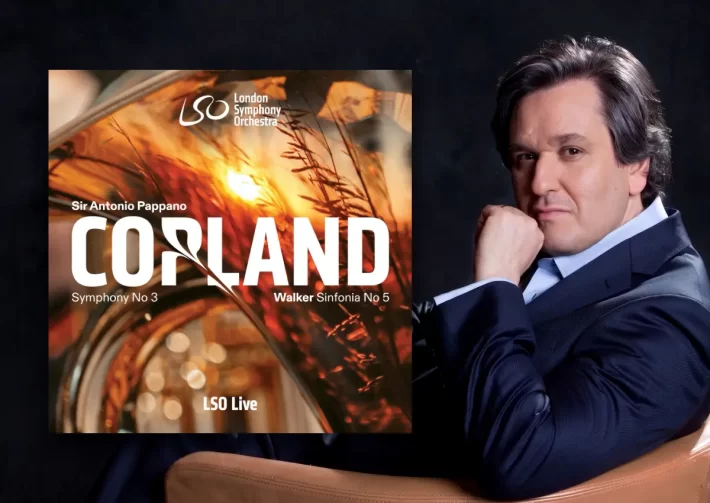
Sir Antonio Pappano and the London Symphony Orchestra pair Aaron Copland with contemporary compatriot George Walker. Both orchestral works serve as profound musical commentaries on the social climate and the spirit of the American nation at distinctly different points in time.
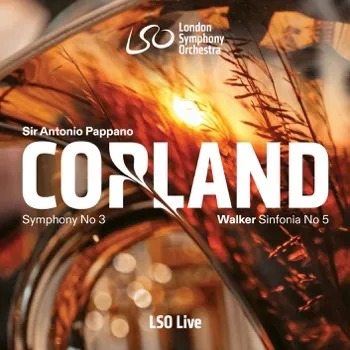
In his Third Symphony, Copland wished to convey the euphoric spirit that emerged at the conclusion of World War II. Throughout the first movement alone, several iterations of this optimism resonate powerfully in Pappano’s reading. The initial hopefulness of the winds, for instance, gracefully transforms into a more expansive feeling within the strings’ sweeping phrases. While perhaps not as subtle an awakening as the iconic opening of Appalachian Spring, the orchestra nevertheless expresses a refreshing vitality.
Because much of the writing throughout this movement is inherently cinematic, the performance excels in its panoramic perspective and vivid evocation of drama. The buildup commencing around the 2’40” mark serves as a prime example: the doggedness of the strings, coupled with resonant horn blasts, vividly portrays an arduous uphill journey culminating in a cataclysmic high point that the ensemble attends to wholeheartedly.
Continuing this optimism through opposing textures and emotional variants, the Allegro proves highly effective. On one hand, the brass and bass drum deliver hefty, unapologetic whomps. Conversely, the lighter winds, strings, and xylophones flutter about, depicting scurrying scenes of eager anticipation. Perhaps the greatest challenge of this movement lies in making these contrasts and transitions simultaneously clear and seamless. While Leonard Slatkin’s account with the Detroit Symphony Orchestra admirably captures the crispness of Copland’s phrasing, Pappano and his London ensemble prove even more successful in enlivening the zesty spirit of adventure, and occasional touch of humor, central to the score. They also do not neglect the music’s more sophisticated side, bringing ample continuity to the melodious writing that emerges mid-movement. The resulting narrative is both dynamic and exciting in its volatility.
Turning to the third movement, Copland presents some of the symphony‘s most nuanced writing. Exhibiting exquisite bow control in the opening passage, the strings conjure an eerie, esoteric atmosphere. As additional layers enter one by one, their transparency makes the trajectory of an otherwise dissonant tapestry remarkably easy to follow. Standing out as one of the interpretive highlights, a gorgeous flute solo near the 3’20” mark conveys a rare instance of tenderness and fragility.
Most recognizable for its integration of the Fanfare for the Common Man, the final movement rightly gives the brass section full billing. Although the landmark recording by Leonard Bernstein and the New York Philharmonic ultimately commands slightly more authority, there can be no complaints regarding how beautifully blended the London brass remains throughout this spirited finale.
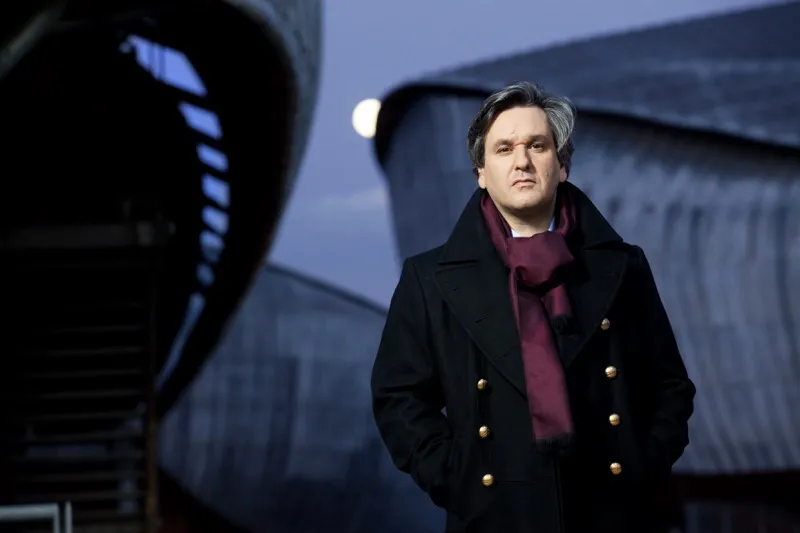
Conductor Sir Antonio Pappano. Photo © Musacchio & Ianniello.
Fast-forwarding to the twenty-first century, George Walker composed his Sinfonia No. 5 ‘Visions’ in 2016 as a stark reflection upon a profoundly disturbing event: the 2015 murder of nine African American churchgoers by a white supremacist in Charleston, South Carolina. Fueled by Walker’s personal connection to the city and his own identity, the resulting work is jarring, riveting, and uncompromisingly honest.
Much of Visions expresses outward anguish, a quality duly captured by the brass section. The stringency and rawness found in their discordant outbursts feel completely appropriate, while the strings further build upon this tension, adding visceral urgency during moments of communicated suffering.
However charged the atmosphere may be, the music does not rely solely on relentless intensity. In the quieter sections, a more intimate angle of Walker’s grief emerges. Consistently entrusting the winds to navigate this side of the emotional palette, the composer draws out a poignant mellowness that the principal players deliver with profound sensitivity.
What arguably makes Walker’s composition so effective is his command of varied instrumentation, particularly the extensive use of percussion. Unafraid to create harsh sonic clashes and discordant harmonies, he ensures his underlying message is unmistakably heard. Honoring this intent, the ensemble makes no attempt to temper the sound or manufacture an ear-pleasing polish. It is precisely this blistering candor that so firmly grips the listener.
Ultimately, these are two significant works, thoughtfully paired for both their thematic resonance and musical weight. Delivering sincere and entirely convincing readings, Pappano and the London Symphony Orchestra certainly do justice to both.
Recommended Comparisons
Copland: Symphony No. 3
Bernstein / New York Philharmonic (DG) | Slatkin / Detroit Symphony | Bernstein / New York Philharmonic (Sony) | Mata / Dallas Symphony
Walker: Sinfonia No. 5 ‘Visions’
Hobson / Sinfonia Varsovia | Noseda / National Symphony Orchestra