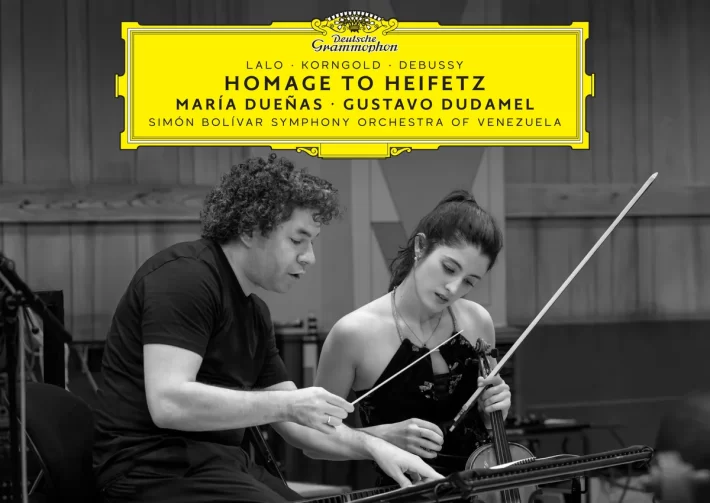
María Dueñas partners with Gustavo Dudamel and the Simón Bolívar Symphony Orchestra of Venezuela to celebrate an artist she has long regarded as an inspiration. Jascha Heifetz’s vinyl recordings of the major works presented here—Lalo’s Symphonie espagnole and Korngold’s Violin Concerto—were ones she grew up with. She also had the opportunity to record three of the accompanying shorter works on his own 1731 ‘Heifetz, Piel’ Stradivarius.
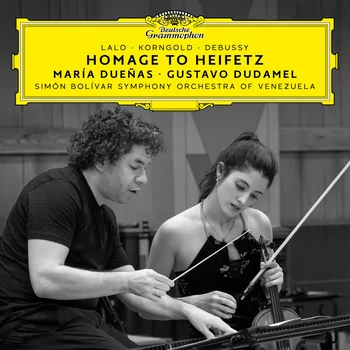
Dueñas mentions that Heifetz’s soul and fire are what have shaped her own playing, and a work as striking as the Symphonie espagnole is a fitting vehicle for those qualities. The orchestra plays a part-and-parcel role in driving the extroverted, passionate spirit of the concerto, and their punchy entrance in the Allegro non troppo (track 1) commands undivided attention.
Dueñas plays with plenty of verve (the opening is perhaps even more emphatic than her predecessor’s recording with William Steinberg and the RCA Victor Symphony Orchestra); there is, however, another, complementary persona that embraces lyricism and poignancy and ensures the melodiousness of Lalo’s writing is never lost. Where Dueñas and Heifetz sound most similar is perhaps in the middle register, as both lean into the strings with their bows to draw a warm, resonant presence.
The Scherzando exudes playful charm as Dueñas adds a coy innocence that contrasts with the smoldering tempestuousness of the previous movement. The Bolívar players evoke a delightful levity in their neat pizzicatos and trills, upon which the soloist builds an improvisatory feel in her part.
The Intermezzo (track 3) shares the vibrant character heard in the Allegro non troppo, but it is the Andante (track 4) that captures the deepest sense of pathos. The ensemble’s thick sostenuto gives Dueñas a rich background texture to work with, and her wide expressive range doesn’t disappoint: some sections express sadness at barely above a whisper, while others powerfully evoke a more tragic presence.
I found Dueñas’ reading of this movement perhaps the most different from Heifetz’s, which is in some ways less outwardly intense but speaks more soulfully and profoundly to the listener.
Korngold’s Violin Concerto possesses intensity, but in a manner different from the melodrama of the Lalo: its harmonic language is more adventurous and its phrasal architecture more expansive. The Moderato nobile (track 6) draws its intensity from anticipation. Dueñas shows plenty of staying power in the held notes of the high register and, together with sparkling fingerwork, reveals the composer’s lush language.
The comparison with Heifetz’s recording reveals some interesting distinctions, though both capture Korngold’s cinematic essence. I found Dueñas’ tone headier and at times angular (owing partly to the bright timbre of her instrument), going hand in hand with her rhapsodic treatment of the virtuosic passages. Heifetz’s sound, meanwhile, is generally smoother yet resonant, evoking nostalgia in choice moments.
The Romance (track 7) is gorgeous, capturing the tender and dreamy side of the work. Dueñas’ ability to switch to a more gossamer sound is impressive, showing that she is as much at ease with nuance as with sensation. The orchestra is highly responsive to the soloist, meeting her at every turn in its color changes and phrase contouring.
The intricacies of the swashbuckling Finale (track 8) are expertly synchronized between the forces, and despite all that is going on texturally and tonally, passages are approached with clarity and ease.
I was curious to hear how the switch of instrument in three of the shorter works would influence the readings. Dueñas performs Léon Roques’ arrangement of Debussy’s La plus que lente (track 10) on the Piel, and we immediately hear the violin speak in a way that recalls Heifetz’s recordings of the two concertos. The timbre is subtler yet more complex in its husky, vocal profile. Combined with her lithe phrasing and lovely soft dynamics, the result is limpid and otherworldly.
Heifetz’s arrangement of La chevelure from the Chansons de Bilitis (track 11) sounds deeply intimate, with Dueñas channeling the instrument’s throatiness to create enigma and suspense. Pianist Itamar Golan proves equally receptive to the dark, almost sinister undertones. Dueñas and her collaborators give top-notch performances that do justice to a heartfelt homage.
Recommended Comparisons
Lalo: Symphonie espagnole
Jascha Heifetz | Itzhak Perlman | Anne-Sophie Mutter | Kyung-Wha Chung
Korngold: Violin Concerto
Jascha Heifetz | Itzhak Perlman | Gil Shaham | Anne-Sophie Mutter
Album Details |
|
|---|---|
| Album name | Homage to Heifetz |
| Label | Deutsche Grammophon |
| Catalogue No. | 4867487 |
| Artists | María Dueñas, violin; Itamar Golan, piano; Simón Bolívar Symphony Orchestra of Venezuela; Gustavo Dudamel, conductor |