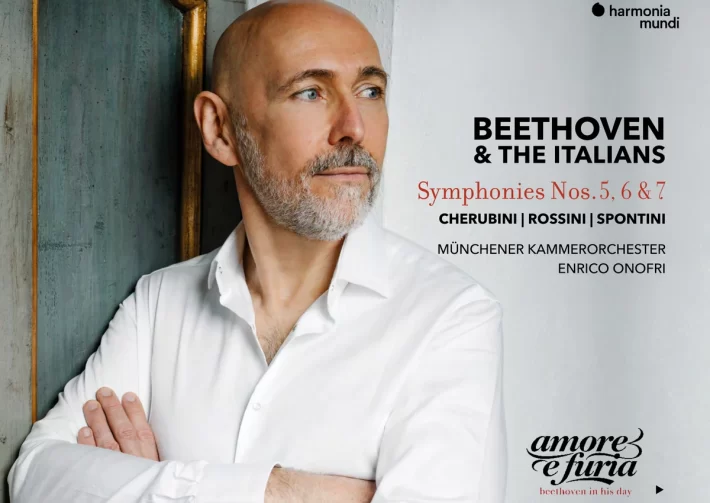
This new release sets Beethoven‘s Symphonies Nos. 5, 6 and 7 beside works by Cherubini, Spontini and Rossini, to reveal parallels and influences between the two. Enrico Onofri, a conductor new to me, leads the Münchener Kammerorchester with interpretive ideas that prove both thrilling and frustrating.
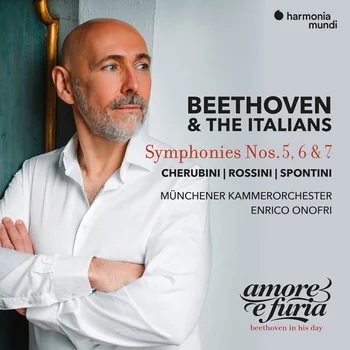
The program opens with an exhilarating reading of Cherubini’s Médée Overture. Although the Munich Chamber Orchestra play on modern instruments, their bowing, articulation, use of open strings, and minimal string vibrato could lead listeners to mistake them for a period-instrument ensemble.
It is likely that the brass are period instruments; the timpani are played with hard mallets and the winds are well to the fore, creating a far more heterogeneous palette of color than is heard in Marriner’s middle-of-the-road performance (Academy of St Martin in the Fields/Warner Classics). Munich’s incisive and dramatic playing is more compelling.
The same cannot be said of Beethoven’s Fifth. Onofri all but ignores the fermatas in the opening bars, as well as the fermata for the first violins a few bars later. Throughout the first movement, rhythmic distortions and unusual articulation are used, perhaps to create more light and shade. But this music is built on incessant, unrelenting momentum; to work against that is to ignore its basic purpose. It also negates the intended moment of calm we are meant to feel during the oboe cadenza in the recapitulation.
It should be the one point where everything stops and we experience a moment of tranquility, until the rest of the orchestra rudely dismisses the idea. Here the oboe makes a full meal of it, and Onofri inserts a long pause afterward, as if the orchestra were weighing the idea of peace: again, the opposite of Beethoven’s intent.
The inner movements are better, because Onofri makes far fewer interpretive interventions. He does insert unmarked swells on long notes, something Norrington and Mackerras both embraced in their first Beethoven cycles (and did not return to in their second traversals).
The Trio section of the Scherzo is brilliantly played, and I like how Onofri adds length and weight to the opening three chords of the finale, giving us the chance to really hear the new sonority of the added trombones and piccolo. The first movement’s interpretive manipulations mar an otherwise exciting performance.
The first movement of Beethoven’s Sixth feels fast (10’50”), though it falls within the range of several recent performances: Immerseel/Anima Eterna on Zig-Zag Territoires (10’37”), Krivine/La Chambre Philharmonique on Naïve (10’53”) and Honeck/Pittsburgh on Reference Recordings (11’01” – review). But each of these earlier readings features greater flexibility of pulse and less aggressive playing, whereas Onofri seems ruthlessly efficient.
The Scene by the Brook is shaped with care, with subtle rubato and soft playing of real delicacy, but there are moments, when the violins have the melody, where one struggles to hear it in the overall texture. The Munich string section is small (the booklet lists 6/5/4/5/2 for the Pastoral), even compared to other historically informed performances: Savall uses 10/8/6/5/3 (review) and Gardiner (Symphonies 5 and 7/SDG) uses 12/10/8/6/4. Throughout the program, the strings lack the presence and power they need.
The stomping energy of the Scherzo feels particularly folksy (listen out for the surprise towards the end of the movement), but the storm is curiously slow, lacking the drive and vivid pictorialism that is so often a highlight of historically informed performances. The Shepherds’ Song finale is joyous, though the braying horns and undernourished strings rob the music of any spiritual ecstasy.
Beethoven’s Seventh receives the most successful performance, because Onofri offers far fewer interpretive ideas. By this point, though, the string problem felt omnipresent, a continual distraction from full engagement with the playing.
And then there are “the other Italians.” Spontini’s Olimpie Overture follows the Fifth, its three-chord opening an immediate connection to the finale of the symphony. It is played with technical brilliance and arresting vitality.
Onofri, to his credit, rejects treating Rossini’s Guillaume Tell Overture as “pops” music; instead, he highlights its originality and symphonic dimensions. The opening is played with real tenderness, and the trombones are impressive in the storm, but once again the strings lack presence.
The final work is Cherubini’s Symphony in D major, in a performance more convincing and better played than Bellugi’s reading (Sanremo Symphony Orchestra/Naxos) or Chailly’s La Scala album (Decca). Onofri’s reading is significantly slower than both, and that extra time allows for lovely lyrical moments.
The program does draw out some parallels between the compositions, but not to any revelatory degree. I would return to this recording for the performances of the Italian repertoire.
Album Details |
|
|---|---|
| Album name | Beethoven & the Italians: Symphonies Nos. 5, 6 & 7 – Cherubini, Rossini, Spontini |
| Label | Harmonia Mundi |
| Catalogue No. | HMM 902443.45 |
| Artists | Münchener Kammerorchester; Enrico Onofri, conductor |