
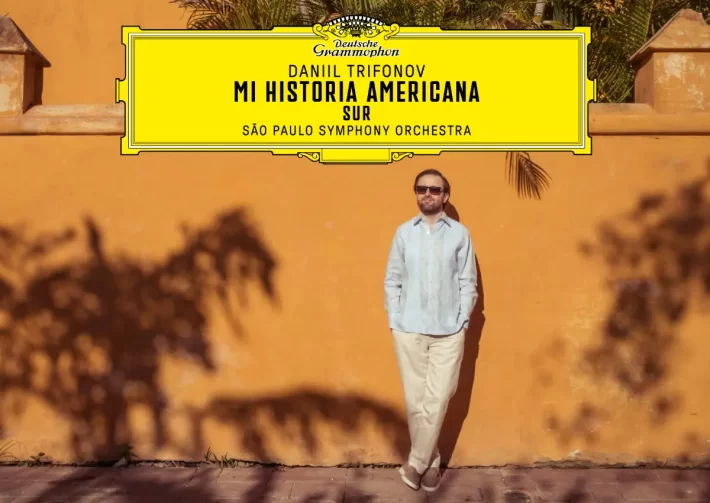
Daniil Trifonov’s newest album is a collaboration with Gonzalo Grau and the São Paulo Symphony Orchestra. It is a collection of 20th-century works by Alberto Ginastera, Heitor Villa-Lobos, and Osvaldo Golijov, with world premieres from some lesser-known composers nestled in. Mi Historia Americana: Sur is a companion recording to his North American album, My American Story: North (review), released two years ago.

Beyond being part of a series, this album reflects a personal connection Trifonov has with the region: his wife is from the Dominican Republic, and he has spent much time in the country, immersing himself in merengue and salsa. This familiarity is evident in works like Golijov and Grau’s Cuadros del Sur, one of the world-premiere recordings and a work written specifically for this project. The suite takes its structural inspiration from Mussorgsky’s Pictures at an Exhibition, and indeed, seven promenades built on the same theme alternate with different Latin American dances. This is a refreshing and musically informative work that takes us on a journey from the Caribbean to the Andes.
There are moments of peace and reflection, which Trifonov and the ensemble approach beautifully, but movements like Candomblé (track 14), Caribe (track 20), and Yoruba (track 22) are where they bring unique dance rhythms and eclectic percussive characters to life with care and enthusiasm.
Perhaps in a gentler light, Trifonov’s arrangement of Michel Camilo’s Suntan (track 10) also evokes the energy at the heart of Latin American music. Although I felt less pedal might better capture the snap of the rhythms, the performance nonetheless conveys the music’s sunny energy in a fun and carefree manner.
Trifonov’s inclusion of darker, dramatic works like Villa-Lobos’s Bachianas Brasileiras No. 4 adds dimension to the program. This four-movement cycle is an interesting combination of moods, all of which Trifonov evokes convincingly. The Prelúdio (track 34) reflects the somber character and texture of a Bach passacaglia, while the Coral (track 35) has some beautifully colored jazz harmonies that he uses to create moments of poignancy and reminiscence.
The Ária is the most jarring movement: the cataclysmic chords that open the piece give way to a middle section of flurried chords, through which Trifonov builds a sense of urgency. The final section resembles a cavernous hymn and, while slower and quieter, seems to prolong the disquiet rather than offer peace. The concluding Dansa (track 37), however, offers a surprisingly positive spin, as Trifonov recalls the bright energy heard elsewhere. The ending is not without a surprise, though: his insistence on the touches of dissonance serves as a reminder of the earlier movements.

Daniil Trifonov. Photo © Dario Acosta / DG.
Thick atonality meets Latin rhythms in Ginastera’s Piano Sonata No. 2, which receives a compelling reading. The Allegramente (track 7), despite being highly rhythmic, has an undeniable sense of chaos that never becomes overbearing. Perhaps it is due to Trifonov’s tone: he has always had a polished sound, which works well here to temper the stringency of the musical language.
I found the Adagio sereno (track 8) the best movement: the bell-like clarity and shades of piano bring out an enigma in the stillness, and some of the tone clusters call to mind Messiaen. Much of the movement’s aura comes from residual sound and silence, and Trifonov handles these moments unhurriedly. The Ostinato aymara (track 9) has a visceral, infectious drive thanks to the precise, deliberate treatment of its pervading rhythmic patterns.
Gabriela Lena Frank’s Sonata Andina (tracks 2–5), also a world-premiere recording, is in some ways similar in character to the Ginastera. While not as strident, it favors sharp rhythms, tone clusters, and atonality over conventional harmony and lyricism. Despite the severe textures, Trifonov draws an integrated thread through all four movements, shaping the work into a large-scale narrative.
A series of smaller pieces adds beautiful touches to the program. Ary Barroso’s Aquarela do Brasil (arr. Grau), which opens the album, is one of the most inviting, cinematic tracks, with its vivacious percussion section and the piano’s breezy part smoothly synchronized with the ensemble.
Rafael Landestoy’s El vals de Santo Domingo (track 29) is simply charming. Through its light melancholy, Trifonov gives the melodic lines a lyrical, romantic air that is nostalgic, dreamy, and tender.
Trifonov has always prided himself on being a pianist-composer, so it comes as no surprise that he features his own Tango (track 31). It reflects aspects of other works heard here: fierce, angular dissonances, a lyrical and sensual middle section, and a passionate, tumultuous finale.
Through a generous offering of solo and ensemble works, Trifonov and company show the dynamism of the Latin American musical tradition. It is a highly intriguing, enjoyable, and finely rendered program.
Recommended Comparisons
Ginastera: Piano Sonata No. 2
Barbara Nissman | Mariangela Vacatello | Fernando Viani | Michiko Tsuda
Villa-Lobos: Bachianas Brasileiras No. 4
Cristina Ortiz | Débora Halász | Jean Louis Steuerman | Alma Petchersky
Album Details |
|
|---|---|
| Album name | Mi Historia Americana: Sur |
| Label | Deutsche Grammophon |
| Catalogue No. | 486 8797 |
| Artists | Daniil Trifonov (piano), São Paulo Symphony Orchestra, Gonzalo Grau (musical direction, percussion) |